8
Sep
Tree Identification for Kids: My Leaf Book
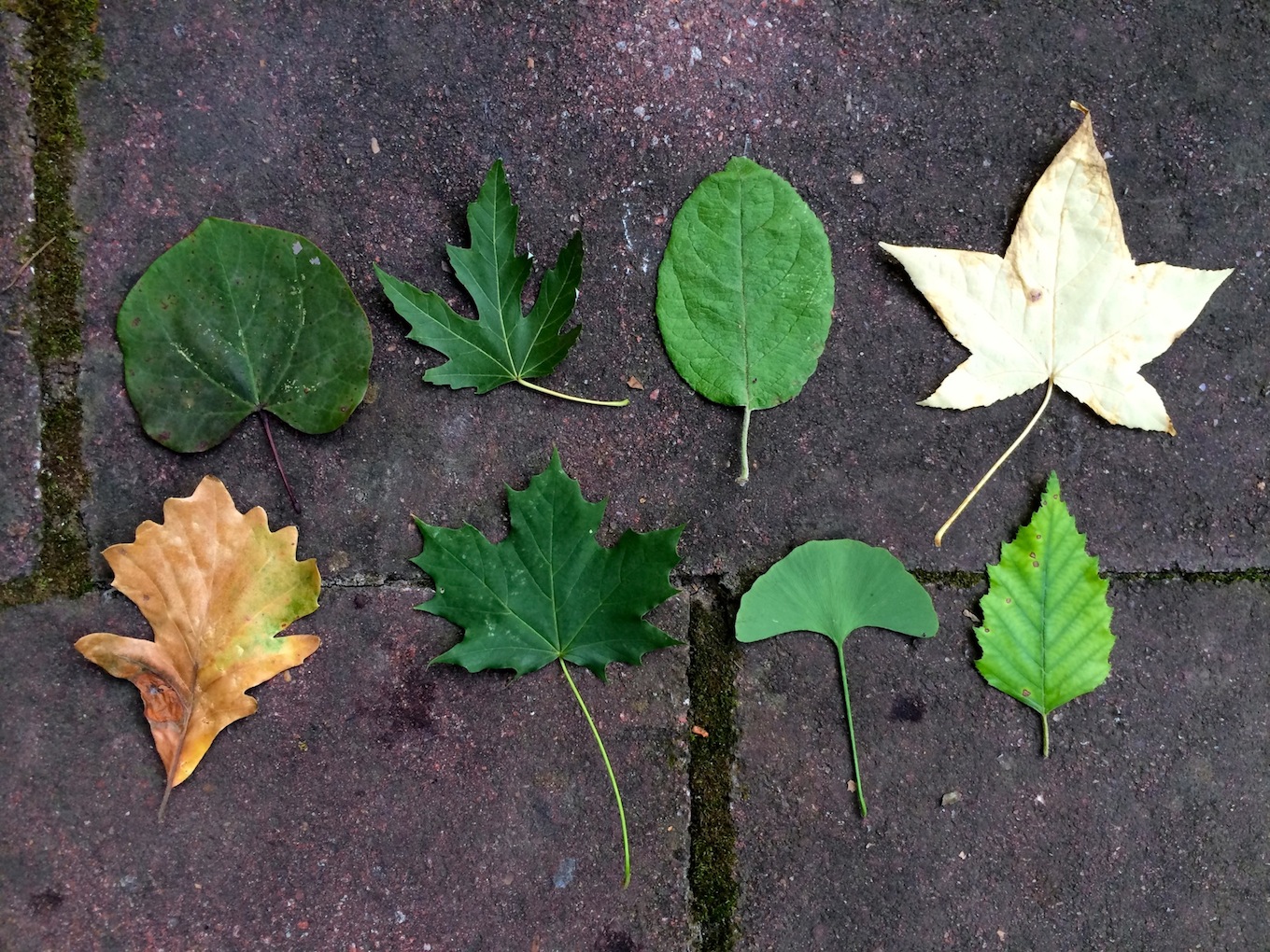
While walking to and from school, leaf collecting has become a daily hobby for my family. The bottom of the stroller is filled after only a few blocks with a variety of leaves found by my 5-year-old while my toddler, who reamains fastened in the stroller, eagerly points to leaves for her sister to collect. With the recent release of Monica Wellington’s latest picture book, My Leaf Book (Public Library/Local Bookstore/Amazon), the timing could not have been more perfect to further our curiosity of trees and their leaves.
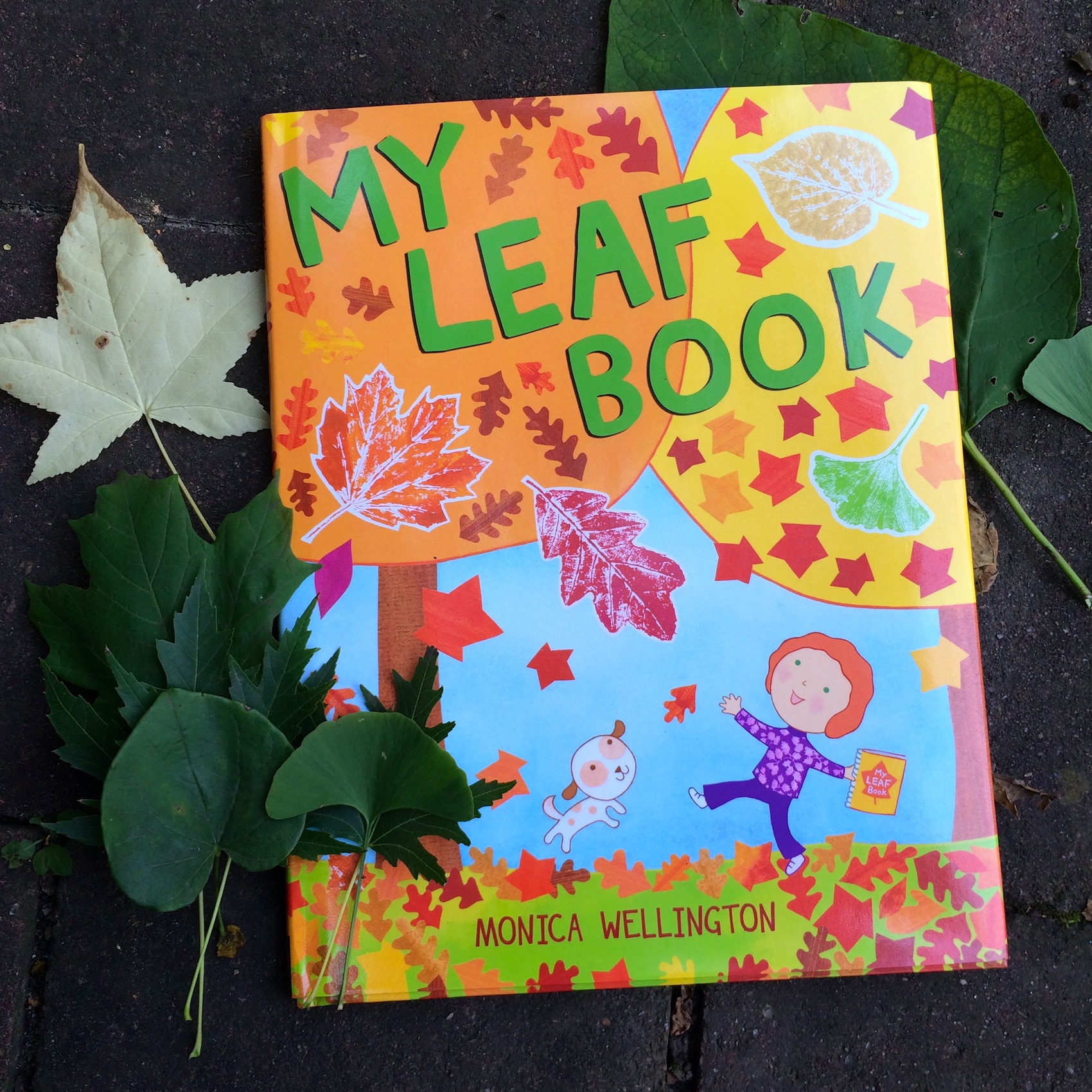
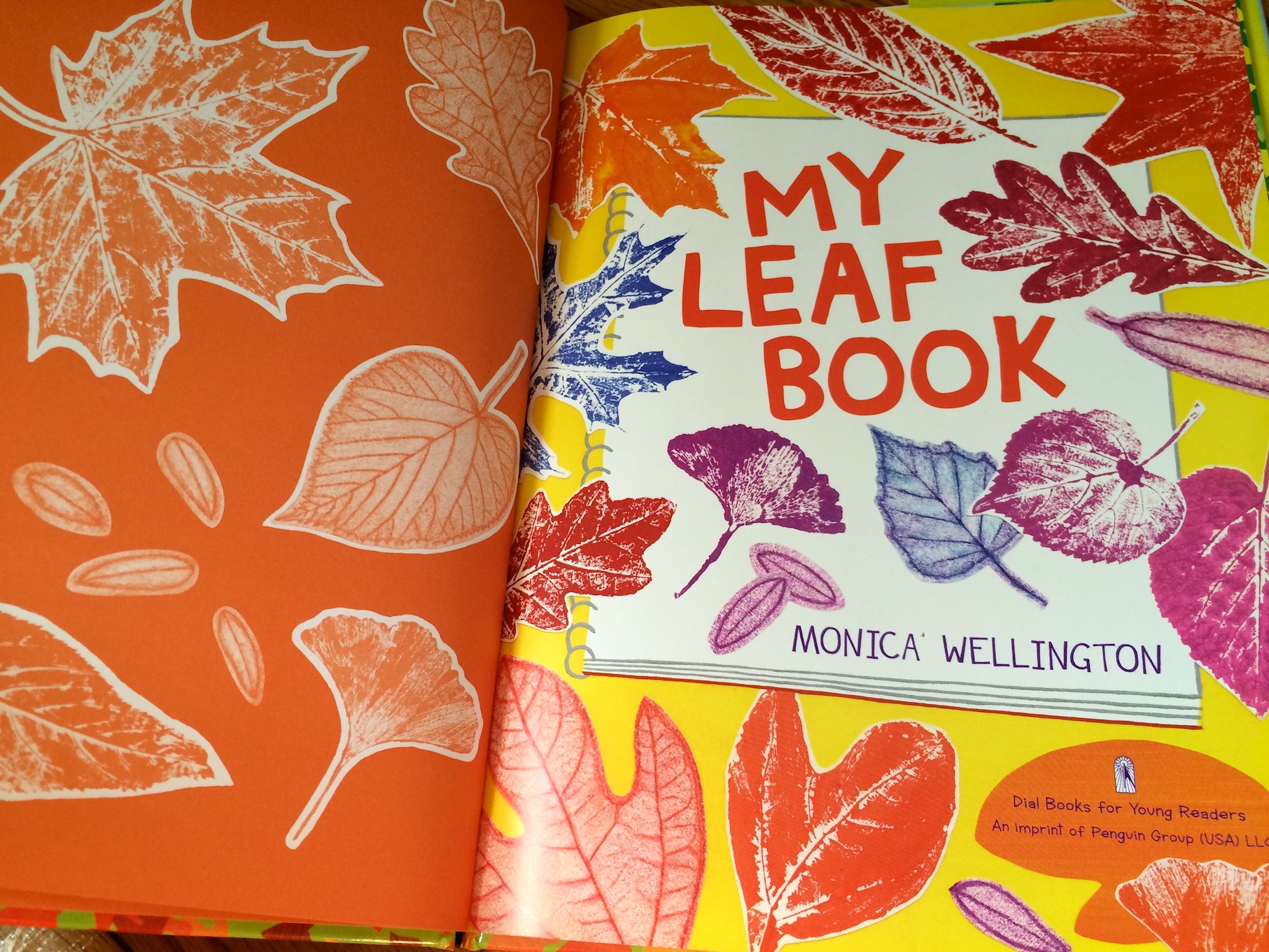
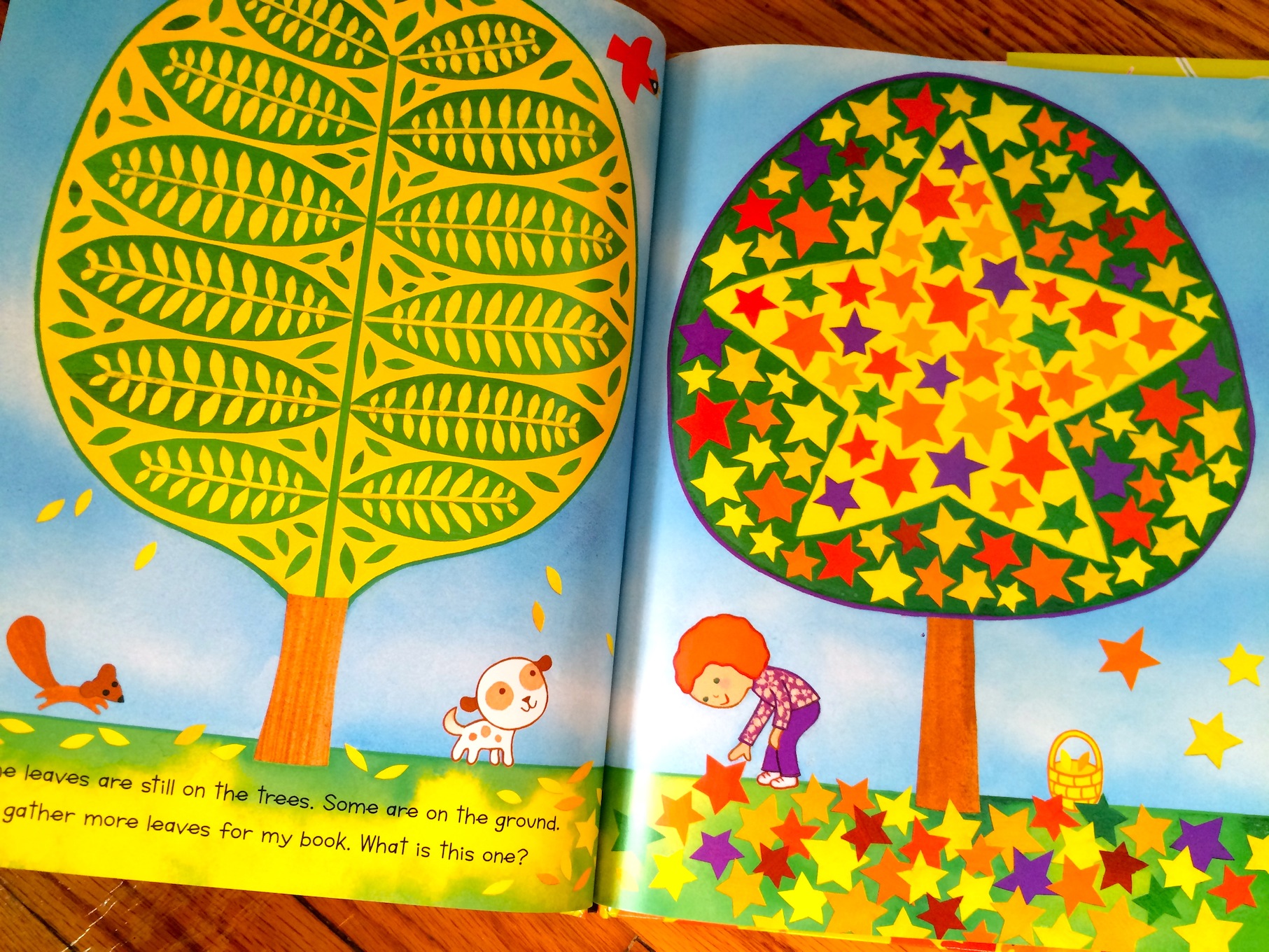
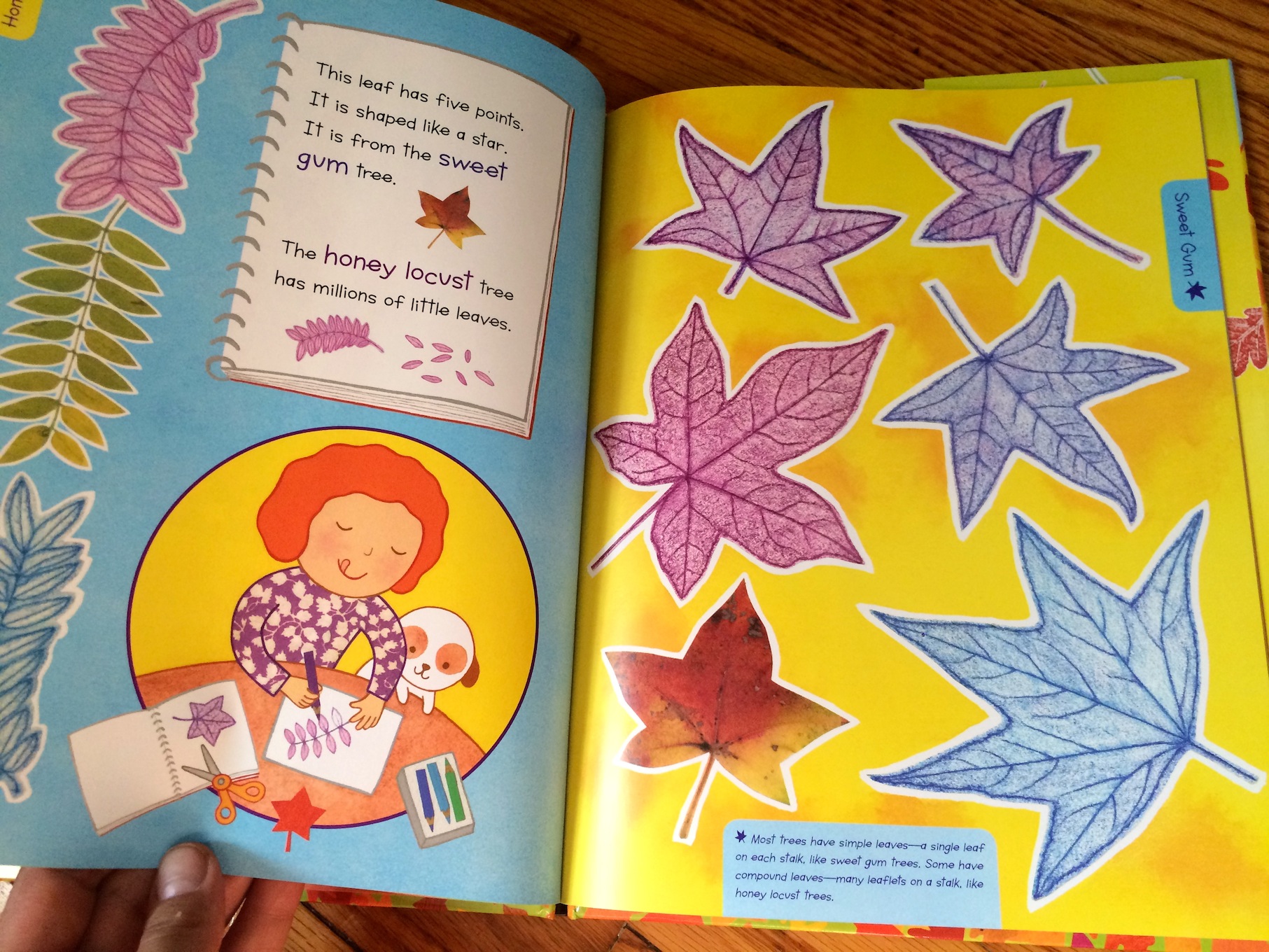
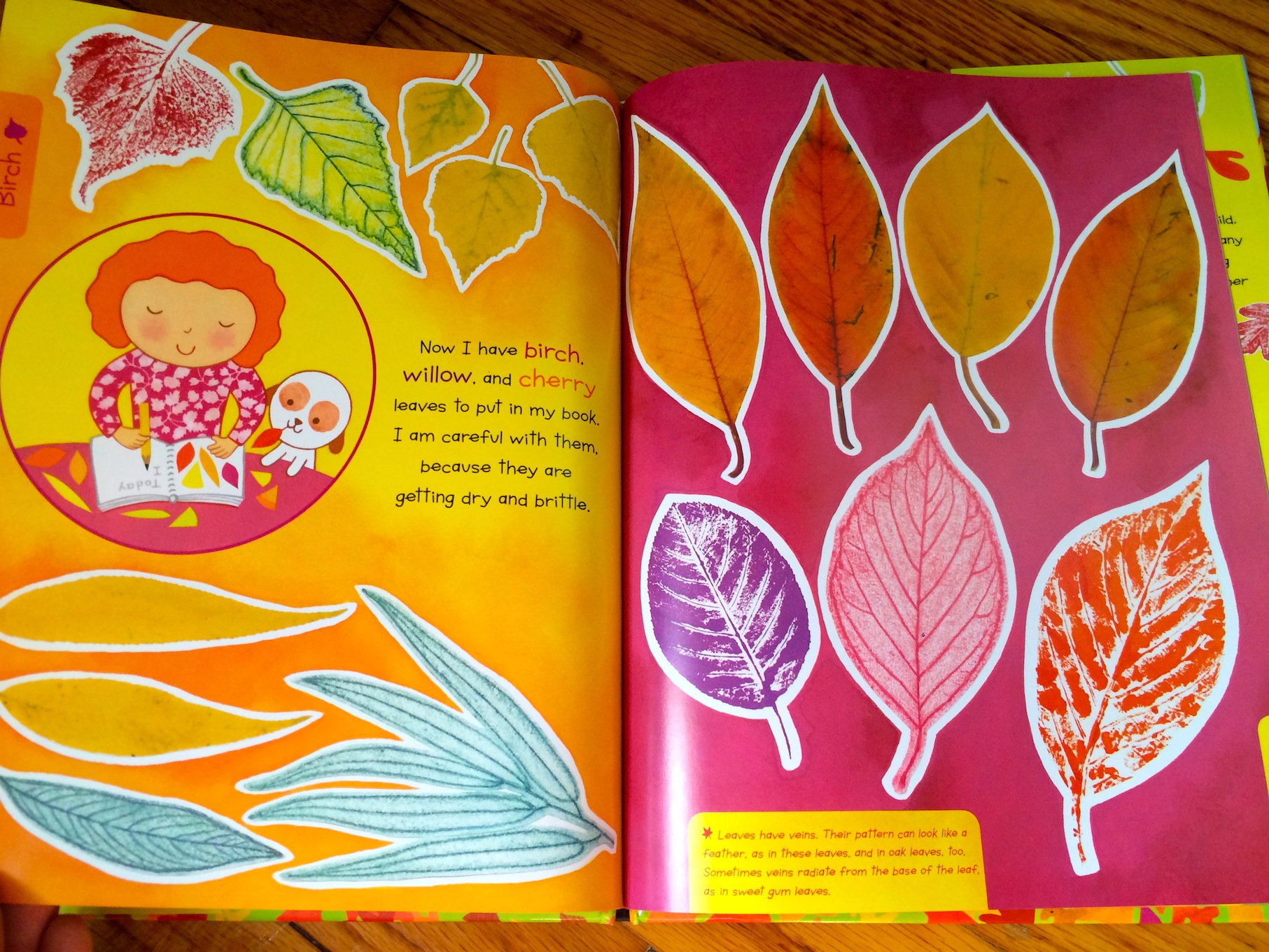
My Leaf Book is the story of a child on her visits to an arboretum and the leaves she preserves in a special book of her own making. Using clues such as shape, size, and color, she collects leaves throughout the autumn season, identifies the type of tree the leaf came from, and adds those findings in her leaf book along with sketches, rubbings, prints, or glueing the actual leaves directly into her book. Monica Wellington’s signature illustration style of bright colors that my girls have grown to love so much over the years is paired with actual pressed leaves, sketches, rubbings, and prints of the leaves and trees depicted in the book.
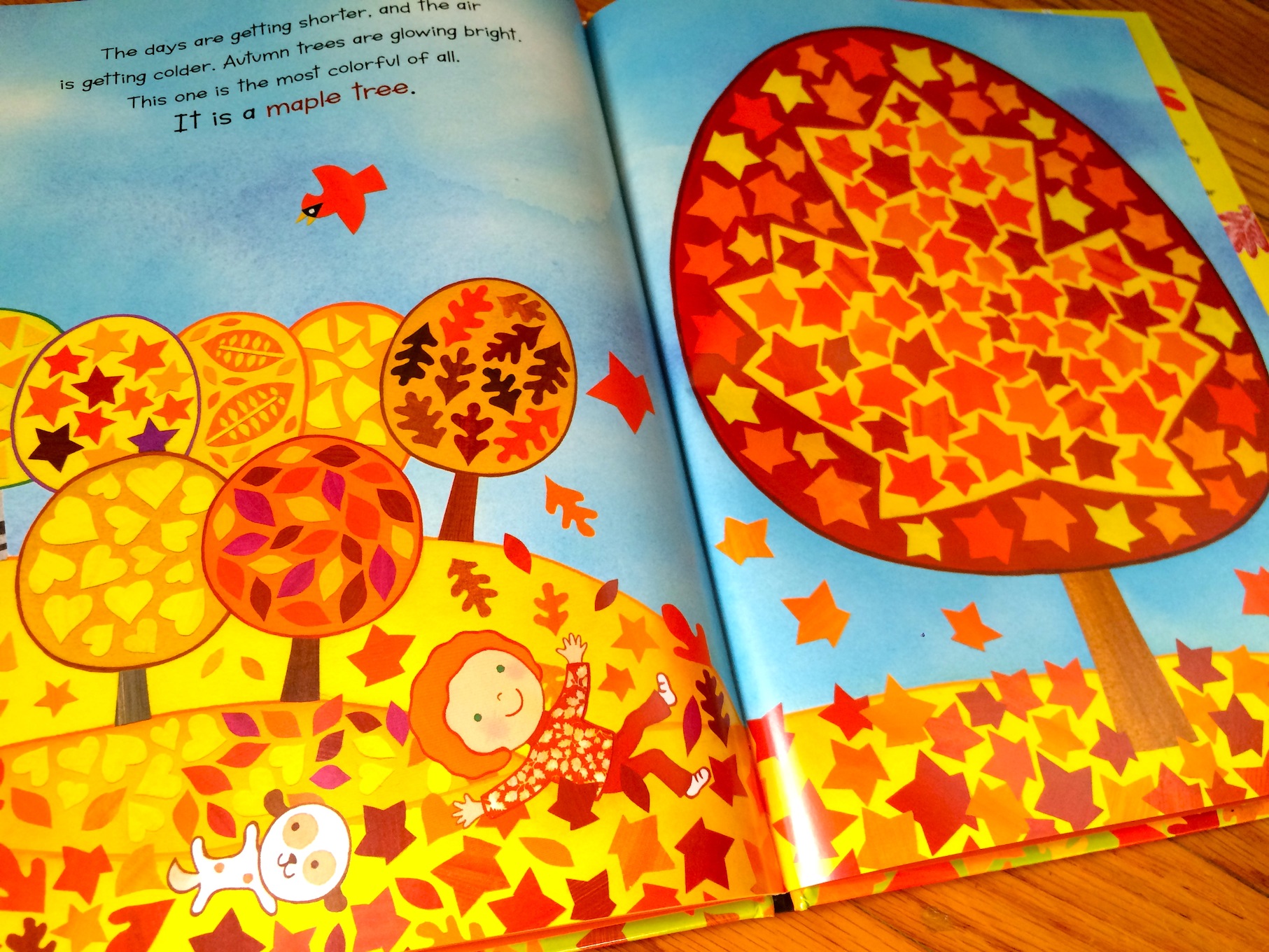
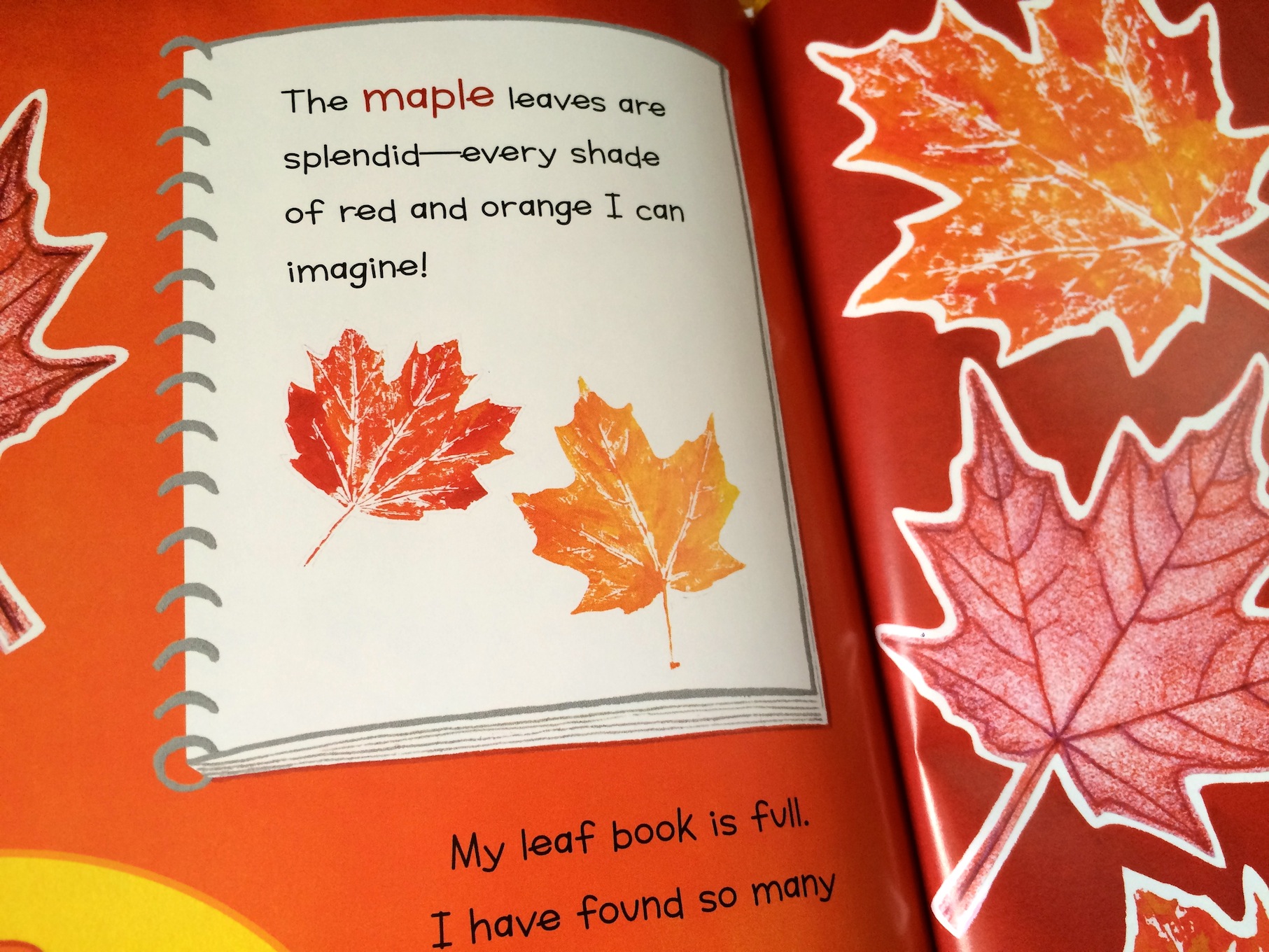
As the fall season progresses, so do the colors of the trees as green trees fade to orange, yellow, red, and brown. If you step back from looking at a tree, the shape of the tree actually mimics the shape of the leaves it produces, and the illustrations capture this concept wonderfully. The child character in the story also notes that trees can be identified not only by their leaves, but by their shape, bark, and leaf color too. An important remark, as so much of what we see is only a glimmer of the collective whole.
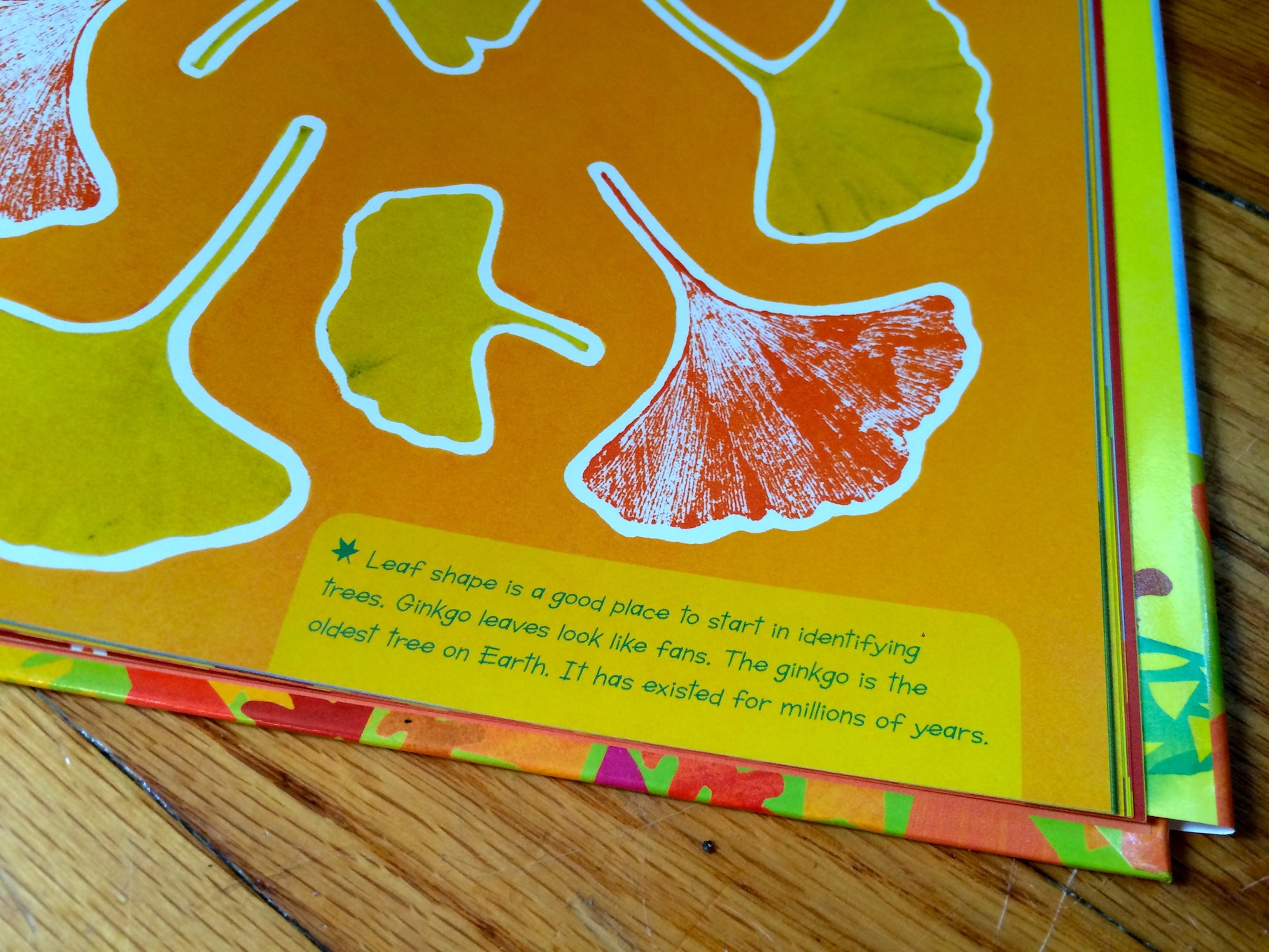
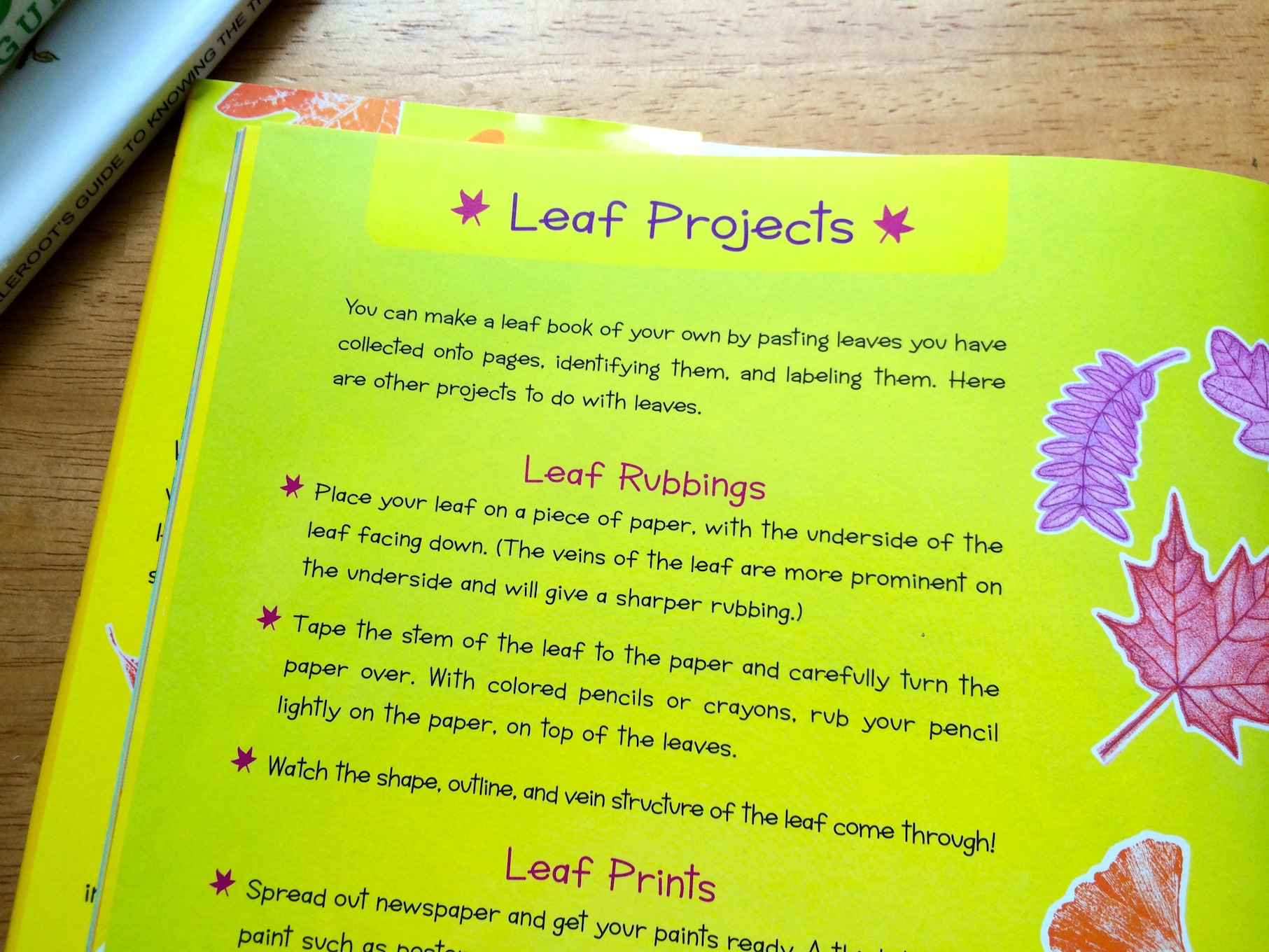
My Leaf Book is a delightful way to encourage observation, especially during this time of noticeable seasonal changes. Interesting facts about the various trees featured in My Leaf Book are located on the bottom pages, and at the back of the book is a step-by-step guide for making Leaf Rubbings and Leaf Prints. Obviously, we had to try both art activities AND make our own leaf book. Don’t you just love a book that implores inquiry and creativity? Win!
So, this happened next:
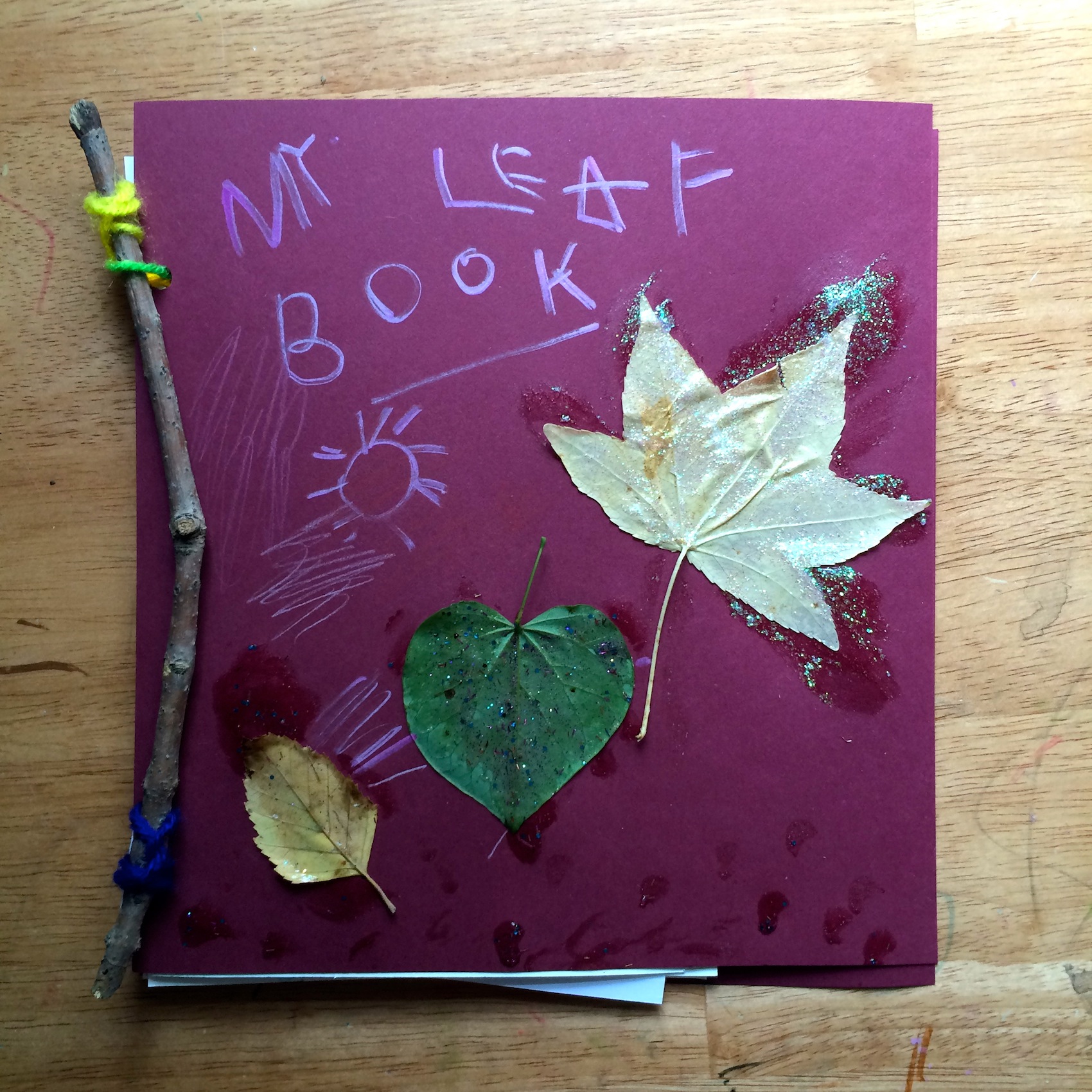
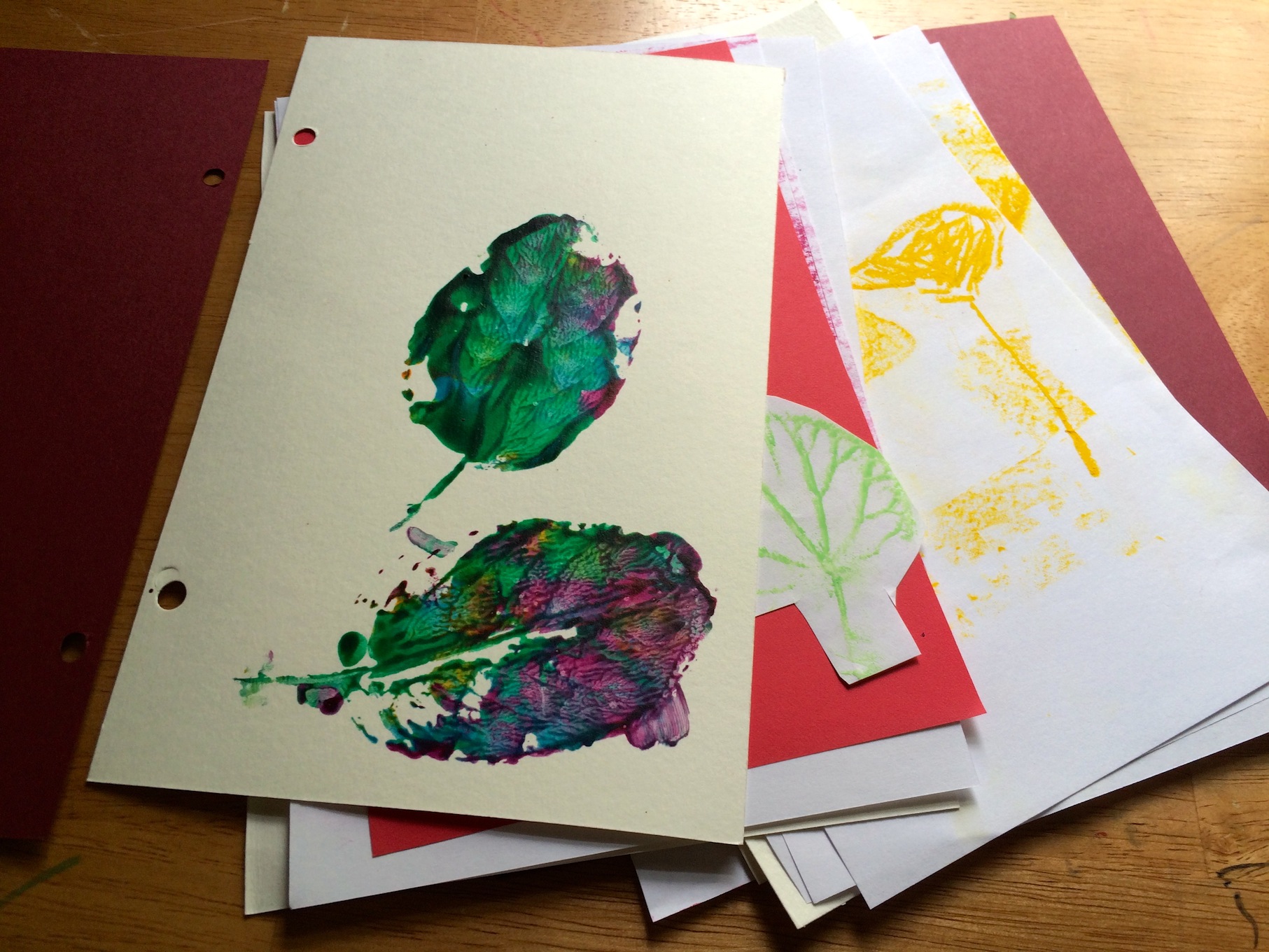
This is my daughter’s most recent leaf book. I’m going to provide a breakdown of how it was created, but before I do I wanted to touch upon the fact that this is an entertaining activity and there are no rules to assembling a leaf book. That’s the exciting part. Make it your own! We did use the instructions for the leaf projects in the back of My Leaf Book, but also explored and played with other ways to document leaves from our surroundings. The art techniques used to document the leaves include leaf printing, leaf rubbings, sketching, and pressing.
<script
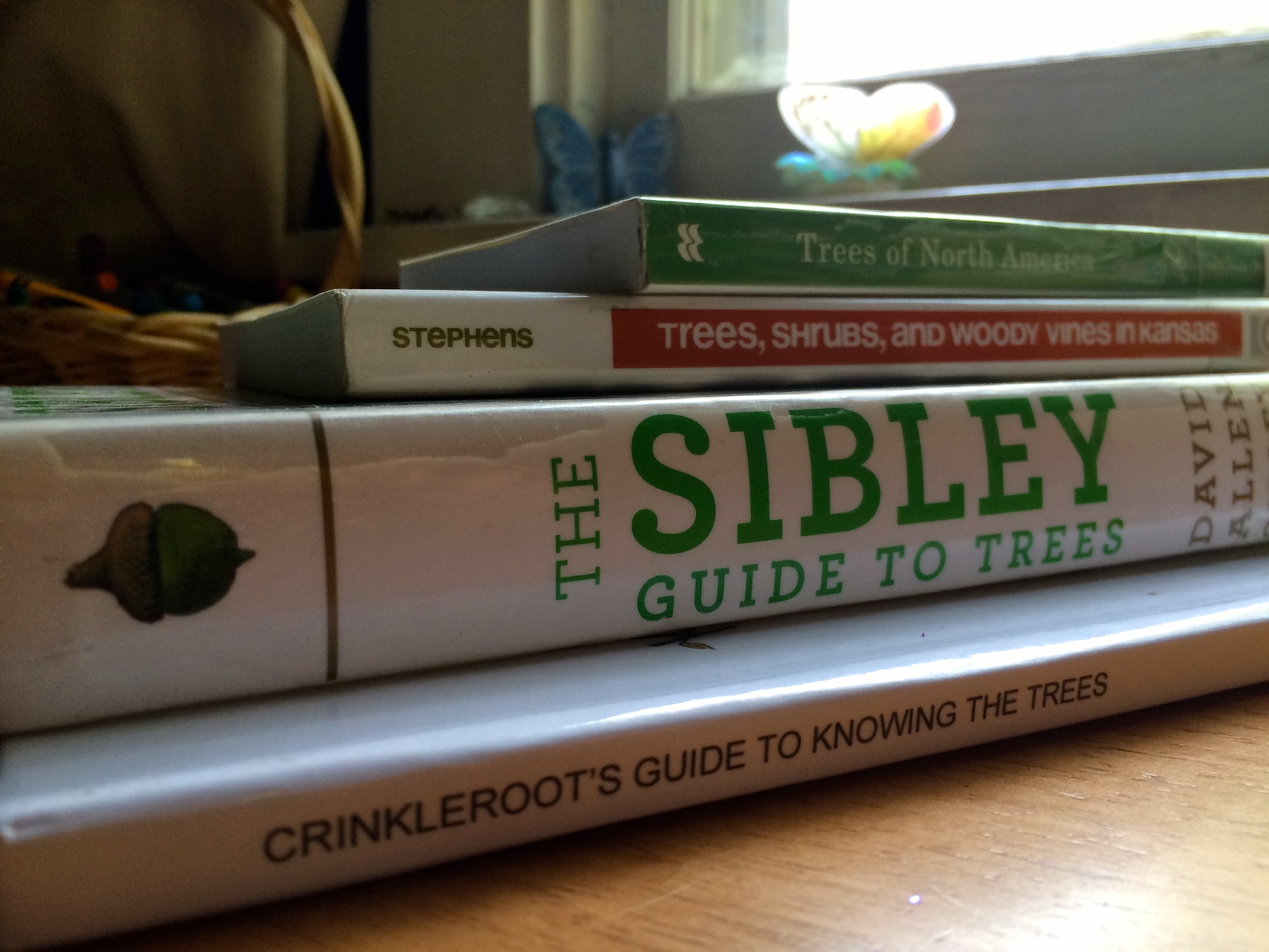
The first step is to go outside. Go outside and look at the ground, go outside and look up at the sky. Go for a walk around the block. Go to the park. Go to an arboretum like the main character in My Leaf Book. Next, visit the library and check out a guide to tree identification. Try to find one with lots of color photos or drawings and that is specific to your region.
Ready to make a leaf book? Get those pretty leaves ready and get out the art supplies…
List of Supplies Used:
- Paper
- Oil pastels
- Paint
- Hole punch
- Colored Pencils
- Scissors
- Yarn
- Glue stick
- Glitter glue
These are the supplies we used, but you can easily substitute crayons for oil pastels or use whatever you have on hand.
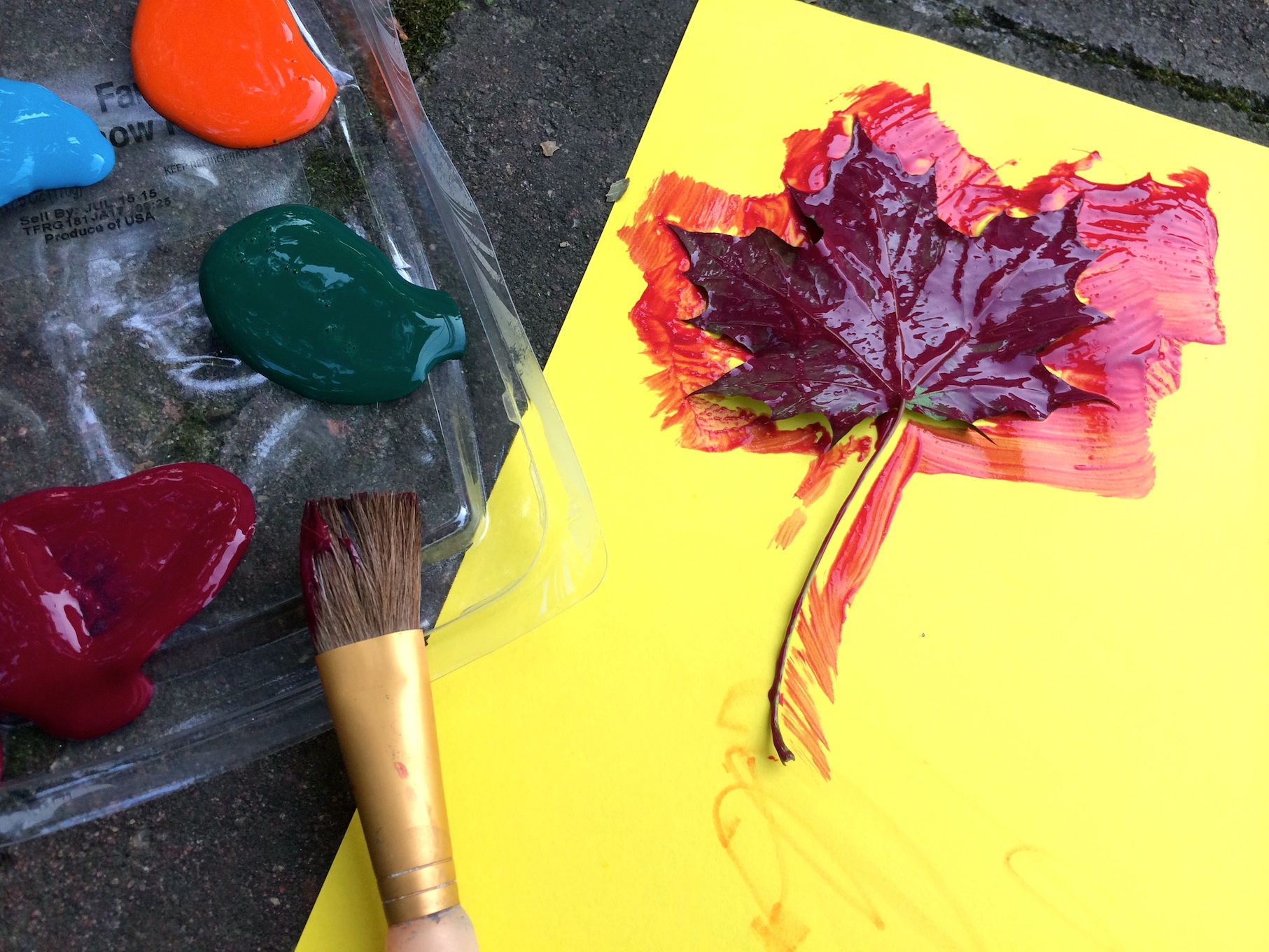
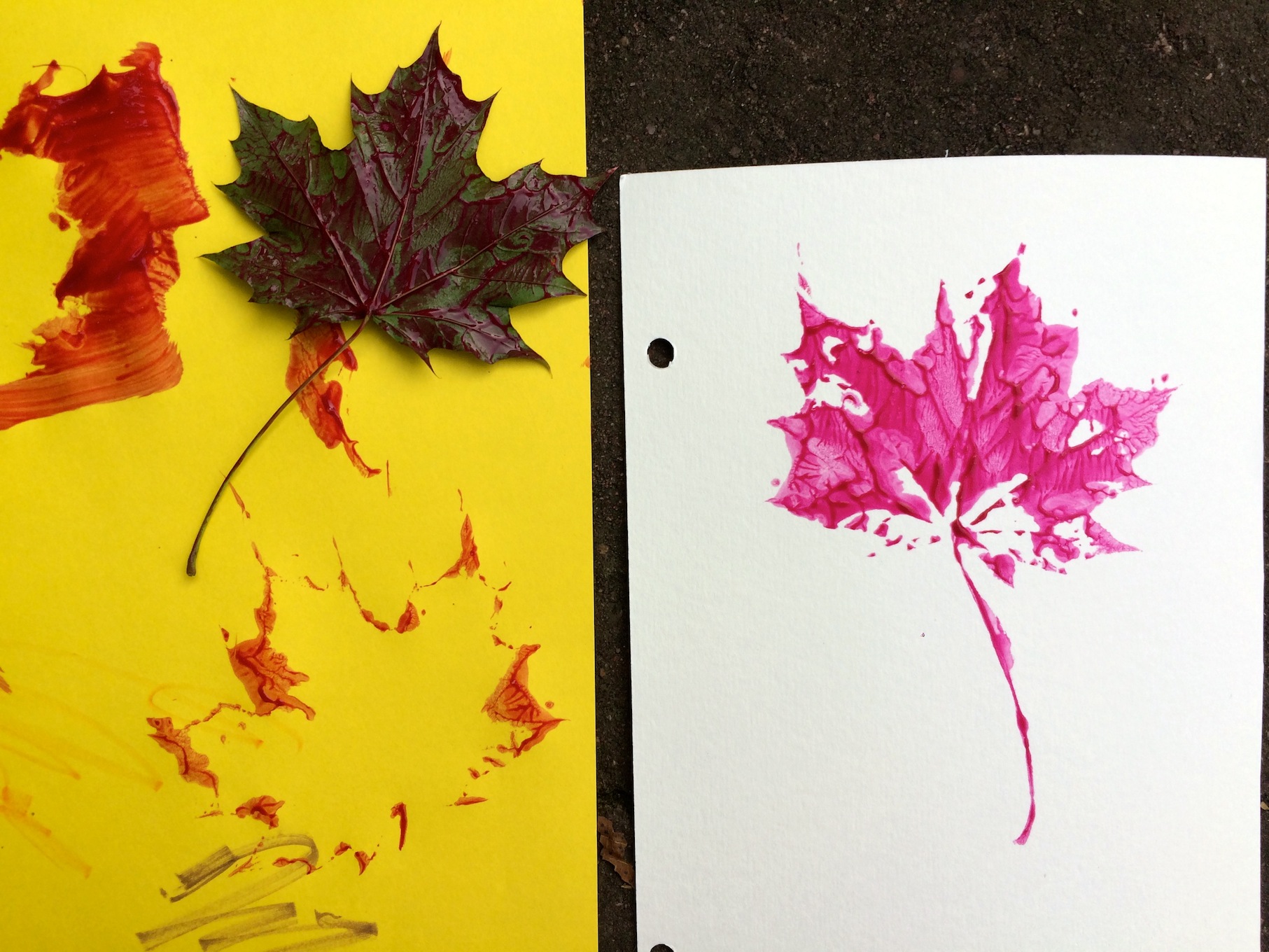
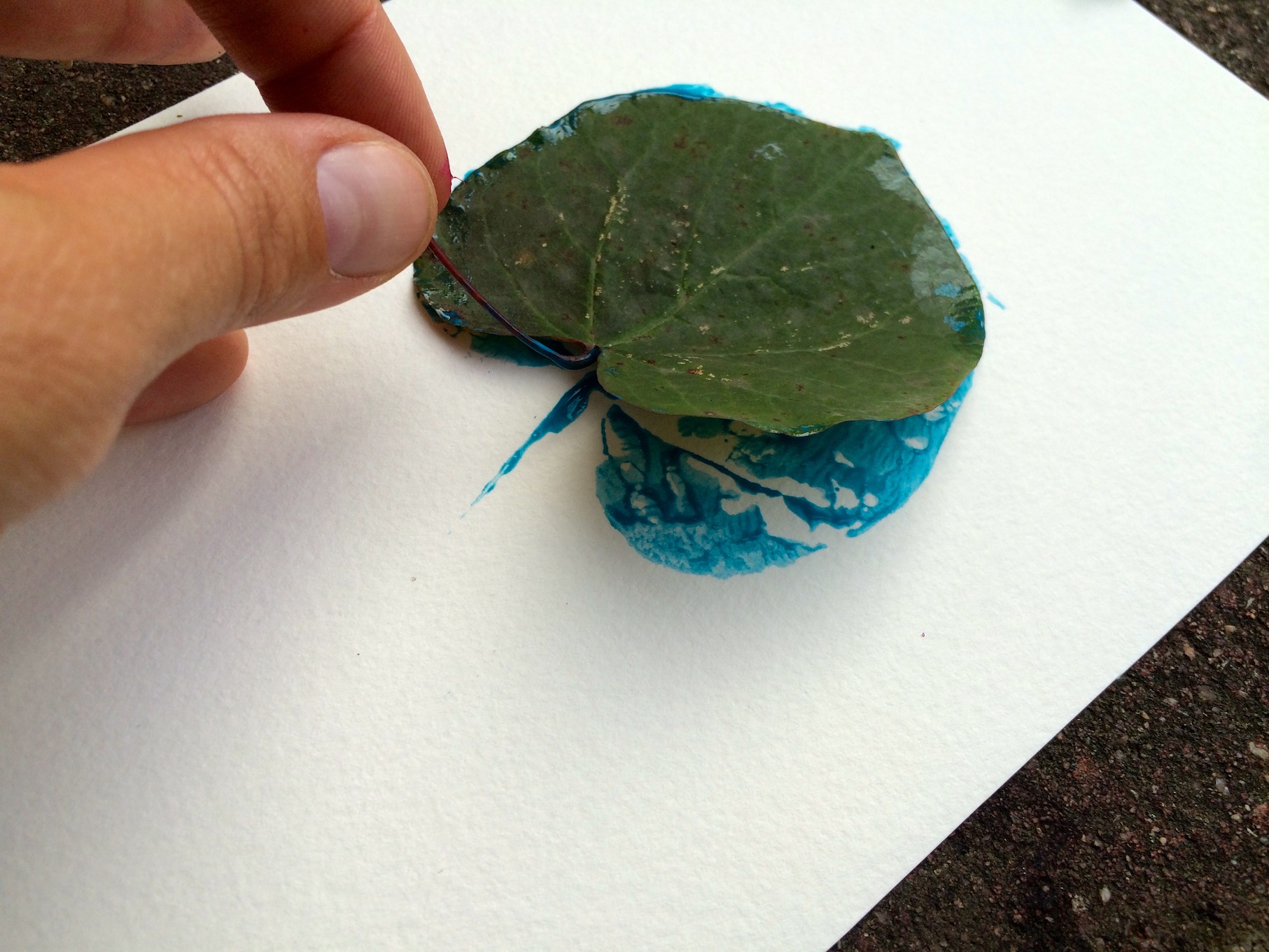
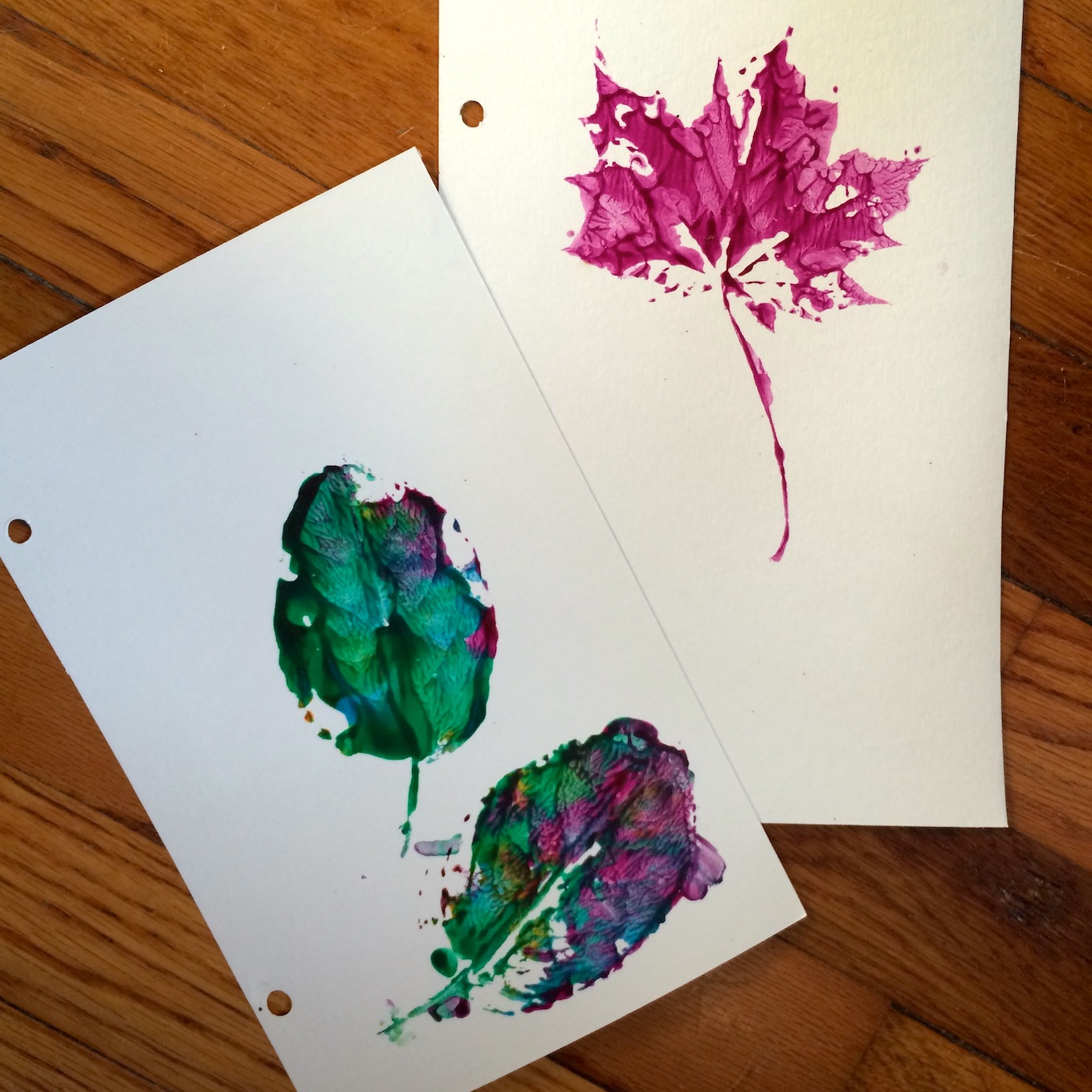
I cut spare sheets of watercolor paper and copy paper in half and punched holes in those sheets with a hole puncher, making sure the holes were all in the same position for when it comes time to bind the leaf book together. We followed the directions on how to make leaf prints in the back of My Leaf Book. Essentially, all that is required for this process is to paint a leaf with a paintbrush (if you have a brayer, use a brayer for more precision) and then press a pieces of paper onto the leaf. Rub the paper on top of the leaf with your fingers, feeling the veins of the leaf and the outer edges, pick the paper up to reveal your leaf print! The majority of the times the leaf was stuck to the apper, so we carefully pealed it off the paper. If the leaf seemed like it had enough remaining paint, we made a lighter print. Once done, allow plenty of drying time.
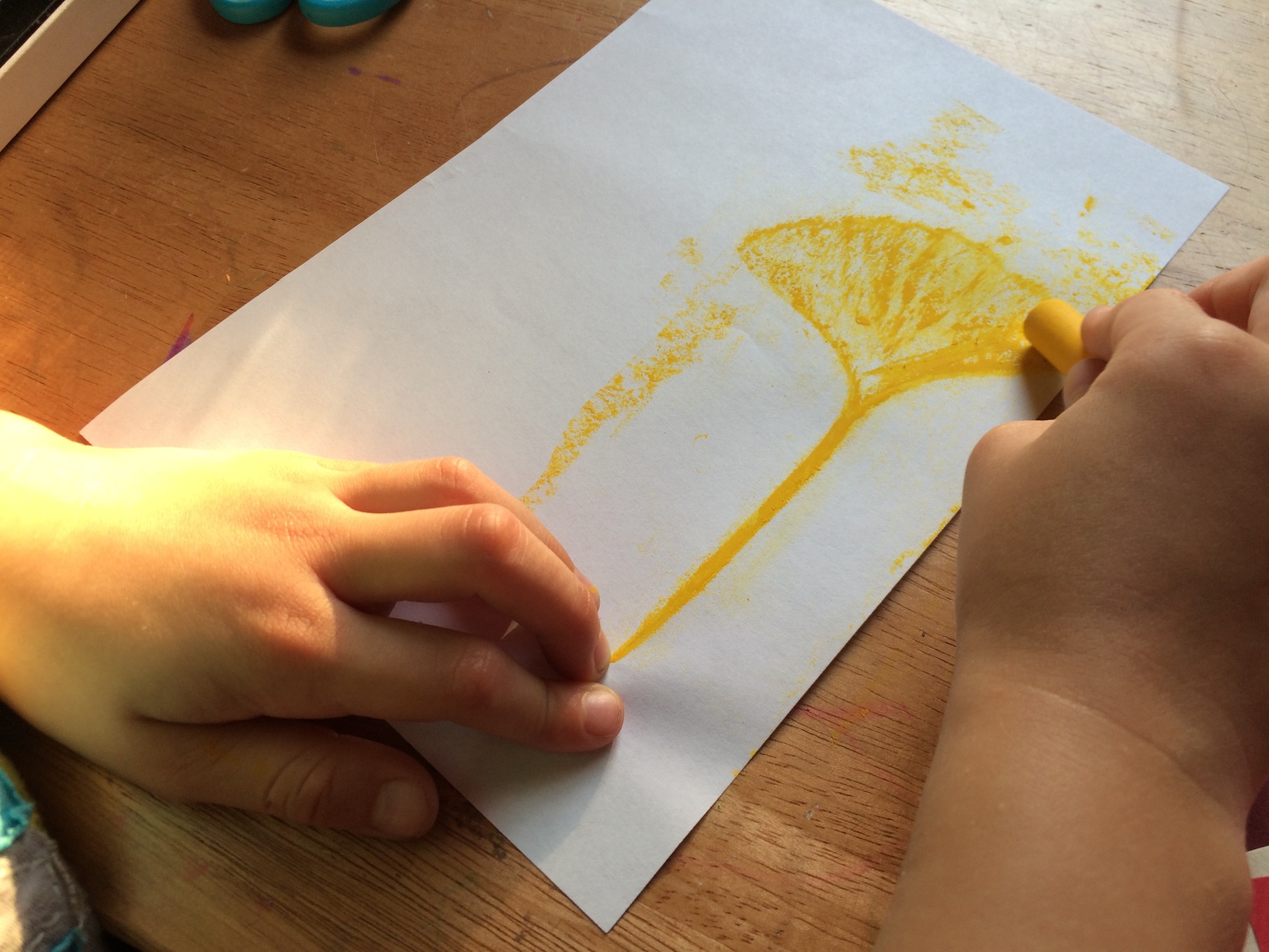
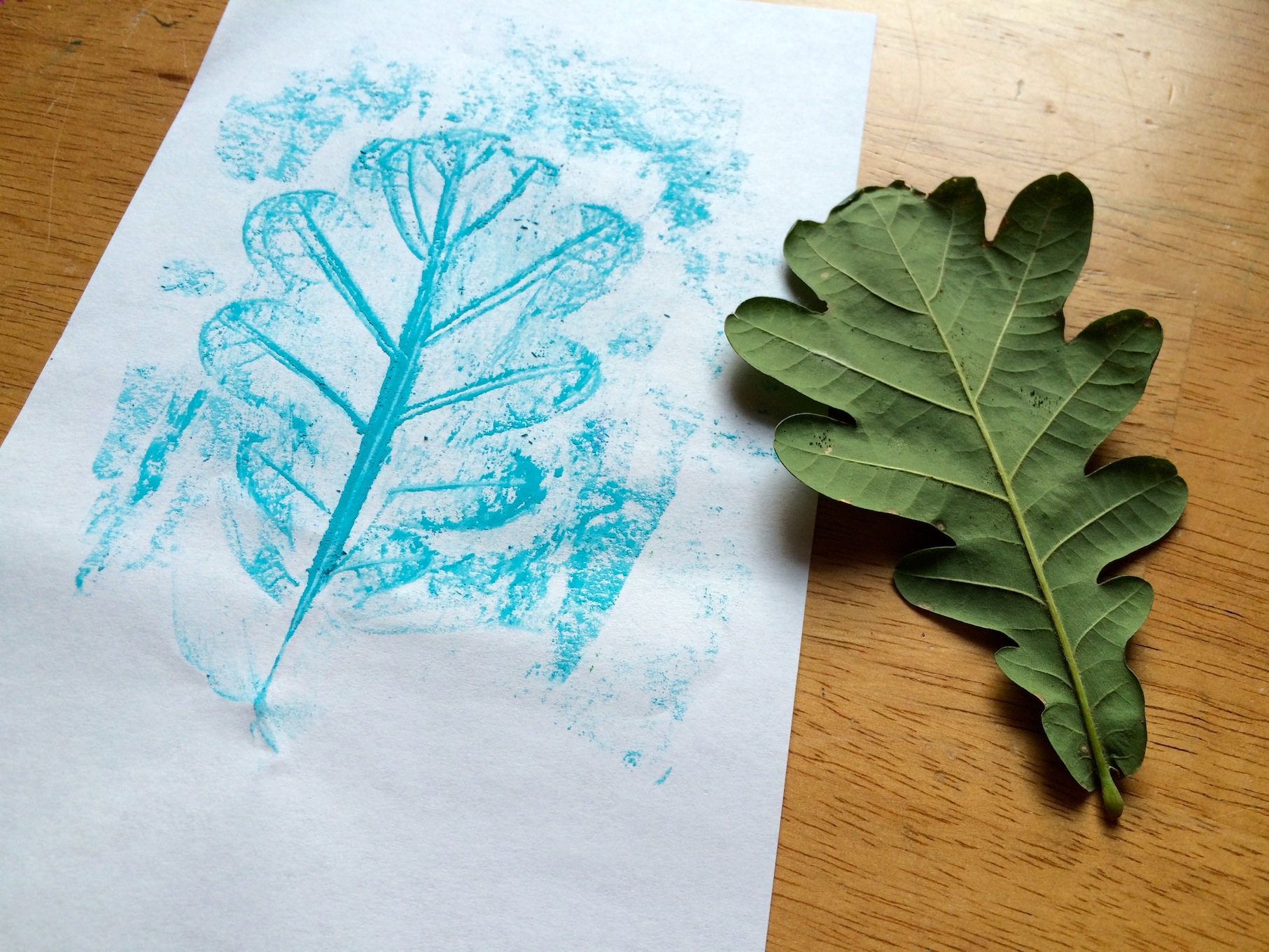
Leaf rubbing is a beautiful and easy way to create leaf art with minimal supplies. Lay a thin sheet of paper (printing paper will do just fine for this activity) on top of the veiny, underside of the leaf. Using the side of an oil pastel or crayon, rub the paper covering the leaf and an impression of your leaf will appear before your eyes.
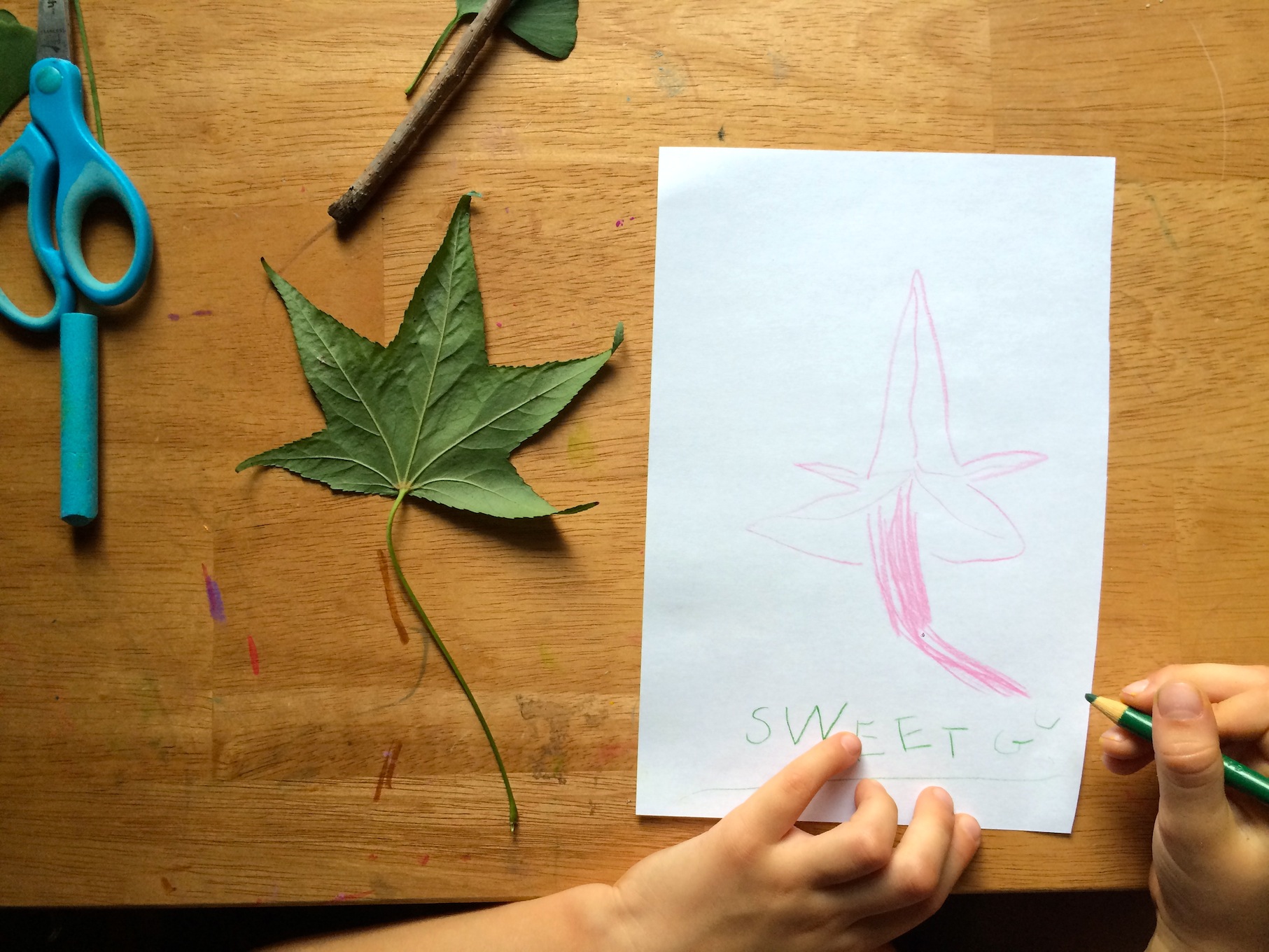
 Another method used was drawing free-hand representations of leaves. She also enjoyed tracing the shapes of the leaves as well as cutting rubbings out and pasting them onto a separate piece of paper. Whatever artistic method your child chooses or whatever you can make happen with the supplies you have on-hand will be wonderful.
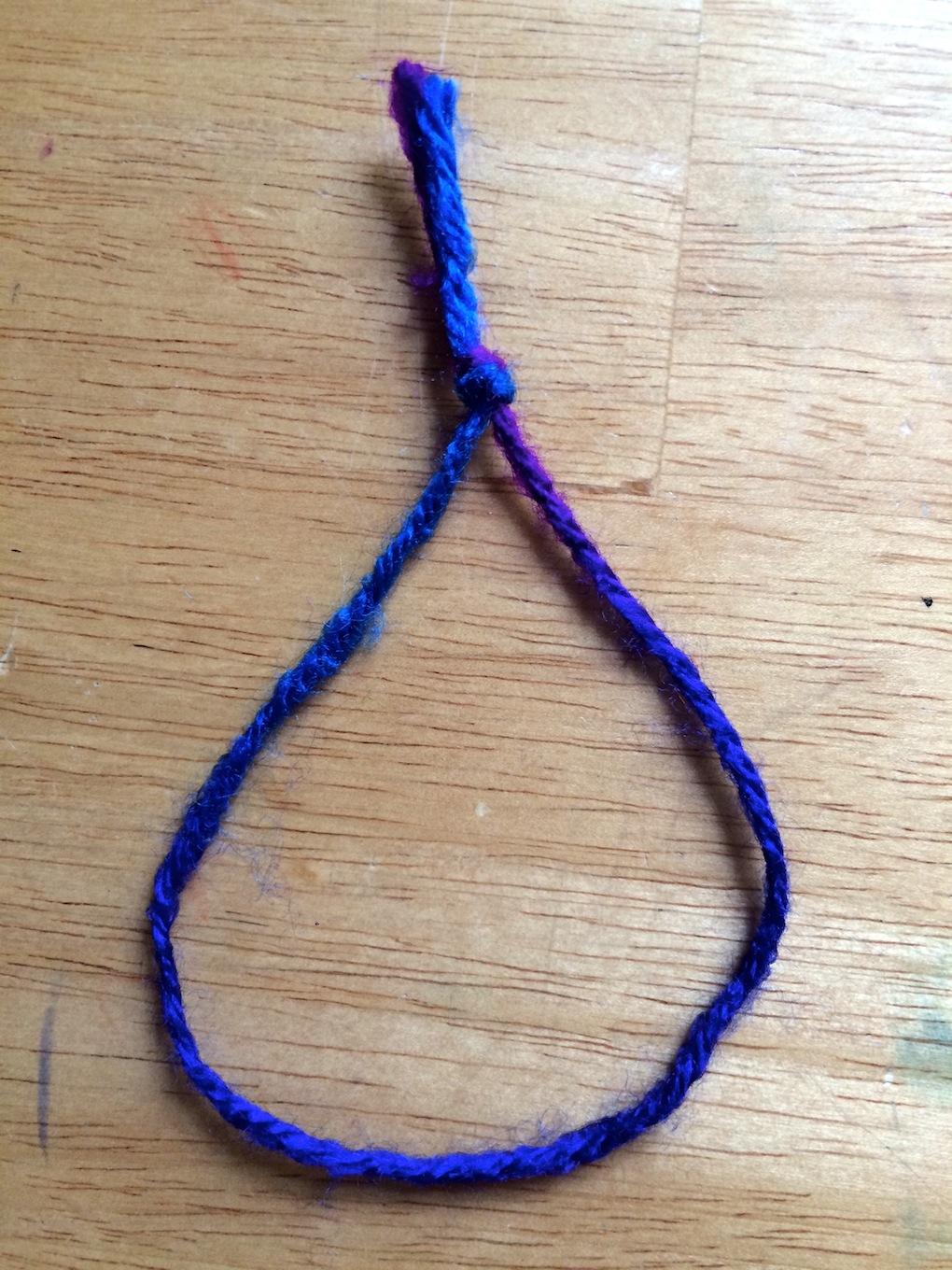
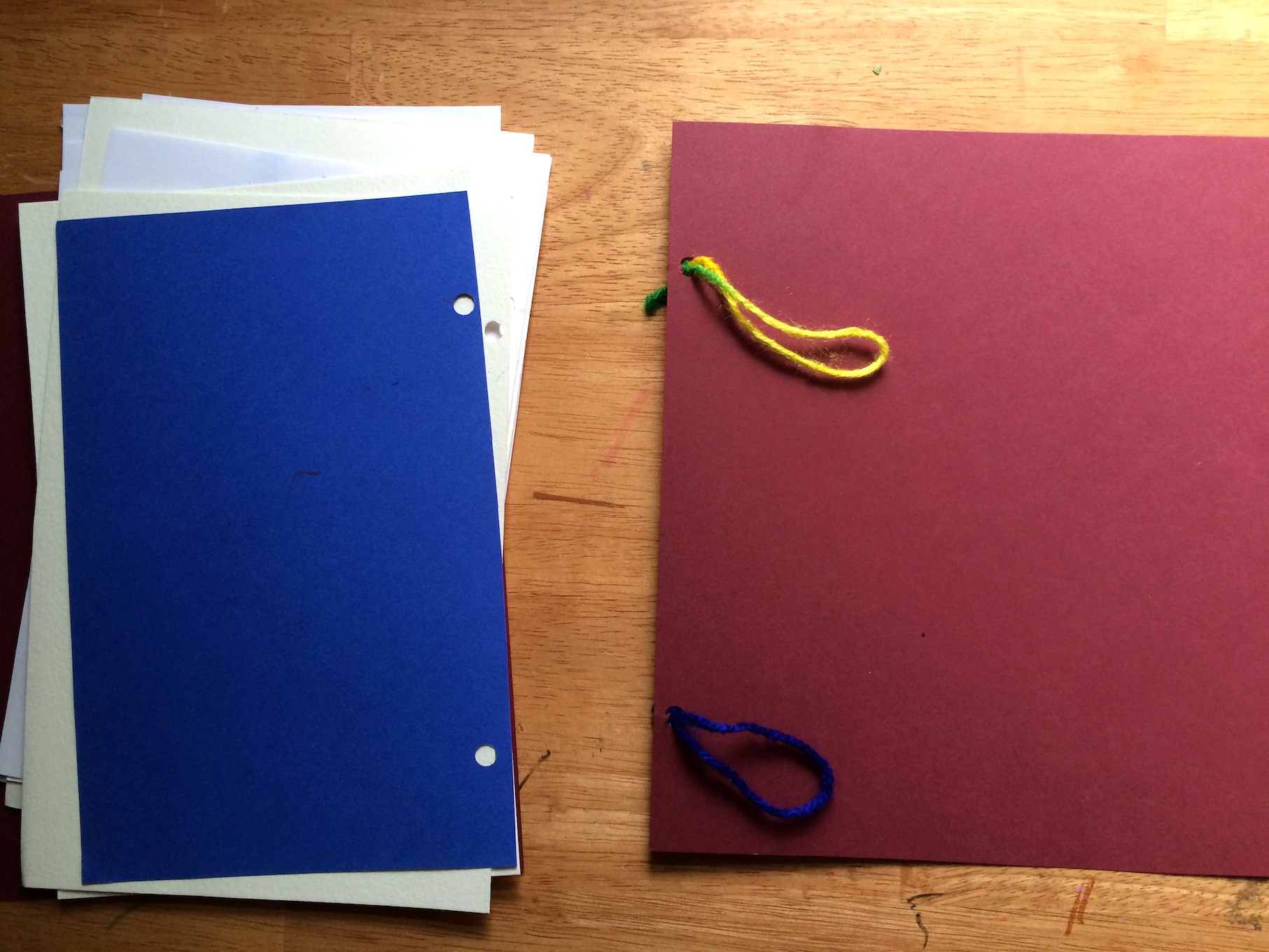
To bind the book together, I cut two pieces of yarn into roughly 8 inch pieces. I found this binding idea here, but had no rubber bands so yarn was my alternative experiment. Each peice of yarn I tied into a loop and then threaded the loop through each hole of the back of the leaf book. Working from the back of the book to front, I threaded the pages through the yard loops.
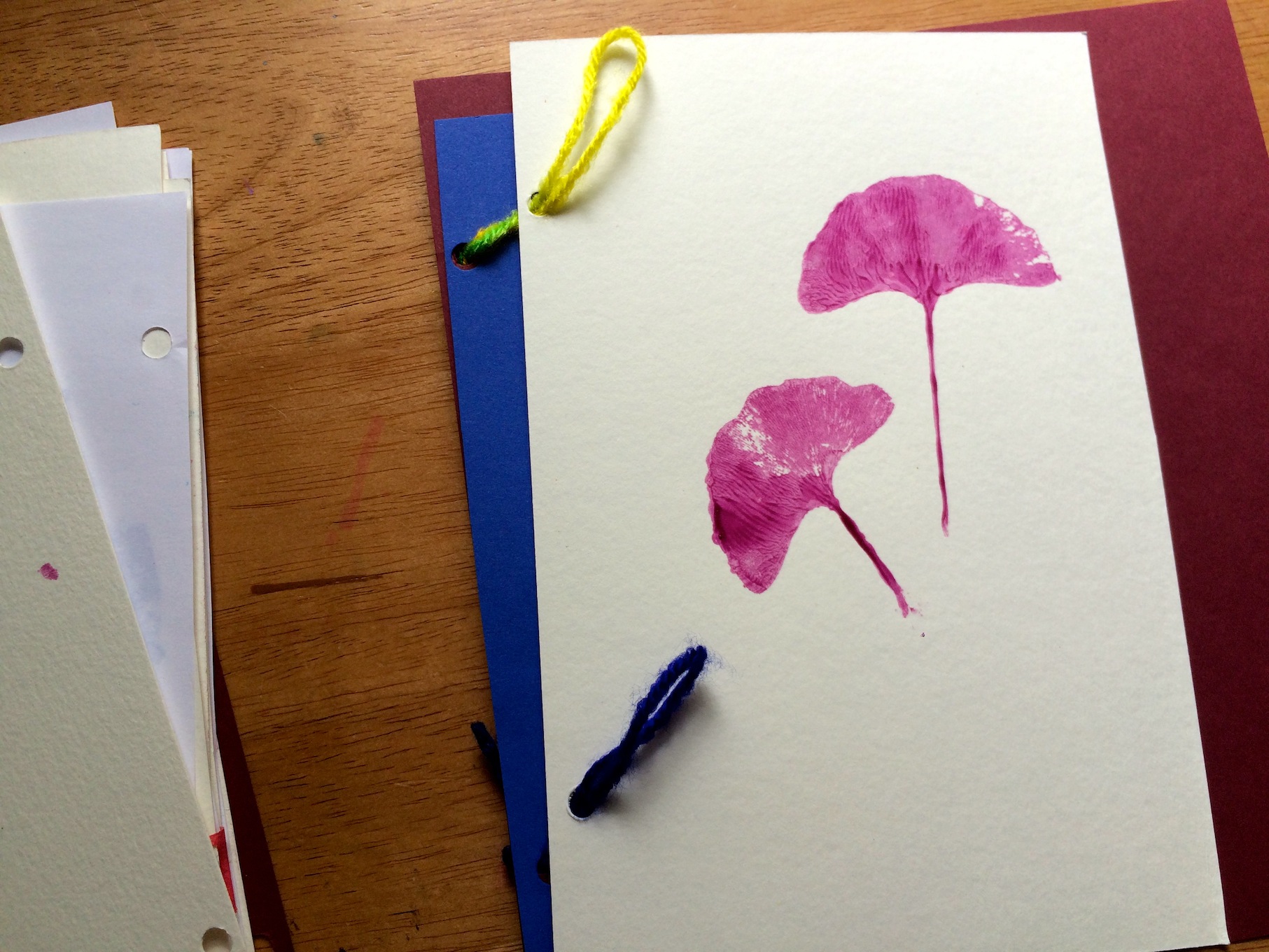
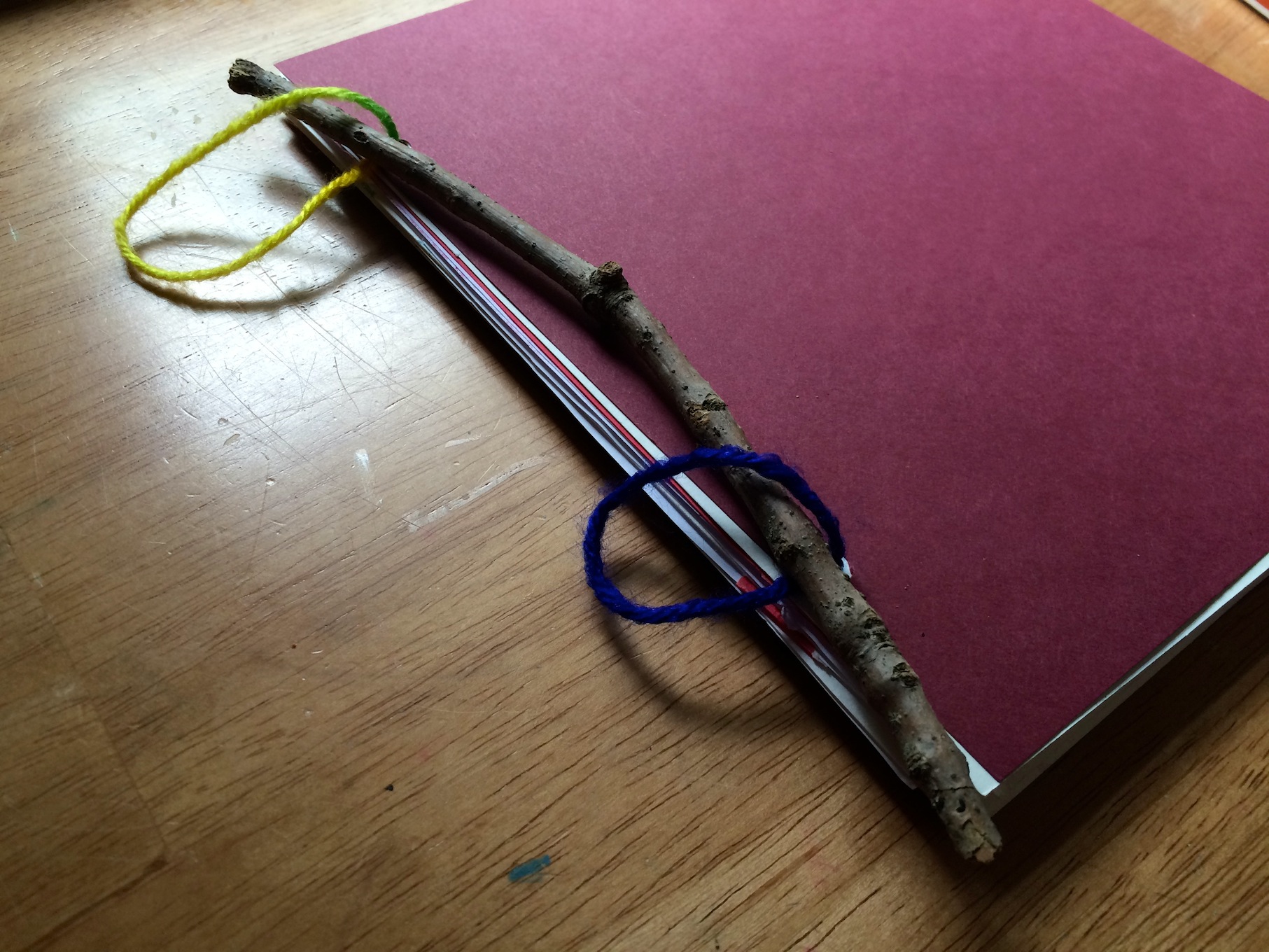
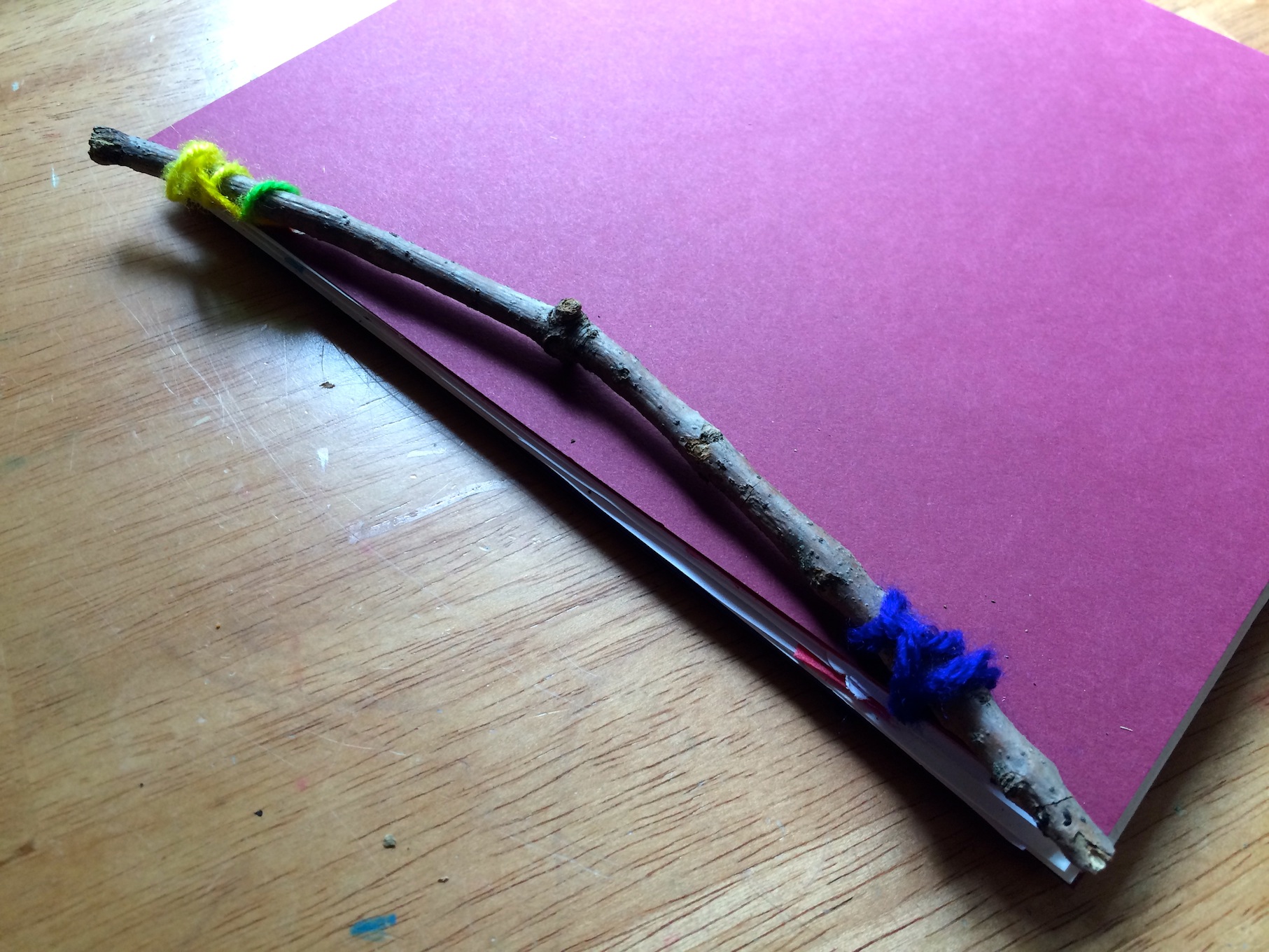
Once the pages are threaded and the cover is threaded, wrap loose ends of the loops around a stick about the same length as the leaf book.
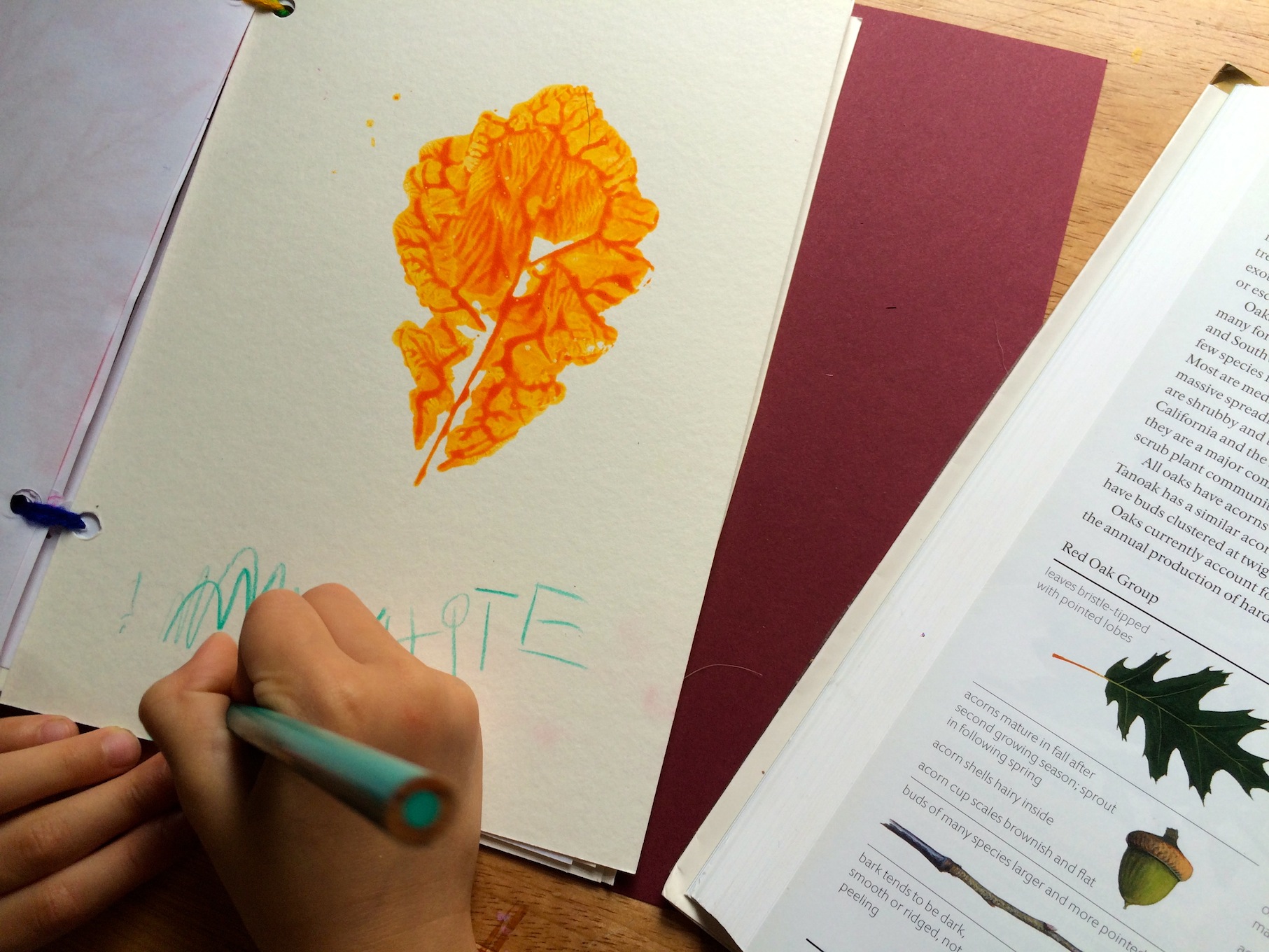
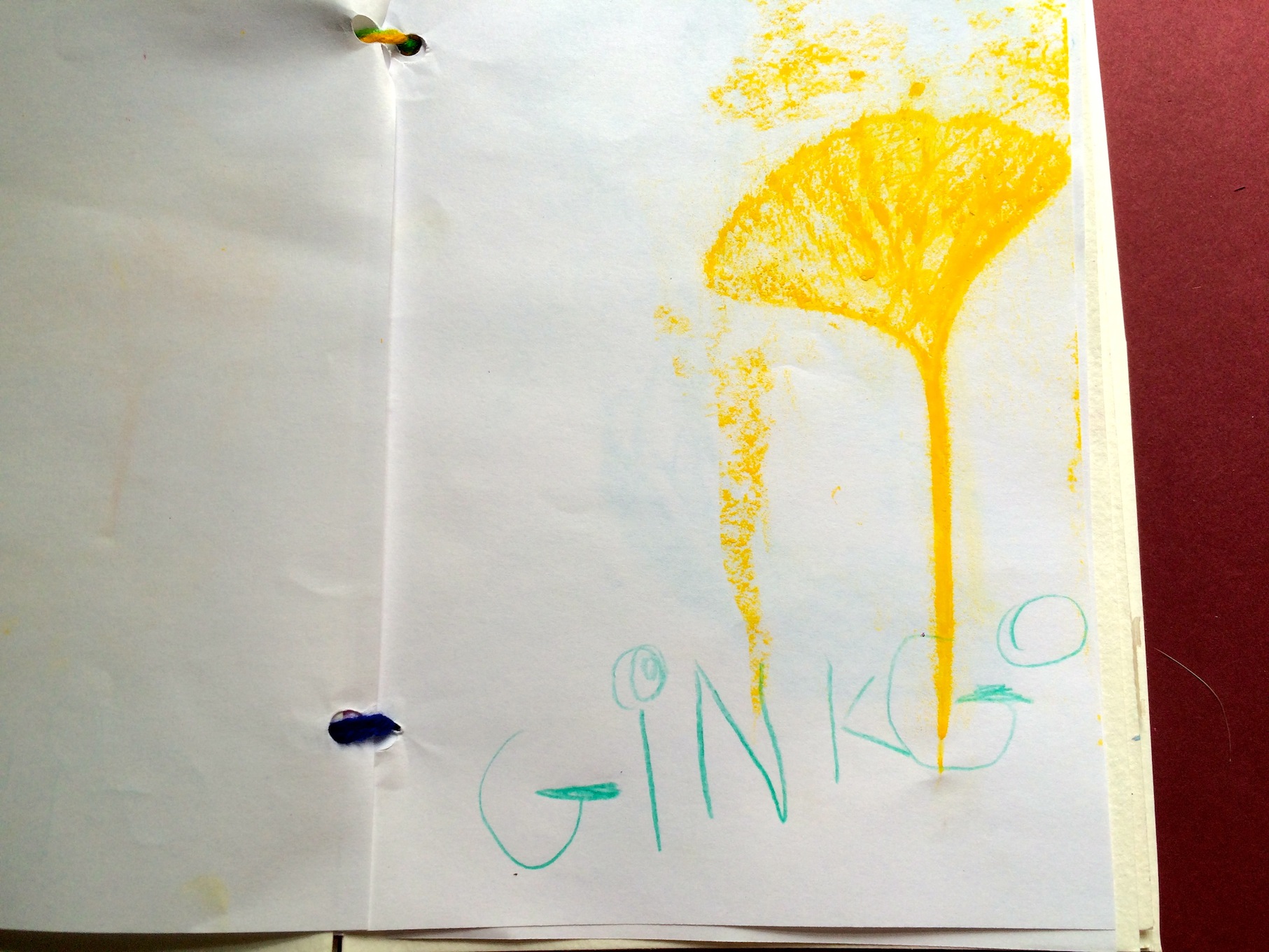
Once the book was assembled, we took time looking up the leaves collected and labeled them.
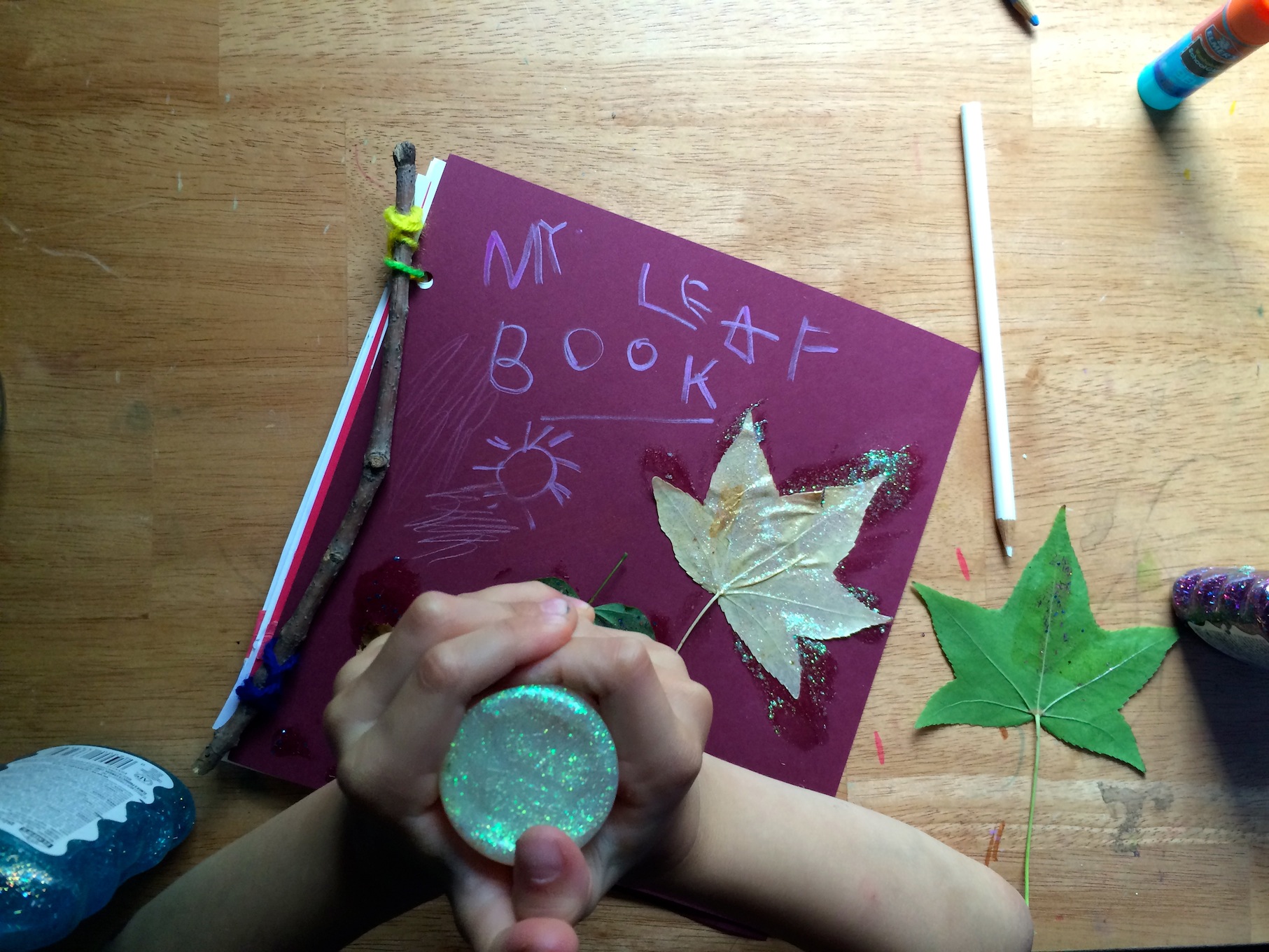
For the cover, she pasted leaves using a clue stick and covered them in glitter glue and sketched a design using her favorite metallic markers.
The finished product:
Take a peak inside….
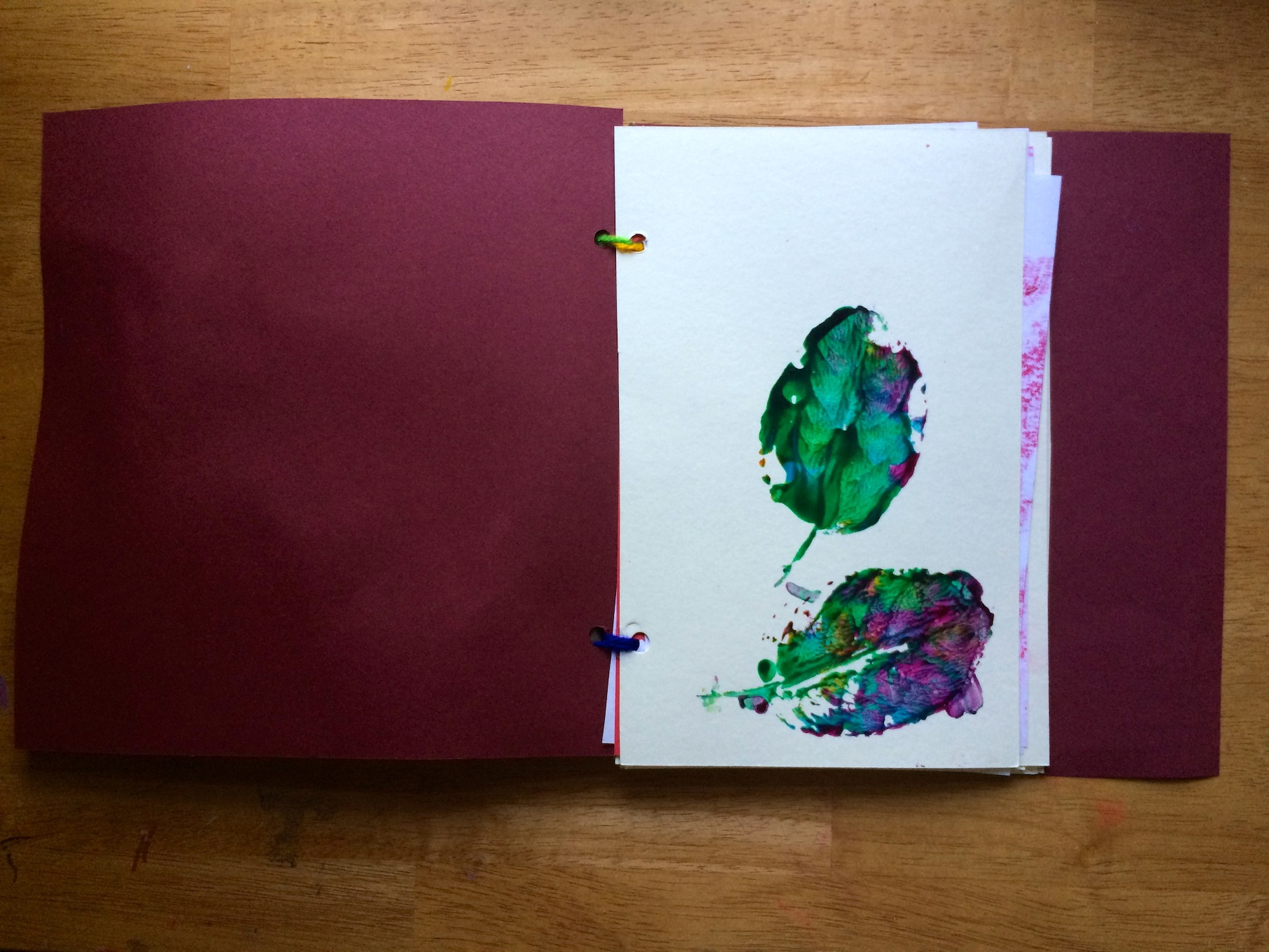
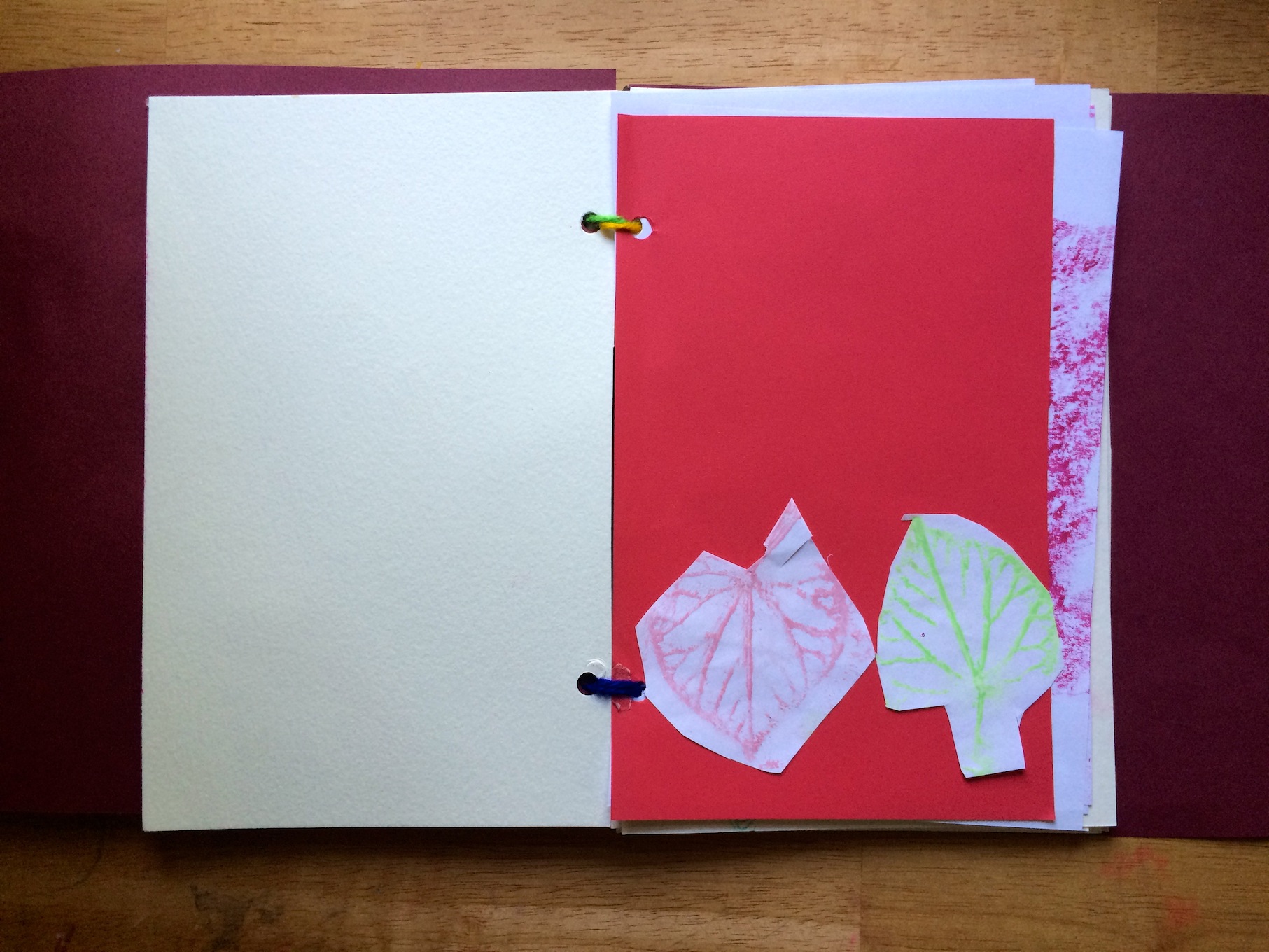
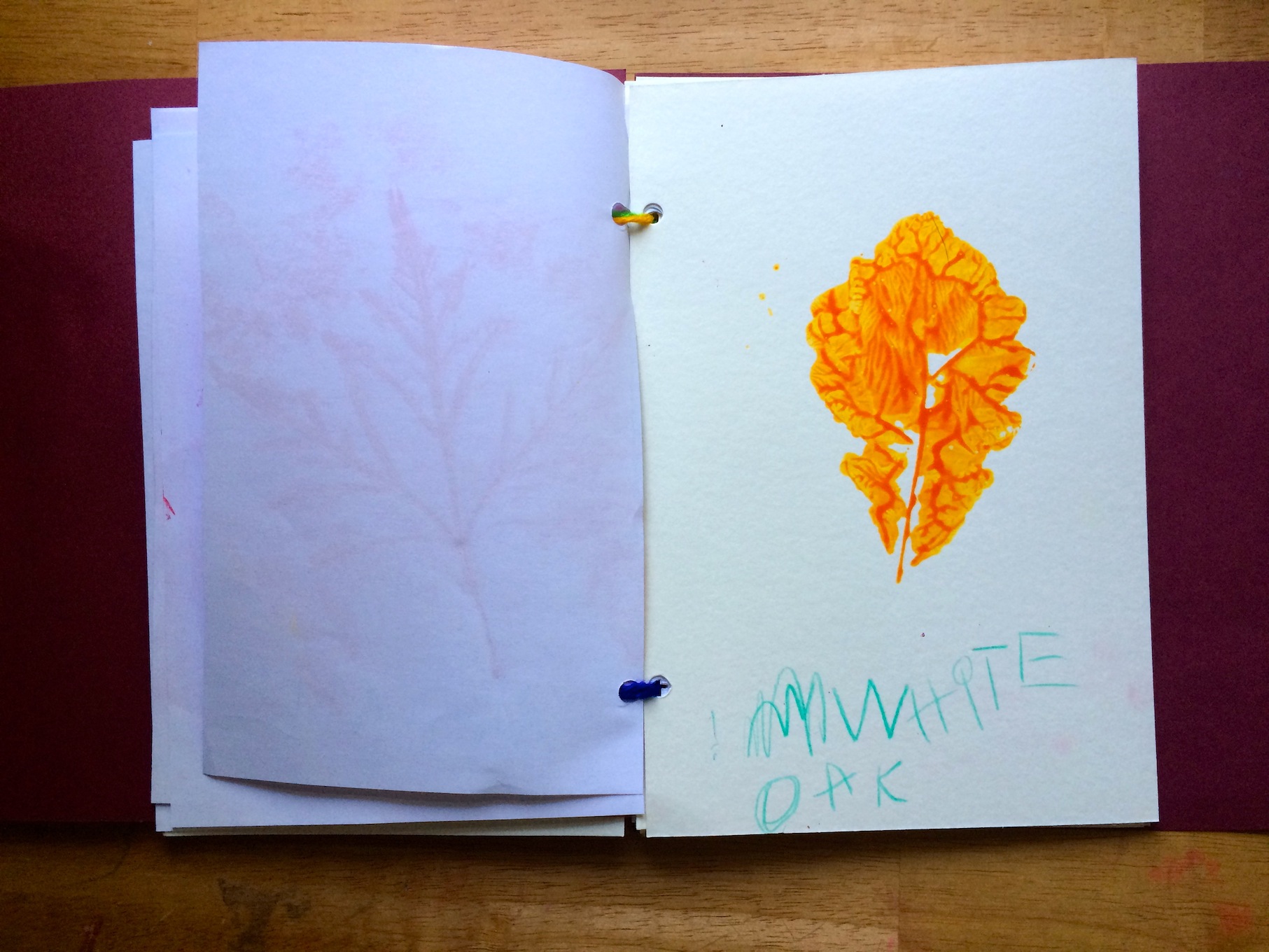
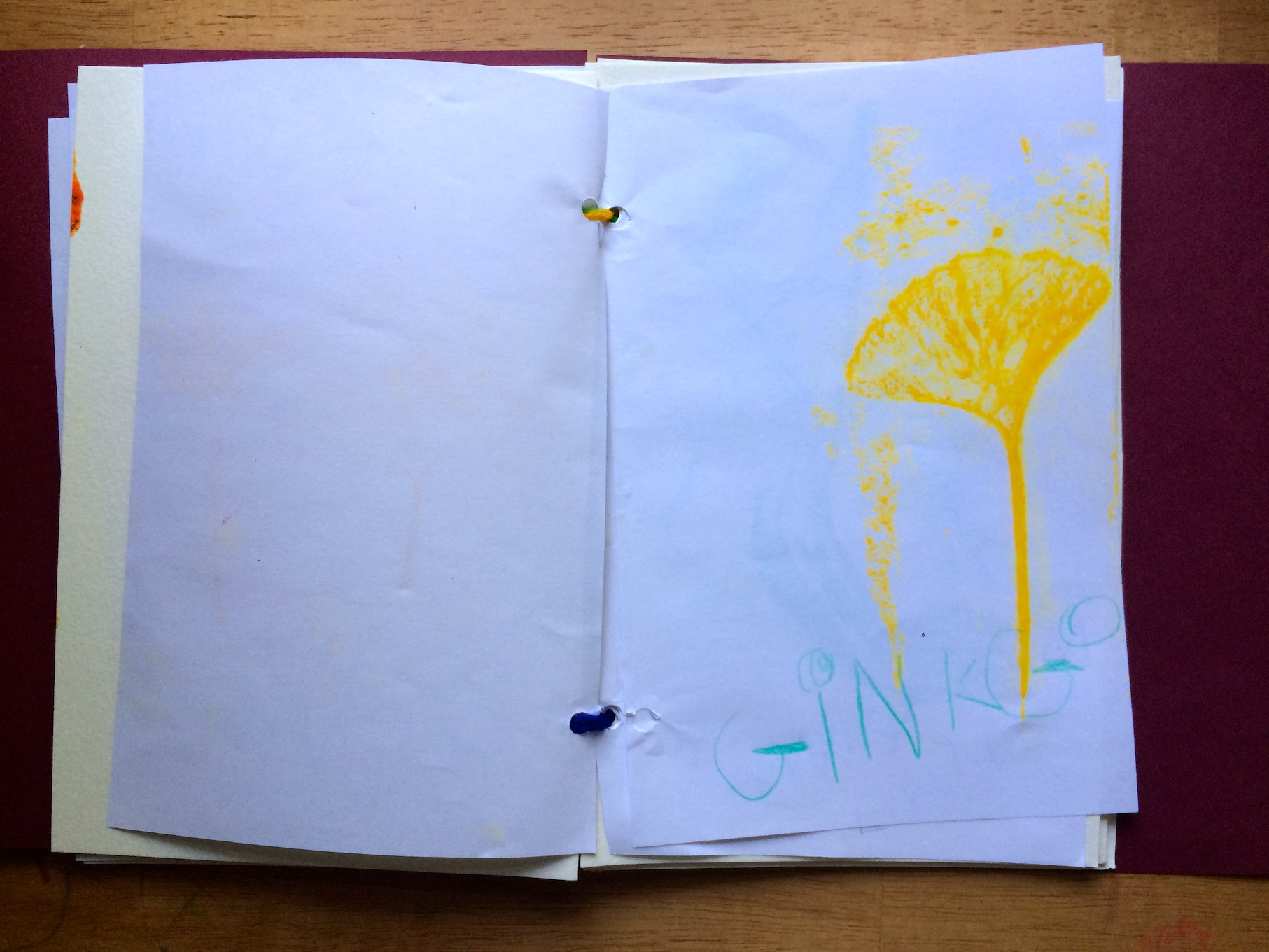
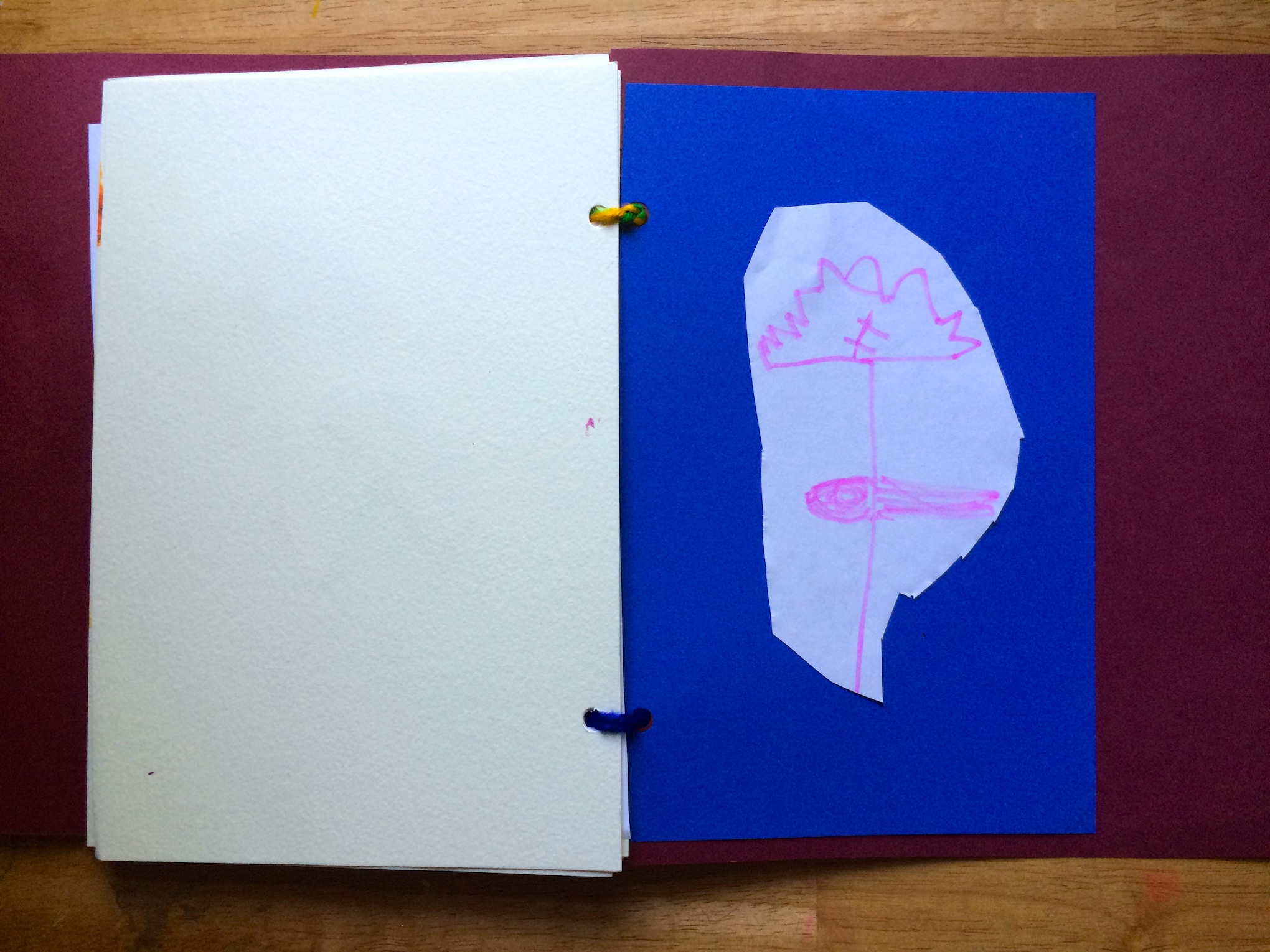
For fun, here’s a vine of Lorelei’s first leaf book made from tracing found leaves from an autumn walk last year:
<script
So many stimulating sights, smells, and sounds roll in with fall. I hope you’re able to make time to go outside and explore them. Happy leaf hunting!
Source of book reviewed provided by Penguin Young Readers

27
Apr
Five Questions with Kids Comics Authors: Cece Bell
Welcome to the start of Five Questions with Kids Comics Authors Blog Tour, a celebration of cartoon artists for Children’s Book Week! This year, Free Comic Book Day (May 2, 2015) will kick-off the longest-running literacy initiative for young people, Children’s Book Week (May 4-10, 2015). Diamond Comic Distributors and Comic Book Legal Defense Fund have combined forces with Every Child a Reader and the Children’s Book Council to call attention to all the ways reading comics has a positive impact on kids.
And what better way to kick-off this terrific blog tour than an interview with the 2015 NEWBERY HONOR WINNING author of El Deafo, Cece Bell?!
Jorge Agurrie and Rafael Rosado, authors of Dragons Beware!, are interviewing some of the most respected and talented graphic novel artists of today starting with Cece Bell! Bell’s recent graphic novel, El Deafo, is an autobiographical account of a girl who overcomes obstacles by imagining her hearing impairment as a superpower, transforming into her superhero alter ego, “El Deafo”. El Deafo quickly became a bestselling graphic novel and the first book ever to be awarded a Newbery Honor Medal, an award given to the most distinguished contribution to American literature for children. This was a huge stake in reaffirming the important role comics have in the reading lives of children. Her books are funny, empowering, and so easy to love that it’s no wonder Cece Bell has a world of readers in the palm of her hands.
Let’s get to it!
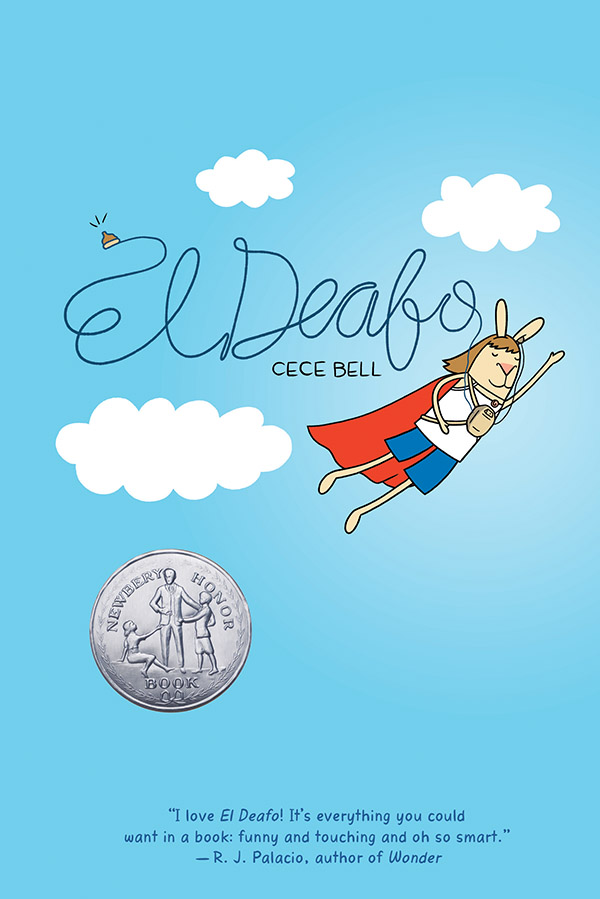
JORGE/RAFAEL: Congratulations on the Newbery, Cece. We thought “El Deafo” was fantastic. It was amazing how you visually represented hearing loss. And besides that, as kids who grew up in the late 70s and early 80s, we appreciated all the touches that brought us back to our childhoods. You even had a Hostess Cherry Pie in there – that takes us waaay back!
CECE BELL: Thank you so much, Jorge and Rafael! I still can’t believe my book got a Newbery Honor. That was never on my list of things to accomplish—I’ve always been fixated on the Caldecott even though I’m clearly not the greatest illustrator in the world. But wow, it is cool! I’m thrilled you enjoyed the book, and that you got all the references to what sadly can only be called “Yesteryear.”
QUESTION (FROM JORGE): One of the themes in “El Deafo” is the idea of being the “other” and not wanting to stick out, which I could really identify with as a guy who grew up in the Midwest as the only Latino around. In my case, being an “other” turned me into an observer of other people, which probably led to me becoming a writer. For you, did feeling different play a part in turning you into a writer/artist?
CECE BELL: I think it absolutely did. For one thing, I was constantly trying to make myself “different” in ways that I could control, since I couldn’t control the fact that I was/am deaf. I threw myself 110% into academics so that the other kids would think of me as the smartest kid in school instead of simply as “that deaf kid.” And when we were assigned projects in which creativity was encouraged—well, look out! I really pushed myself to come up with creative solutions to these projects, and I continue to push myself to do that in my book projects today. Like I said earlier, I know that I’m not the best illustrator in the world—I don’t have a natural ability for it—but I certainly do try to do the best work I can.
For another thing, and this is a bit weirder: I watched a LOT of TV in the days before closed-captioning. I couldn’t understand a word of what was said. But I would watch the images on the screen and then try to figure out what the story was, based on what I was seeing. I’d make up the story in my head—including what the characters were saying—if I couldn’t figure out the real story. I totally think that has helped me pair pictures and words fairly successfully in my books.
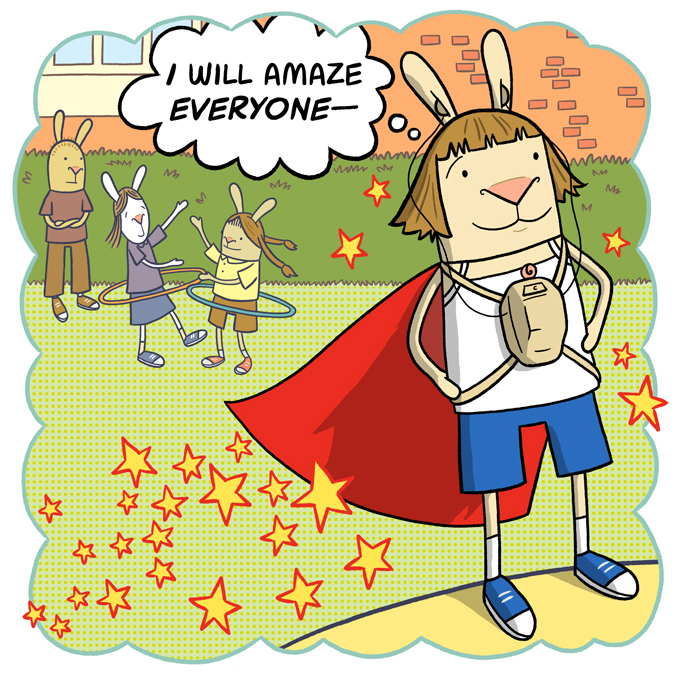
QUESTION (FROM RAFAEL): Why did you decide to anthropomorphize your characters in “El Deafo”? My children love that aspect of the book, and of course we’ve seen it used successfully in books like “Maus,” and now yours.
CECE BELL: This is the most popular question I get from readers, and I don’t blame ’em! Here’s the copy-and-paste version of my answer (and my apologies if you’ve read this version before):
I wanted to show what it felt like to be the only deaf kid in my elementary school. I needed a good visual metaphor, and rabbits, with their big ears and amazing hearing, were perfect for that. Essentially, I felt like the only rabbit whose big ears didn’t work—I had the ears for show, but little else. Also, drawing the cords of the hearing aid so that they went above my head into rabbit ears (as opposed to having them go into my actual ears) perfectly captures how conspicuous I felt as a kid.
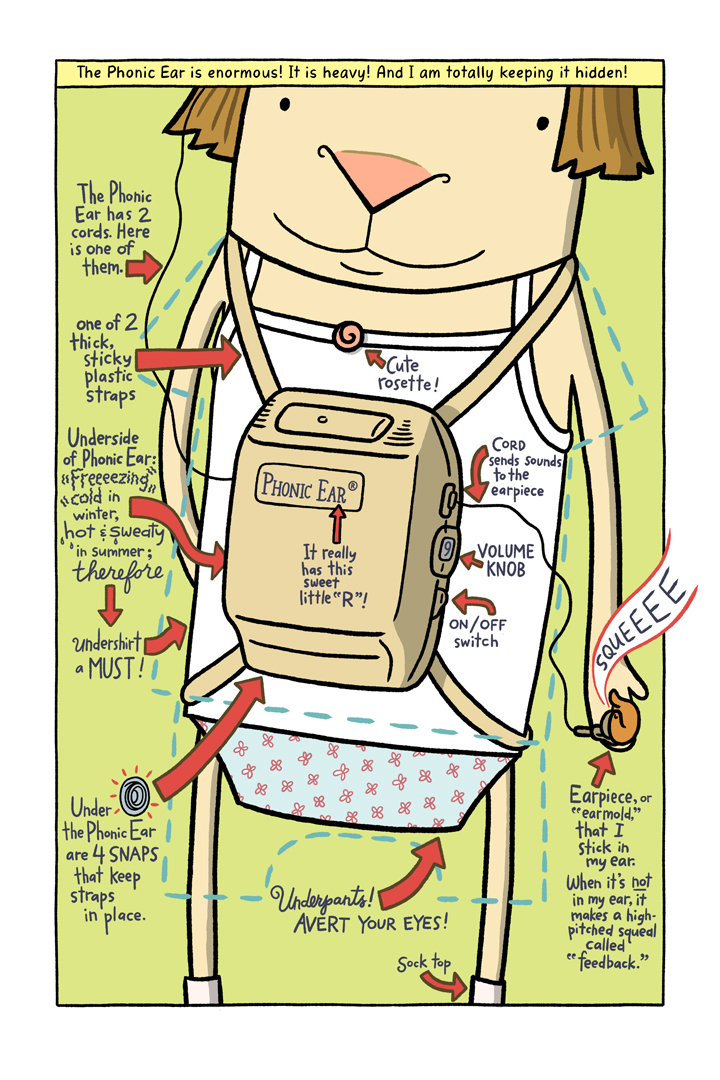 QUESTION: In an interview with Geek Dad you said, “I’d love to do another [Graphic Novel], but gracious, the work. I’m definitely considering it.” We (in particular Rafael) can attest to how labor intensive producing a graphic novel is, however I’m sure we’re not alone in wanting to see another one from you. So have you decided if there’s a graphic novel in your future?
Graphic Novels Get Awarded! Interview With Newbery Honoree Cece Bell – GeekDad
CECE BELL: All I can say is, I hope there is another one! There are a lot more childhood/middle school stories rattling around in my head as I consider a sequel to El Deafo. And I think about non-El Deafo graphic novel ideas all the time—nutty fictional ones, that is. But I have a bunch of actual projects with actual deadlines that I need to finish first!
QUESTION: Knowing they present different kinds of challenges, do you prefer making picture books or graphic novels?
CECE BELL: That’s a tough one. In some ways, you could see a picture book as a very short graphic novel. Both picture books and GNs have words and pictures that work together to tell a story. You could almost imagine that each page, or each spread, in a picture book could represent a panel in a GN. I guess I like the fact that a picture book feels more finite while you’re working on it—with approximately 32 pages to complete, you can see the light at the end of that tunnel. When you’re working on a GN, the tunnel is extraordinarily long and there’s a feeling of I’m-never-gonna-finish-this-puppy that haunts you as you plow your way through. BUT I think I’m a better storyteller when I use the GN format, and I found myself having quite a bit more fun while working on El Deafo than I have on my picture books. Whether that was because I was retelling stories that I knew so well, or because of the format, I’m not sure. It’s a toss-up, clearly.
QUESTION: What are you working on now?
CECE BELL: I have a picture book coming out in June from Clarion called I YAM A DONKEY. It’s complete yuk-yuk and is basically just an argument between a donkey and a yam about grammar. I just finished the art for a picture book for Candlewick called CHUCK & WOODCHUCK, yet another Cece Bell friendship story (I mean, how long can I milk that theme?). I’m currently working on a second RABBIT & ROBOT early reader book for Candlewick, and I’m supposed to be doing a fourth SOCK MONKEY book for them, as well (let me know if you’ve got any ideas for Sock Monkey, ha ha ho). And finally, I need to get started on the illustrations for a series of early reader books for Abrams (about a Venus flytrap detective) written by my husband, Tom Angleberger. Good times! Except for the fact that it feels like there’s no time for graphic novels….
Thanks so much for taking the time to read my book and for crafting such thoughtful questions. All the best to both of you. I can’t wait to see what you do next!
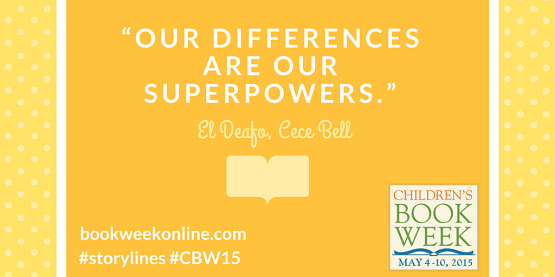
Join us in celebrating these incredible artists and youth literacy advocates throughout the month with Five Questions with Kids Comics Authors blog tour!
Find a comic book store in your neck of the woods participating in Free Comic Book Day, this Saturday, May 2, 2015!
Looking for a good read?
- Check out the Seasonal Graphic Novel Showcase on the Children’s Book Council website.
- This list of the Top 25 All-Time Children’s Graphic Novels.
- And the Top 25 Notable New Releases: Children’s Graphic Novels.
Here’s where you can find official Children’s Book Week festivities and ways to celebrate, including casting a vote in the Children’s Book Choice Awards!
Five Questions with Kids Comics Authors Blog Tour:
Dan Santat interviewed at SLJ Fuse #8
Andy Runton interviewed at The Hiding Spot
Colleen AF Venable interviewed at Graphic Policy
Jay Hosler interviewed at My Bookish Ways
Eleanor Davis interviewed at Love is Not a Triangle
Ben Hatke interviewed at YA Bibliophile
10
Dec
Flashlight Review + Activity
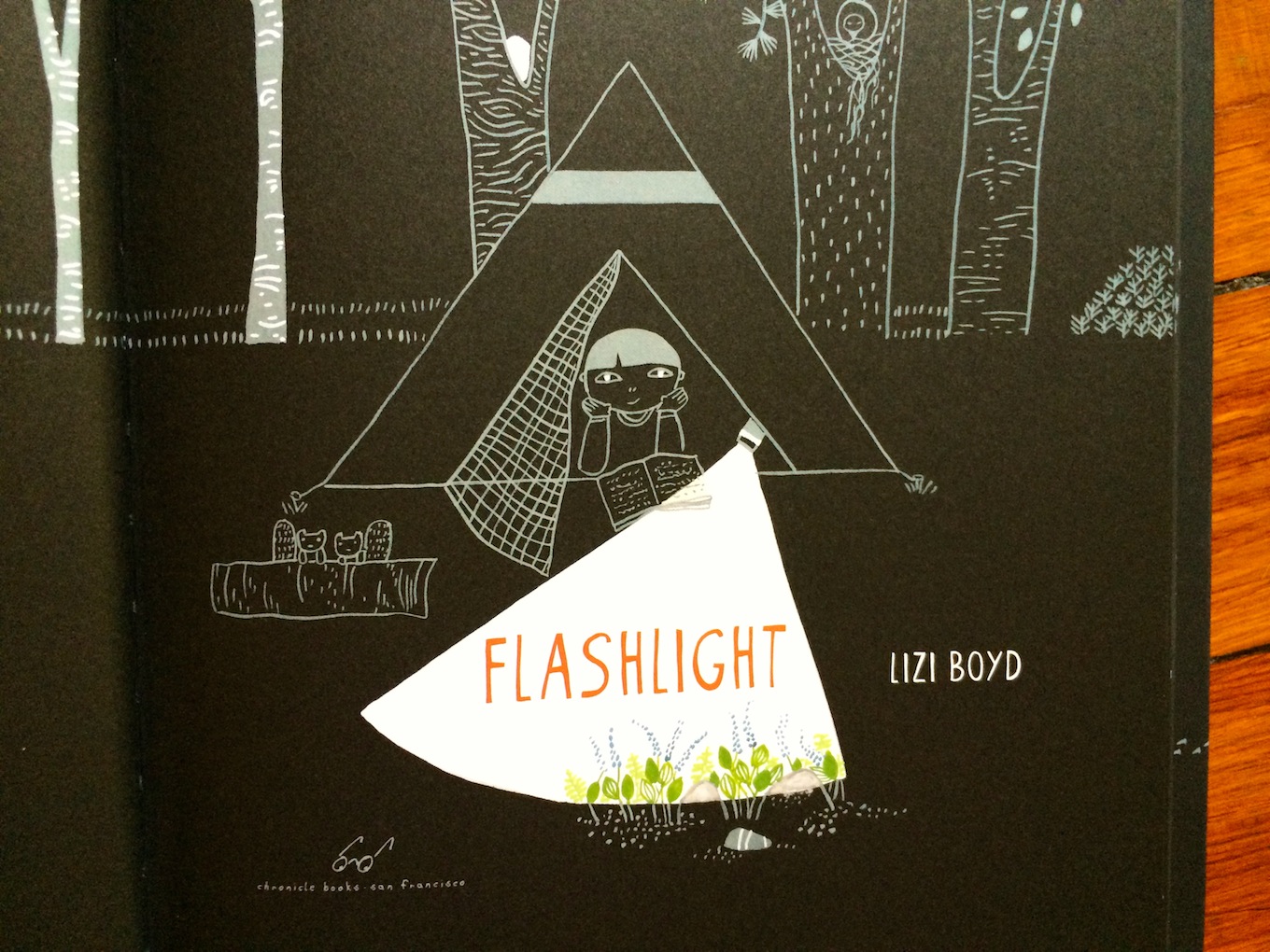
Ahh… Lizi Boyd. You’re a wordless picture book illustrating wizard. You’ve done it again.
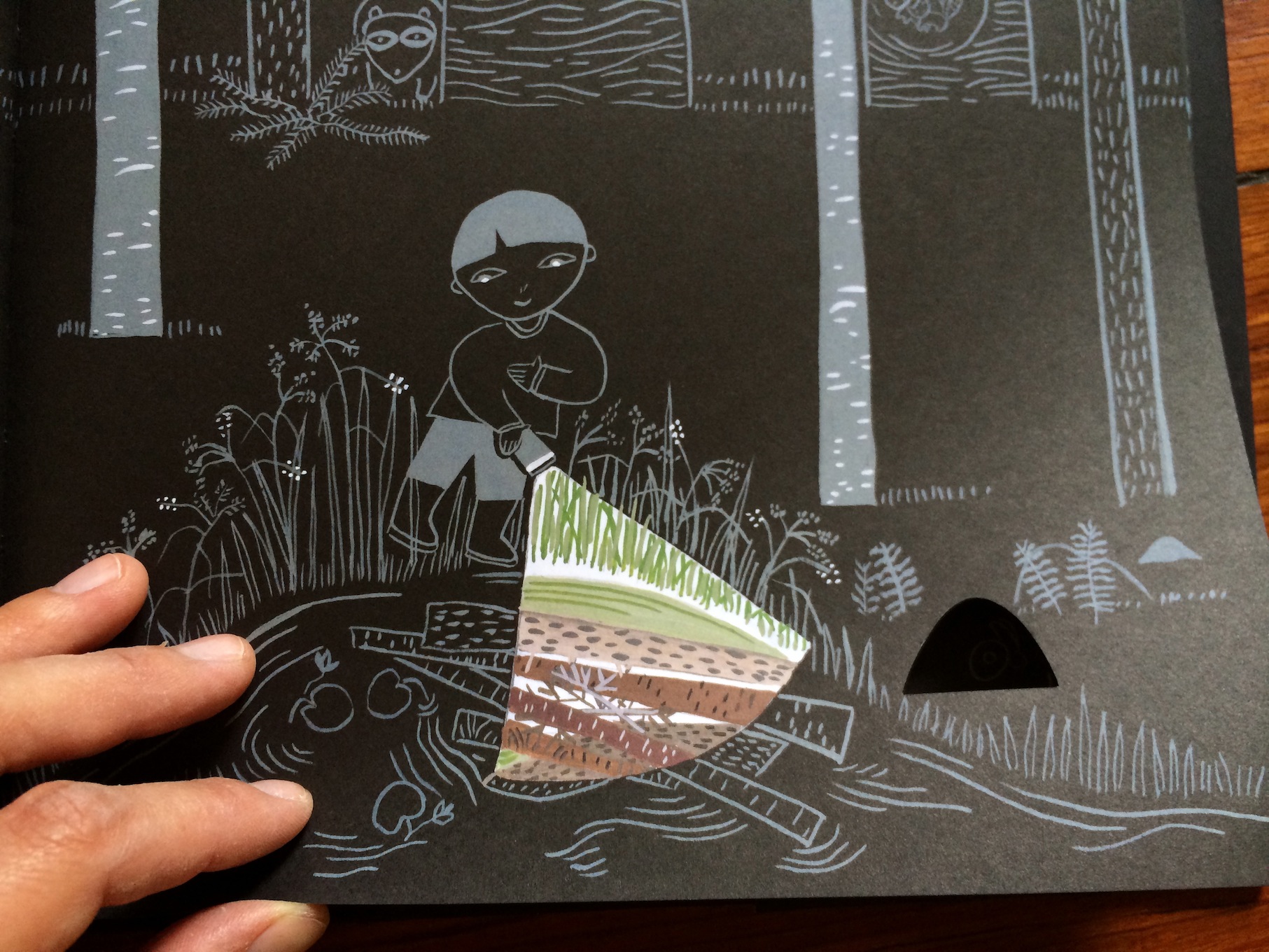
I fell hard for Lizi Boyd’s Inside Outside, and the love affair continues with her latest, Flashlight. A child spends an evening exploring the yard shining a flashlight and revealing surprises the nighttime darkness hides. In the same style as Inside Outside, little peek-a-book cutouts are sprinkled throughout the pages. Hello whimsey!
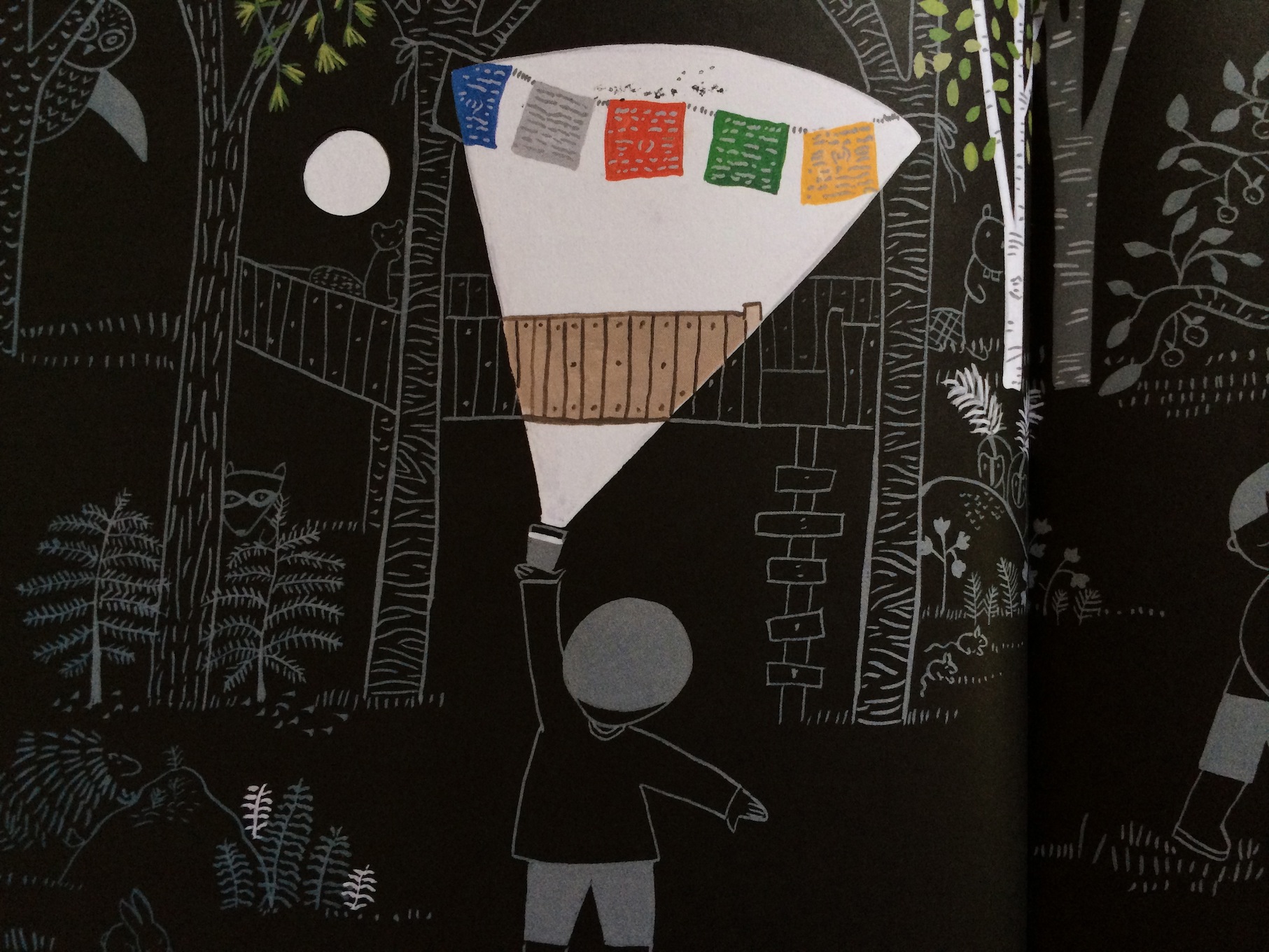
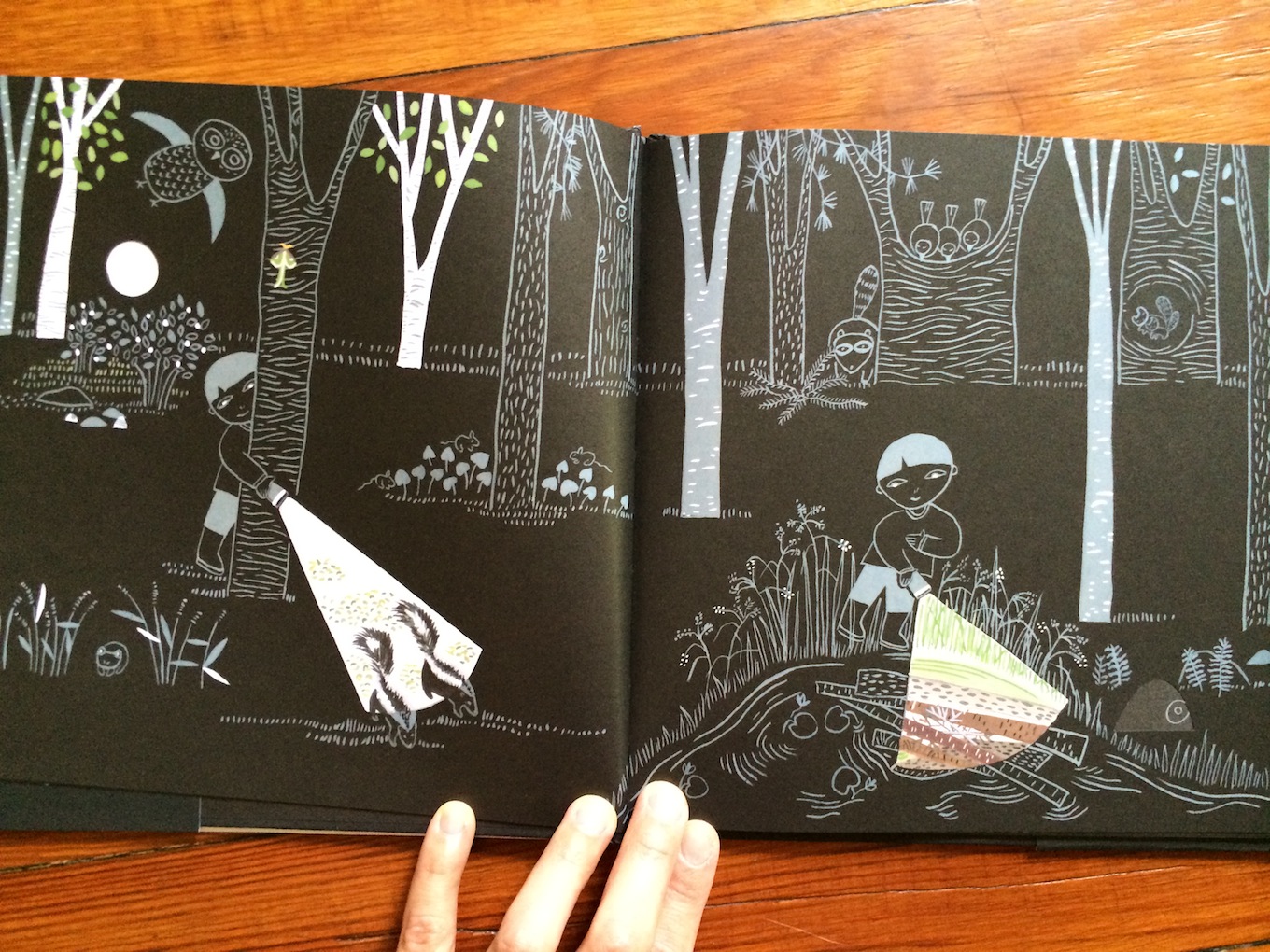
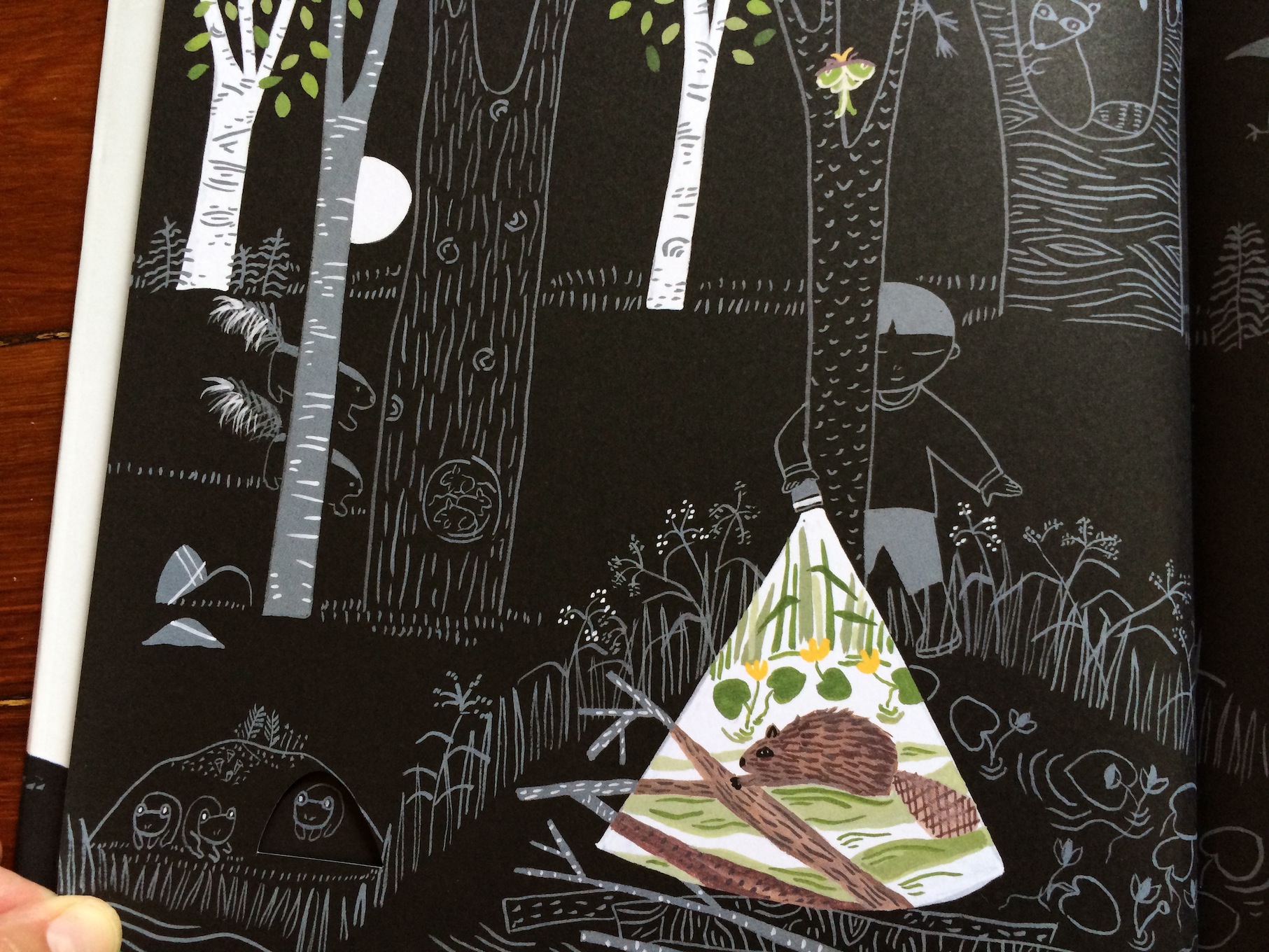
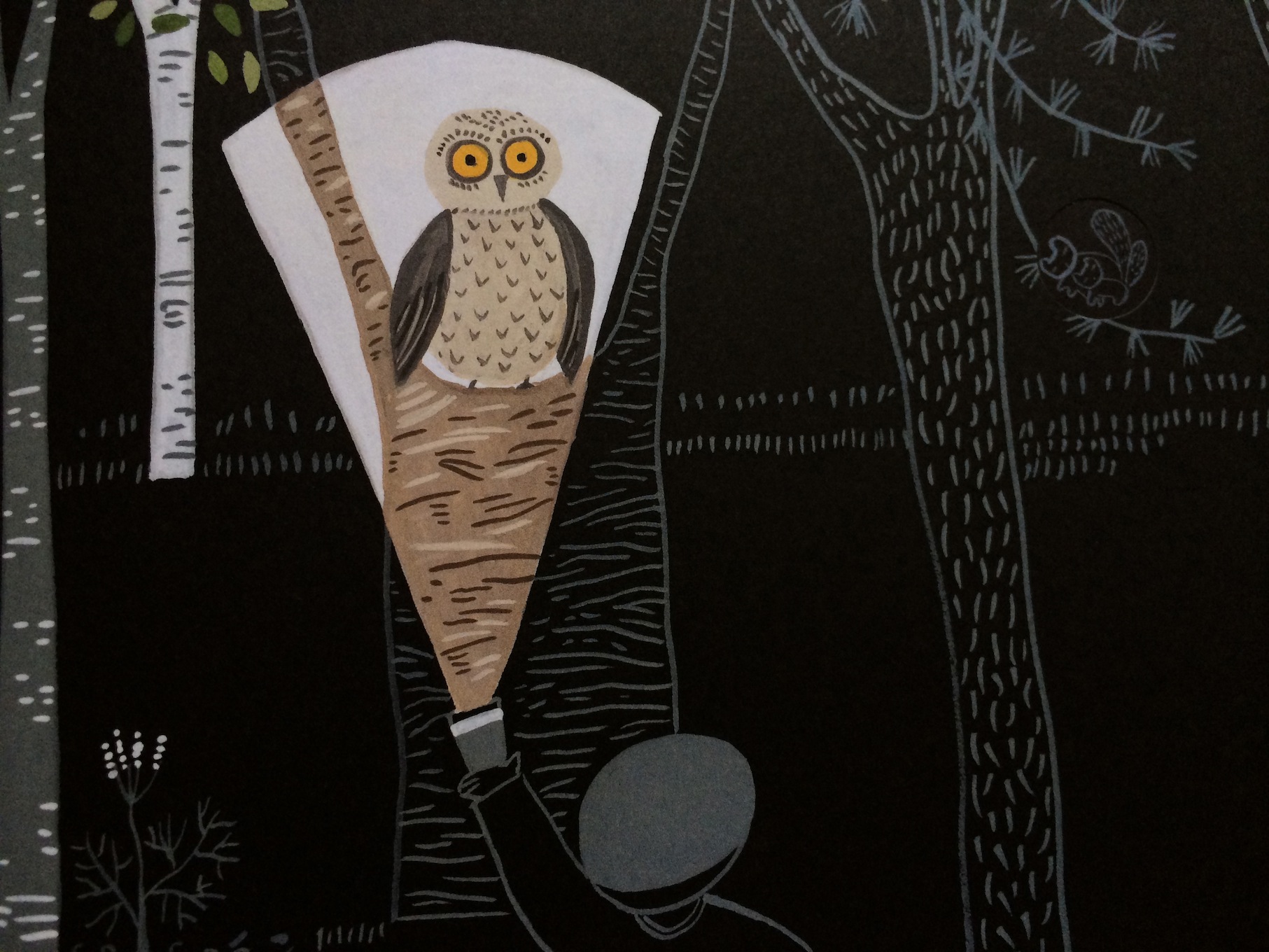
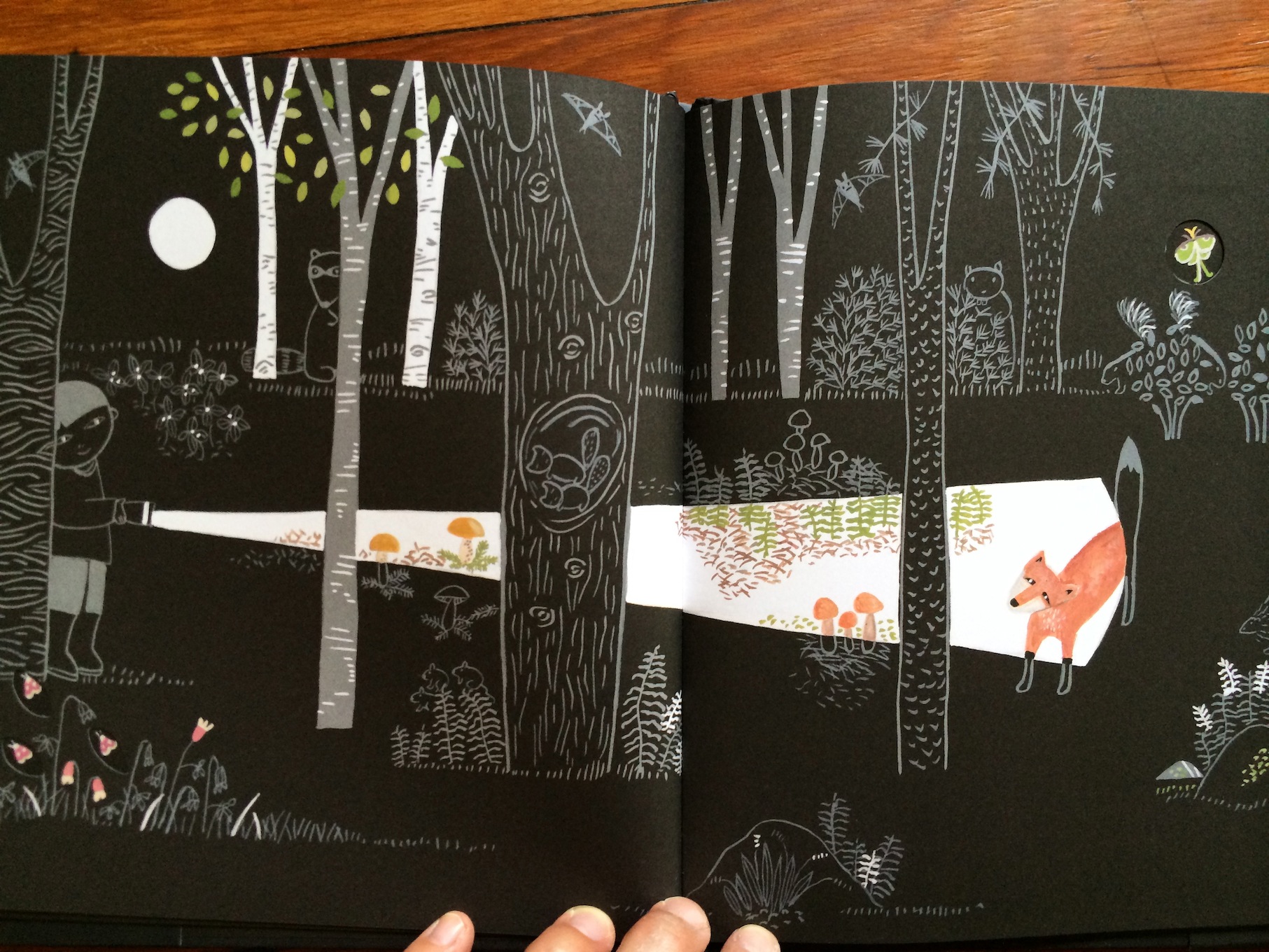
Back in August when I received this book, I immediately took it to the library to share with the kids for Spontaneous Storytime. Lately, I’ve been creating little extension activities for books I’ve been reading for Spontaneous Storytime and Flashlight presented the perfect opportunity do so. I found images of the animals depicted in the book, printed them out, and pasted them around the storytime room. I also made a tibetan flag using colored copy paper and yarn.
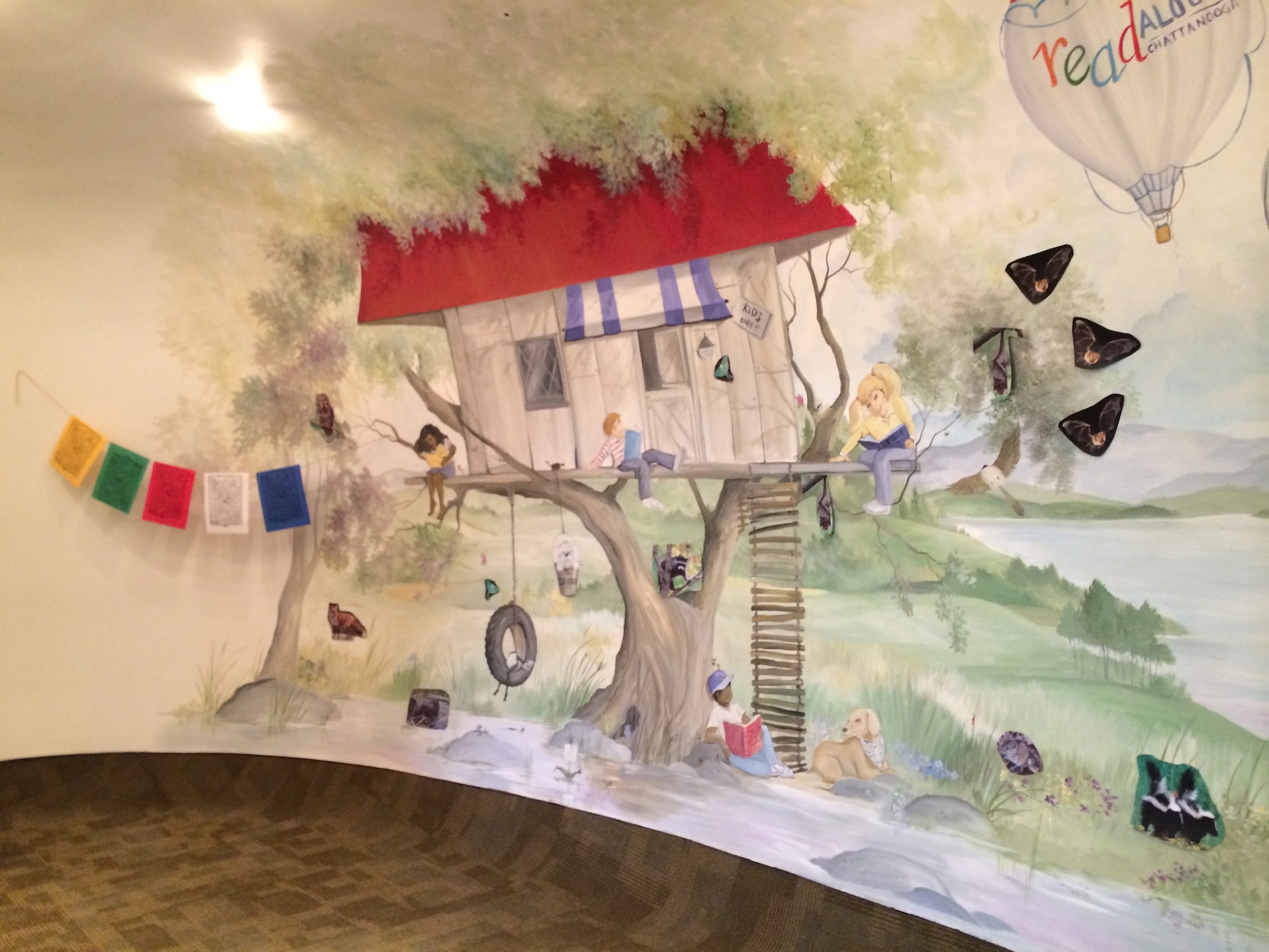
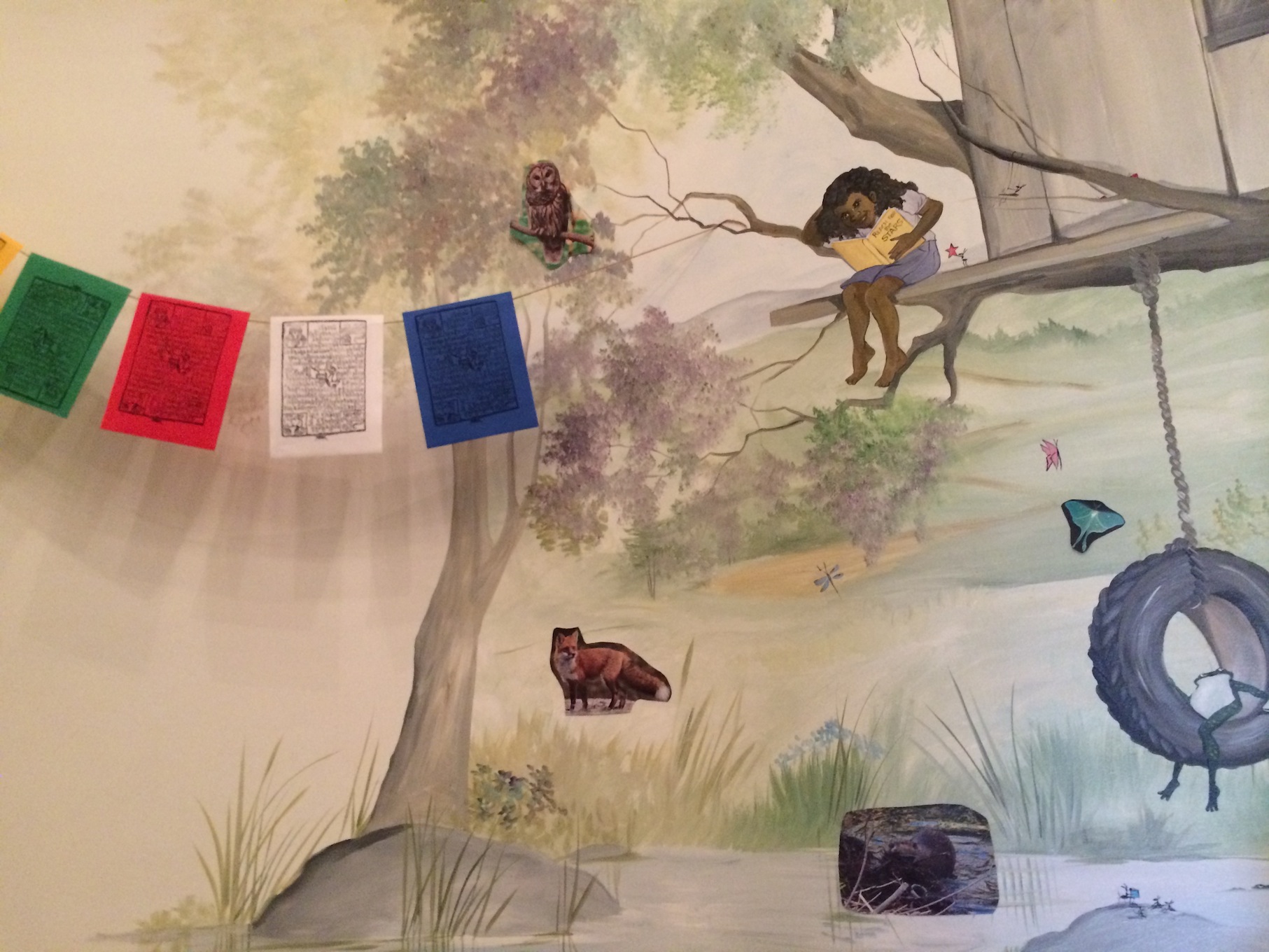
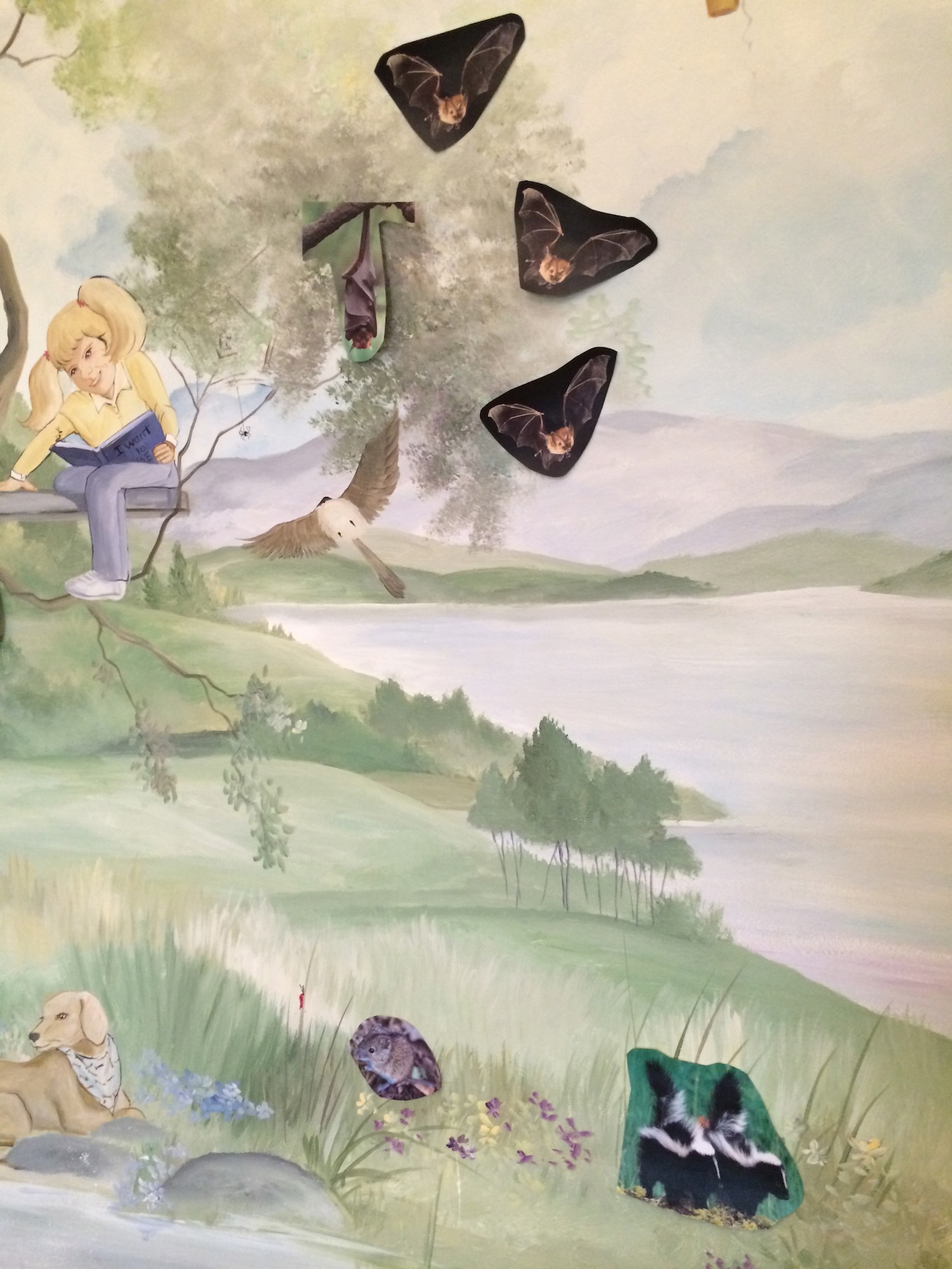
For Spontaneous Storytime throughout that week, small groups of 1-5 children were each given a flashlight, and we read Flashlight in the dim room with the flashlights. They loved shining their flashlights on the book so I could “read”. I explained that this was a book that didn’t have words which means we get to make up the story as we go. The storytimers loved this idea. Some contributed to the story and some took a listening role. After reading, we went on a flashlight hunt where we were sitting to see what animals we might find with our flashlights just like the child in the story.
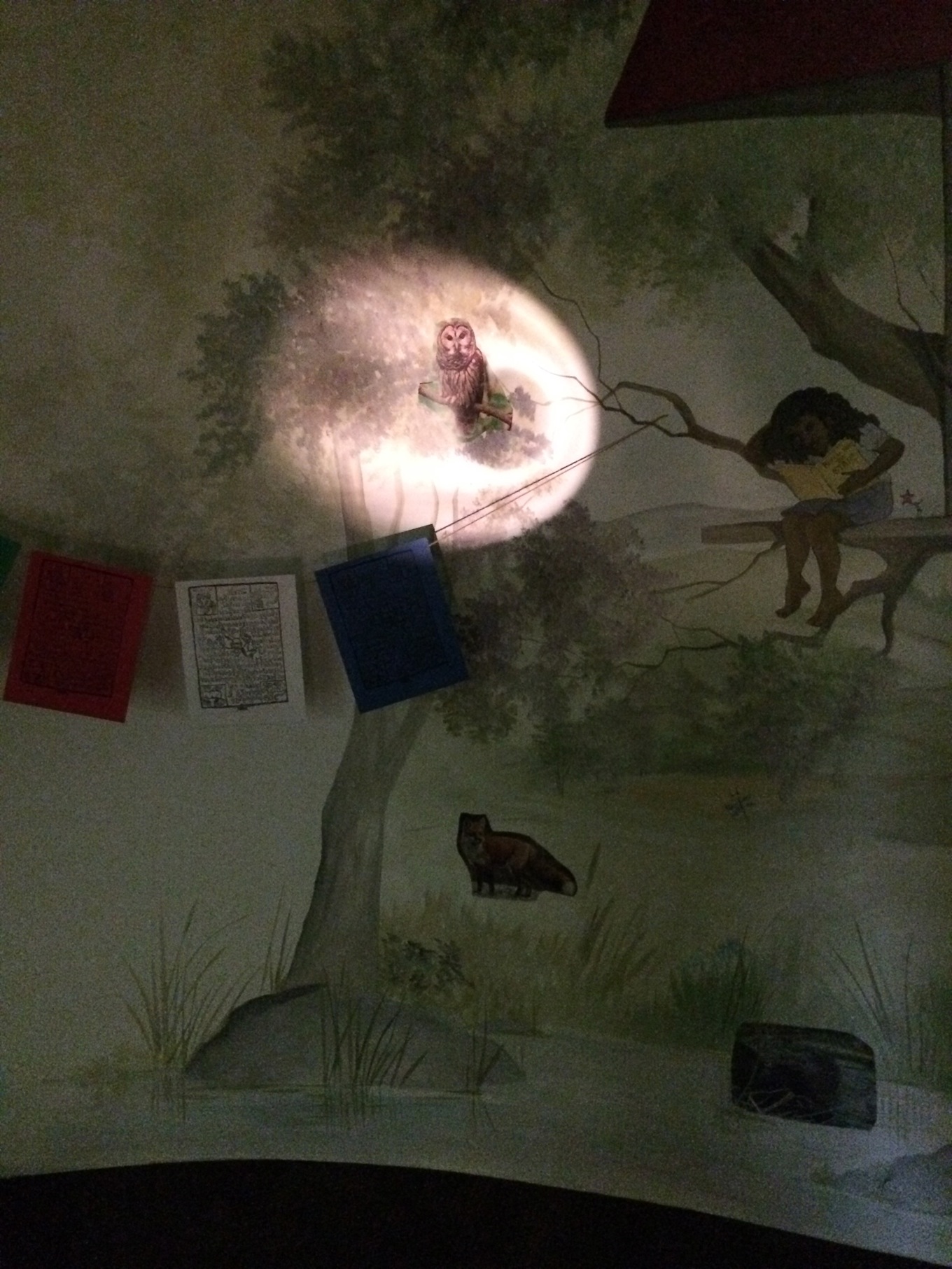
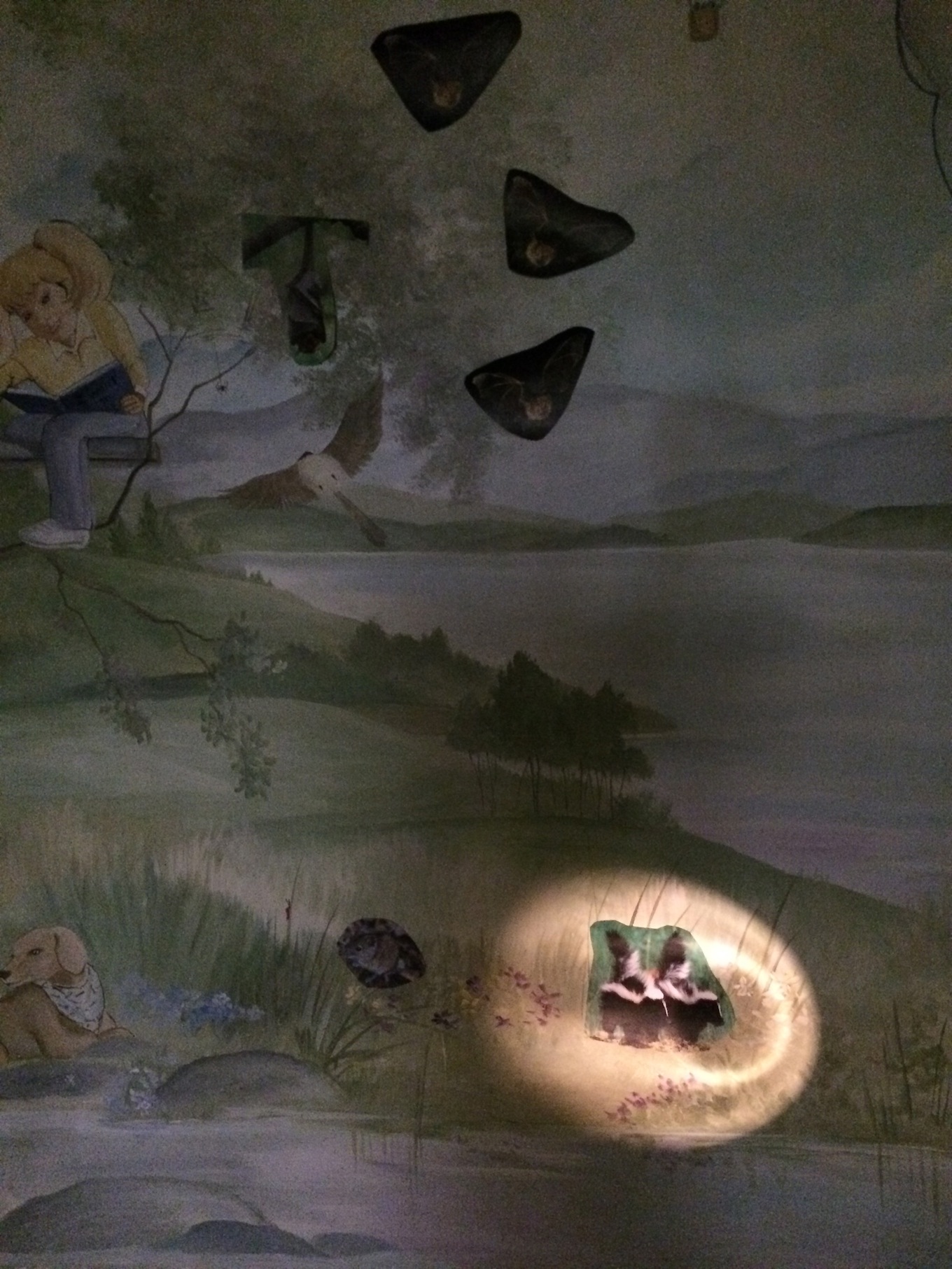
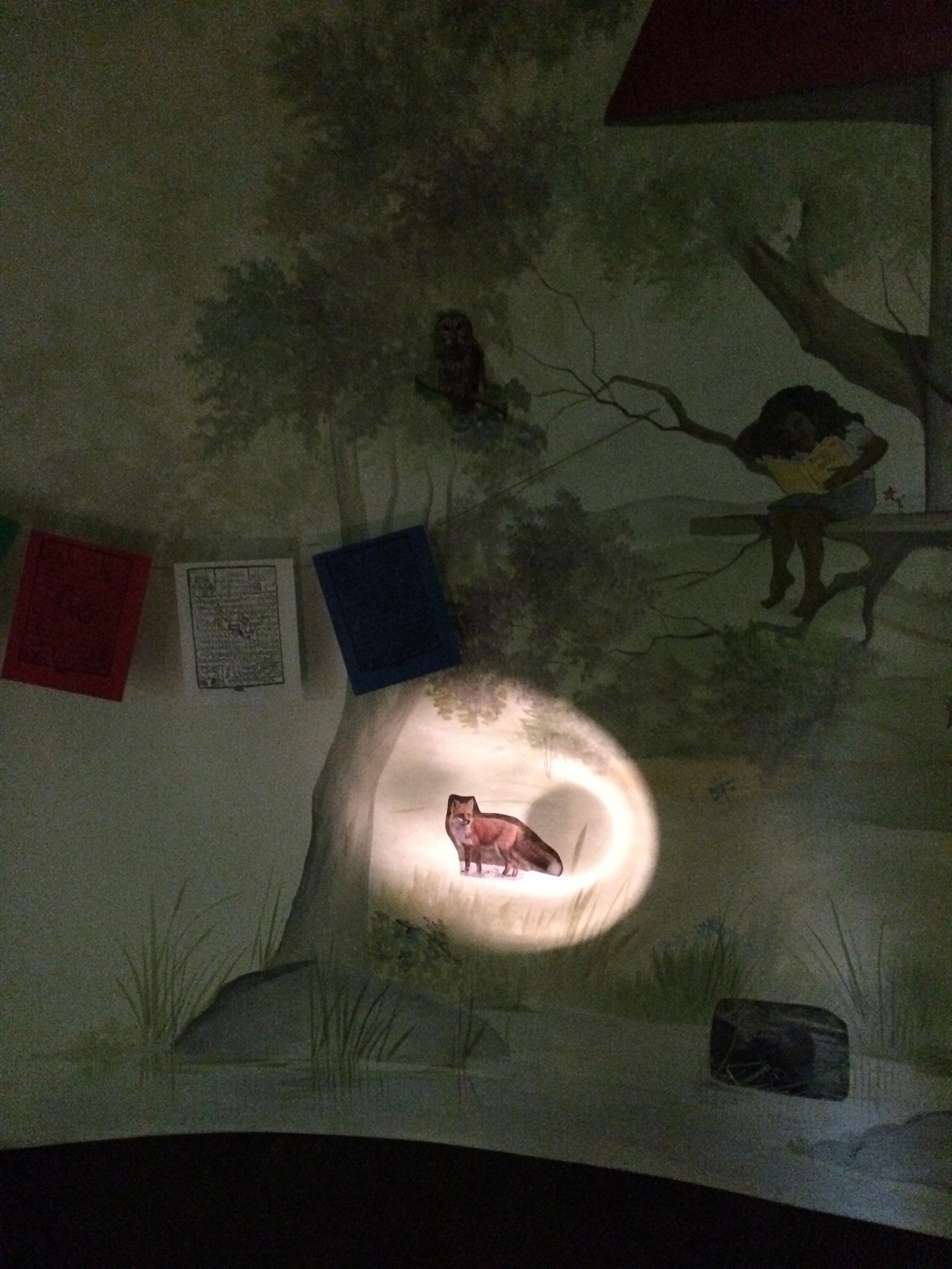
If you have kids or grandkids or nieces and nephews this is also a fun activity to do on a rainy or snowy day inside. You don’t even have to print out animals! What can you spy in the dark? How does it look different with a flashlight? Or if it’s a nice day, explore the outdoors with a flashlight… What can you see? How does it look different than day time? What animals do you see? Flashlight is a wonderful way to spark investigation and imagination!
More flahslight activities for kids:
3 creative flashlight activities via My Kids Adventures
These flashlight games for kids via Kids Activity Blog
More storytime ideas:
Night and Day Storytime via Storytime Kate
Flashlights in Story Time via Seattle Science Story Times
Shadow Storytime via So Tomorrow
Glow in the Dark Storytime via NYPL
Nocturnal Animals via Fun with Friends at Storytime
Source of book reviewed: The fabulous folks at Chronicle Books.
20
Oct
No Such Thing
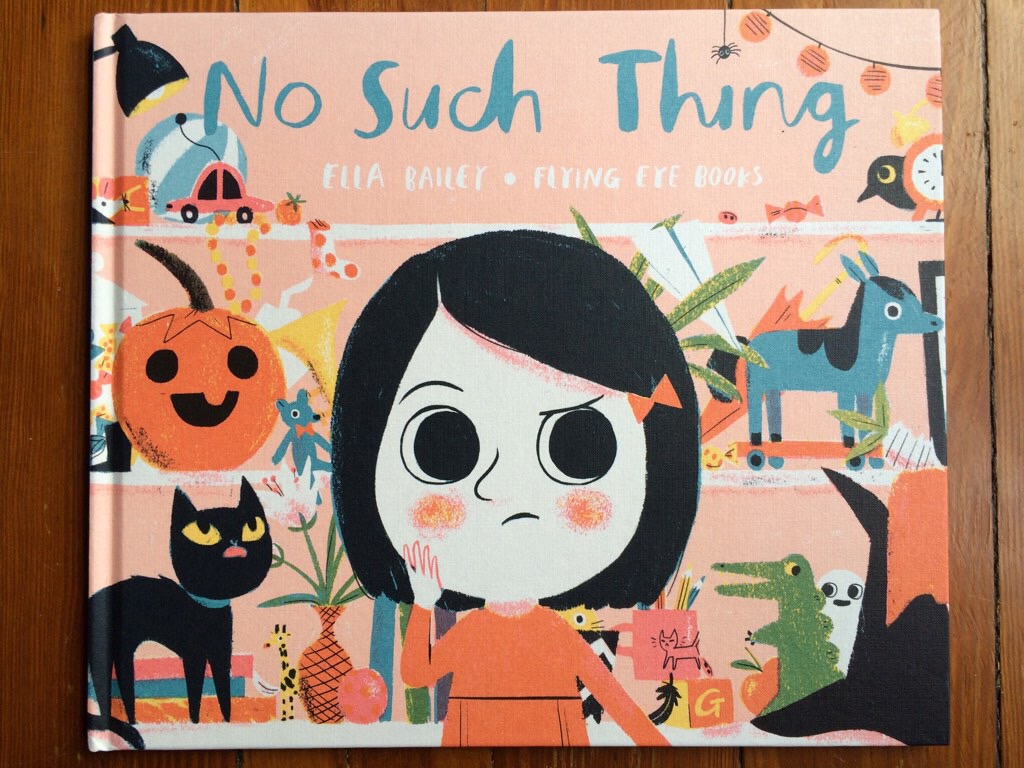
Halloween is my *favorite* holiday of the year, which means of all the holidays I have soft spot in my heart for Halloween picture books. This year, I fell hard for No Such Thing, by first time picture book author, Ella Bailey.
As Halloween nears, young Georgia notices bizarre happenings around her house. A vase falls out of nowhere. (Must be the cat.) Her socks go missing. (Must be mice.) Her crayons go missing and pictures appear on the walls. (Must be little brother.) Georgia always finds some type of logical deduction to explain these occurrence, determined there are no such things as ghosts.
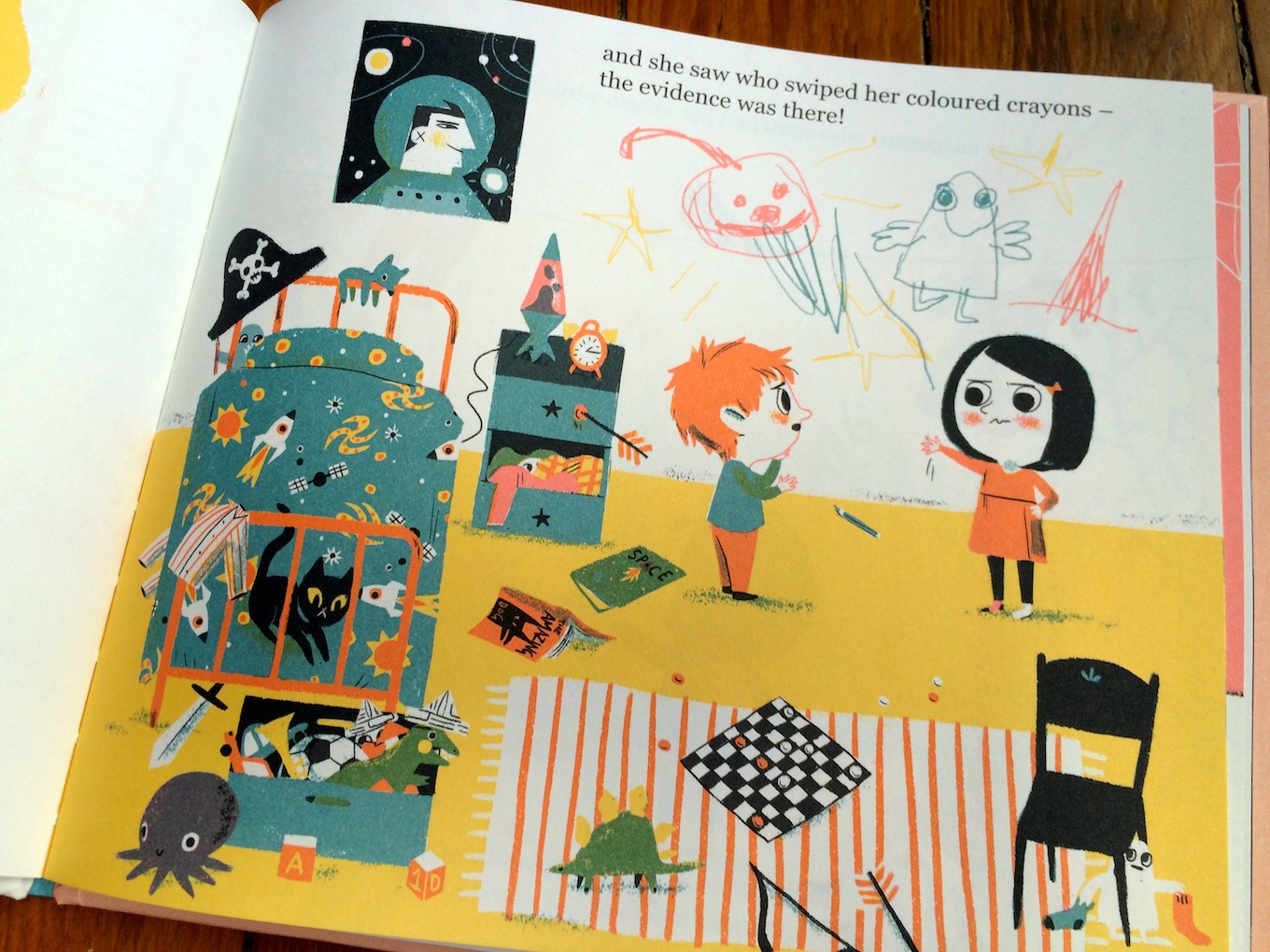
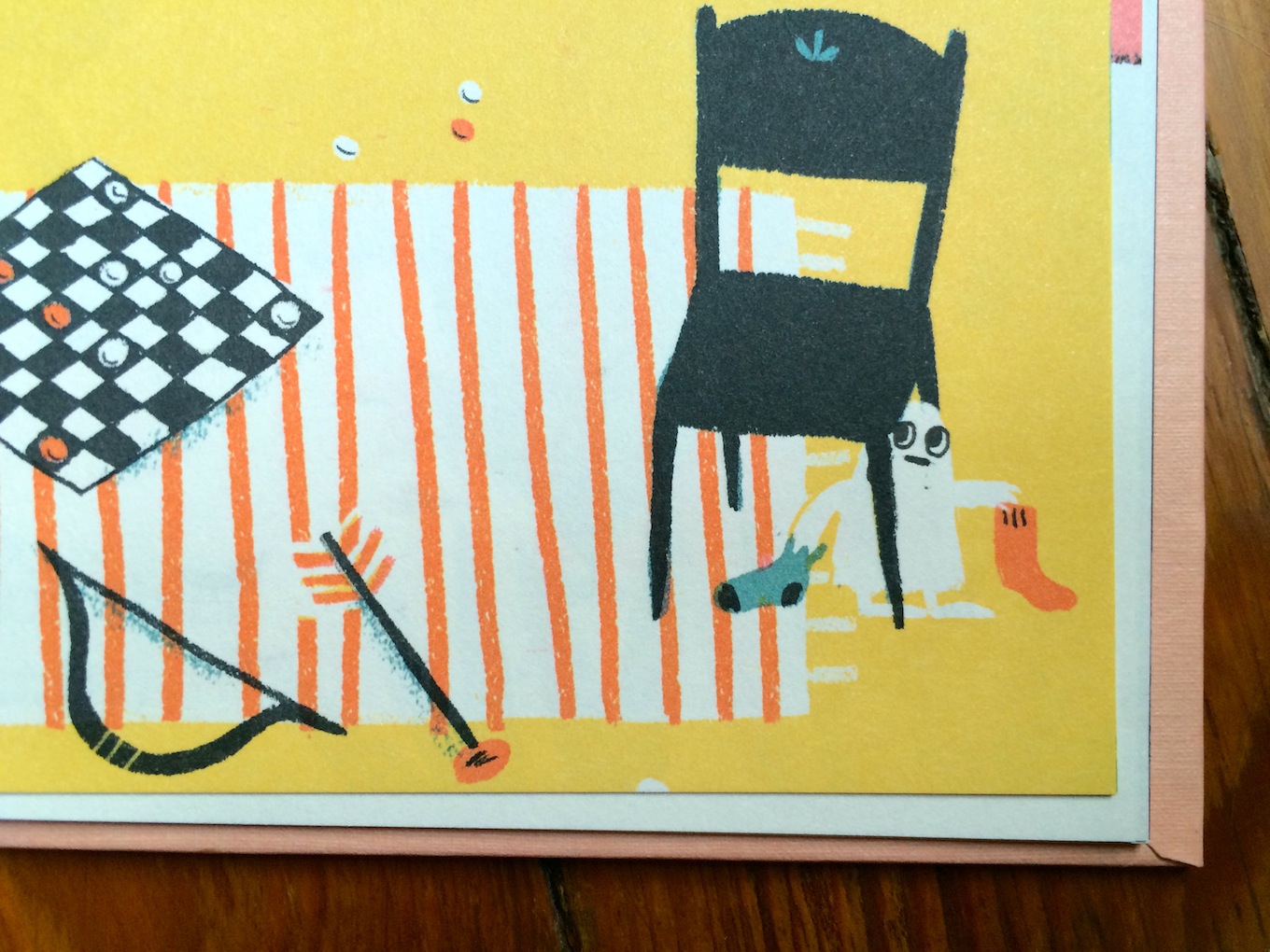
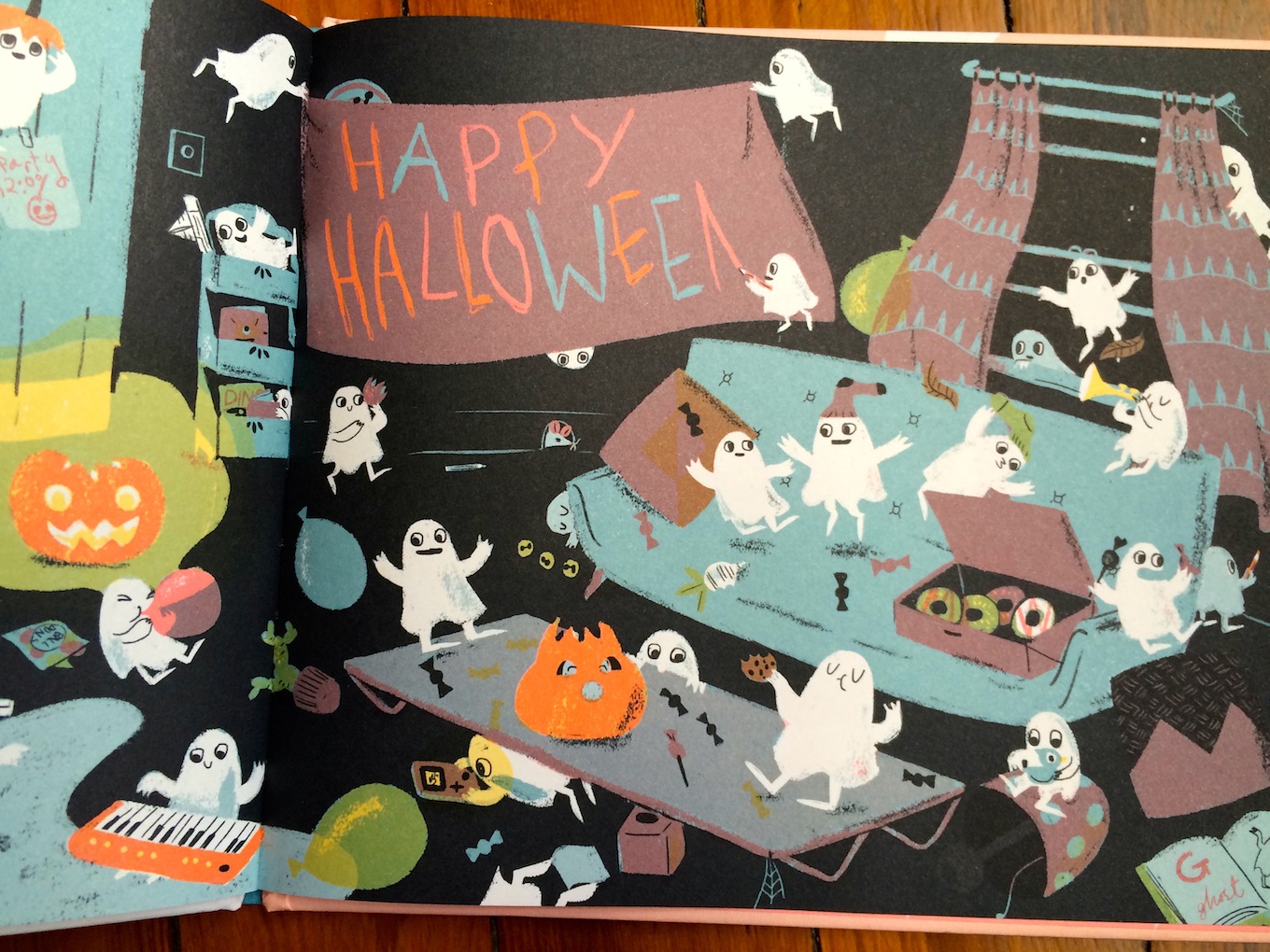
A nice element of surprise to this book is that until the very end, there are ghosts hidden on almost every page. If you didn’t happen to notice, at the end the reader is prompted to go back and search for them. Frequently, I have children that come to the library that are easily scared. With it’s playful, smiley ghosts, No Such Thing is a great Halloween pick for those who tend to become uncomfortable or frightened by ghoulish holiday staples.
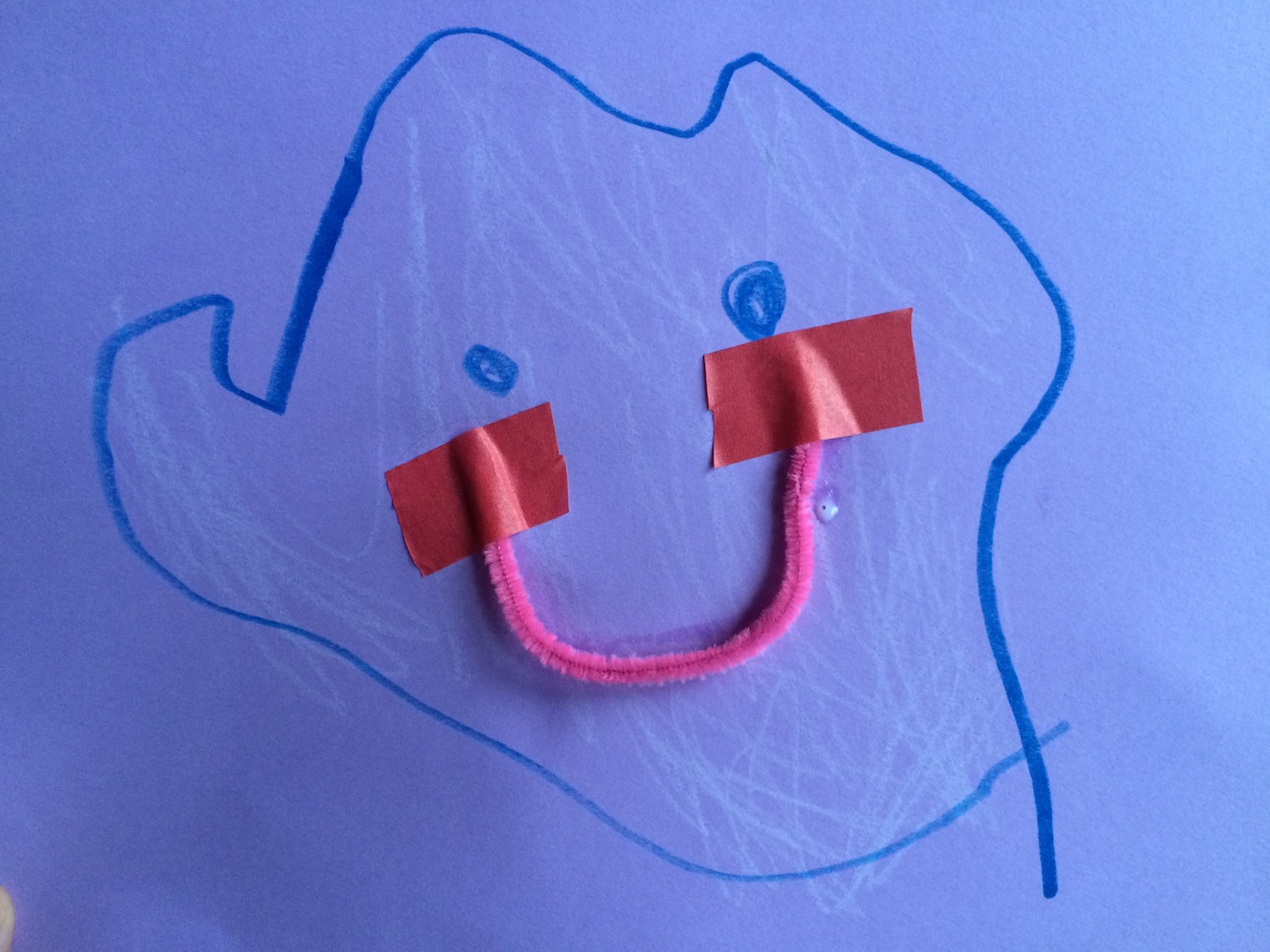
Since sharing this book with my 4-year-old daughter, she has been ghost crazy and is frequently found creating her own not-so-spooky renditions at her art table:
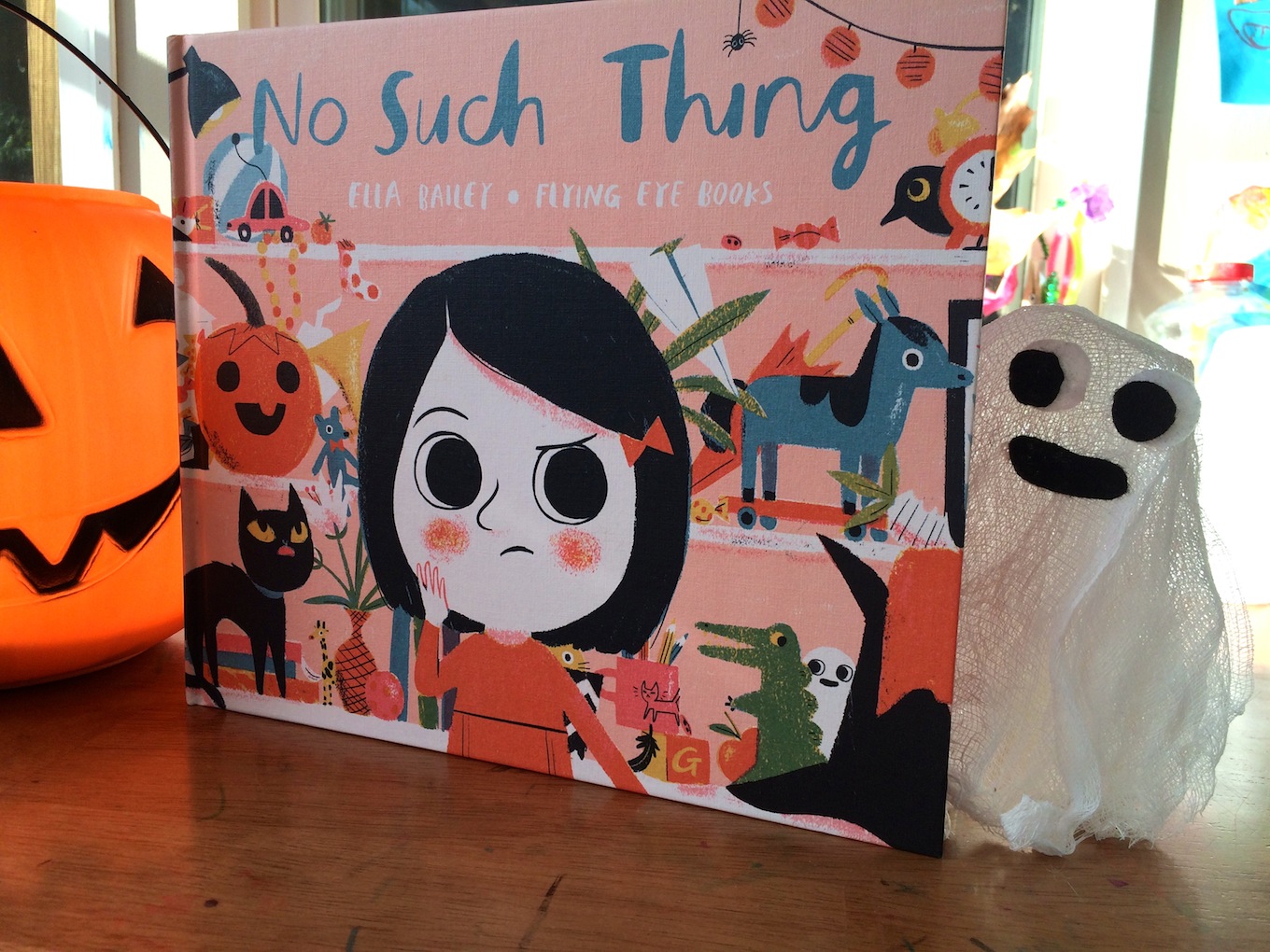
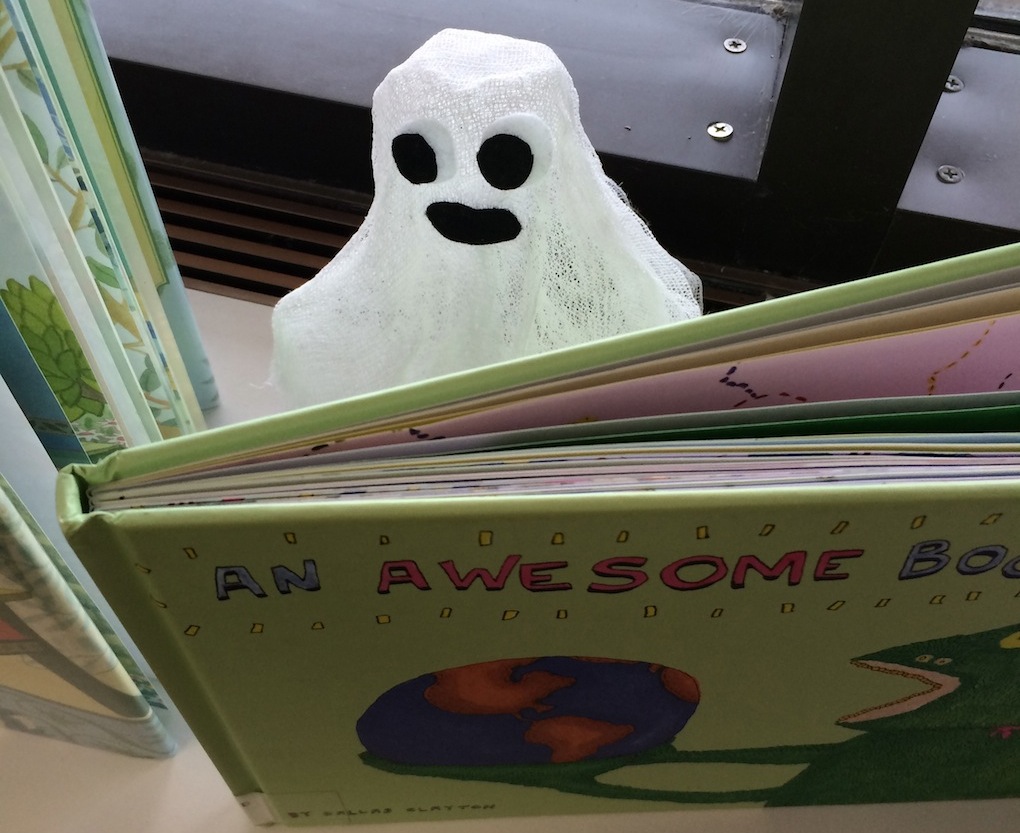
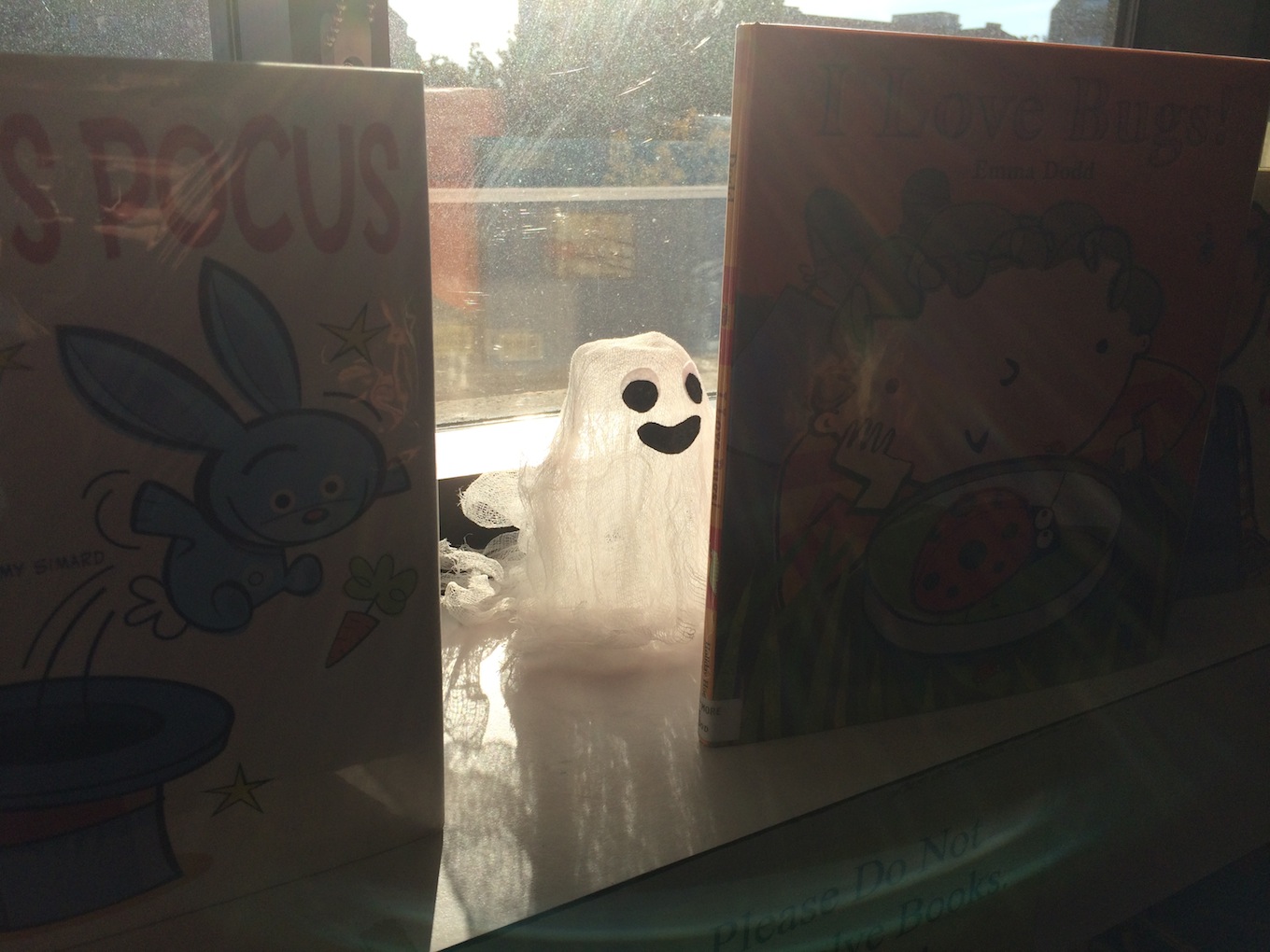
She was having such a good time making her own ghosts, that I thought we’d try going 3-D and construct friendly cheese cloth ghosts. We kinda-sorta followed this tutorial from Martha and once dry, cut the eyes and mouth out of felt and adhered using fabric glue.
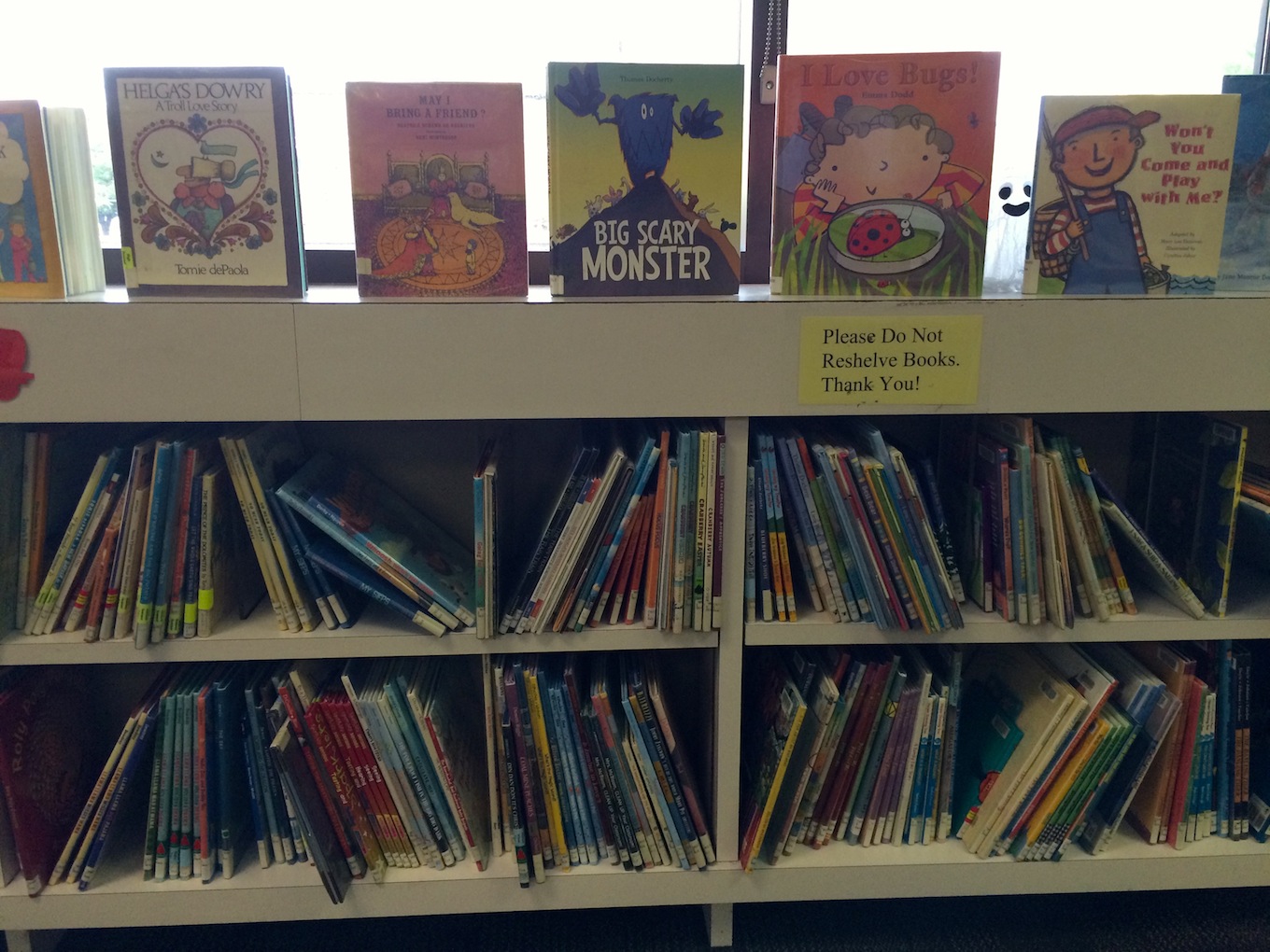
For Spontaneous Storytime, an initiative to conduct random storytimes on the fly in the library, I have been playing around with the idea of reading a featured book of the day several times to kids throughout my shift and having an extension activity available to explore after the reading. So, I brought in a few of the cheese cloth ghosts L and I made and hid them behind displayed books. After reading No Such Thing, the kids went on a ghost hunt in the library! The ghosts decided they enjoy the library so much that they’re going to hide out and cause mischief until Halloween…
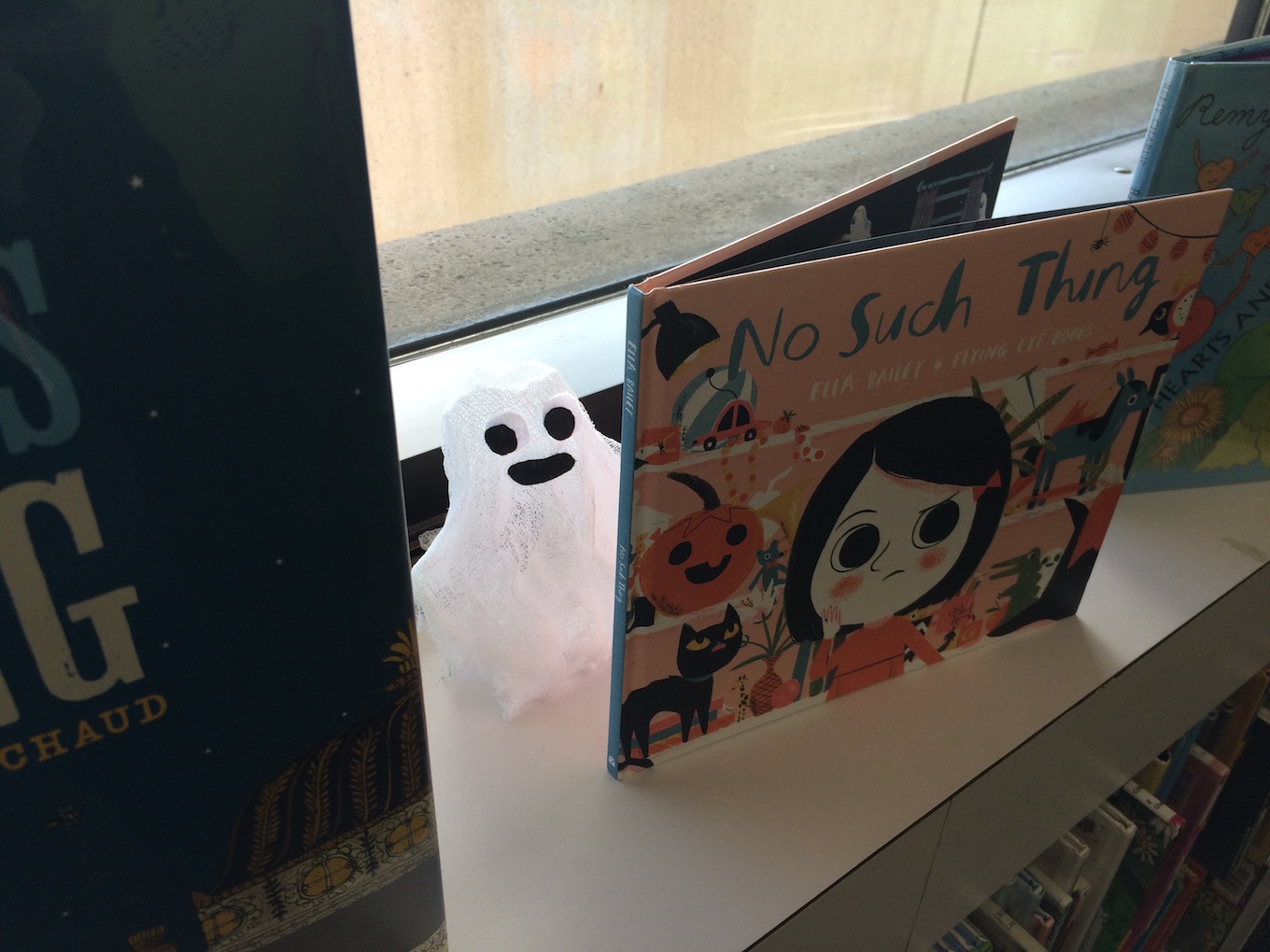
Recently, I found out that the library has a REAL resident ghost named Eugene. Hope he enjoys his new buddies in the Kids Room!
For more fun Halloween activities in the library, check out:
Hafuboti’s Mostest with the Ghostests and Book Graveyard.
These adorable book character pumpkin contests here, here, and here.
A couple other easy-peasy ghost crafts that look like all the fun:
Coffee filter ghosts via Blog Me Mom
Cotton Ball Ghost Craft via Happy Hooligans
Source of Book Reviewed: The wonderful folks at Flying Eye Books!
8
Oct
Introducing Miss Lucy Jane
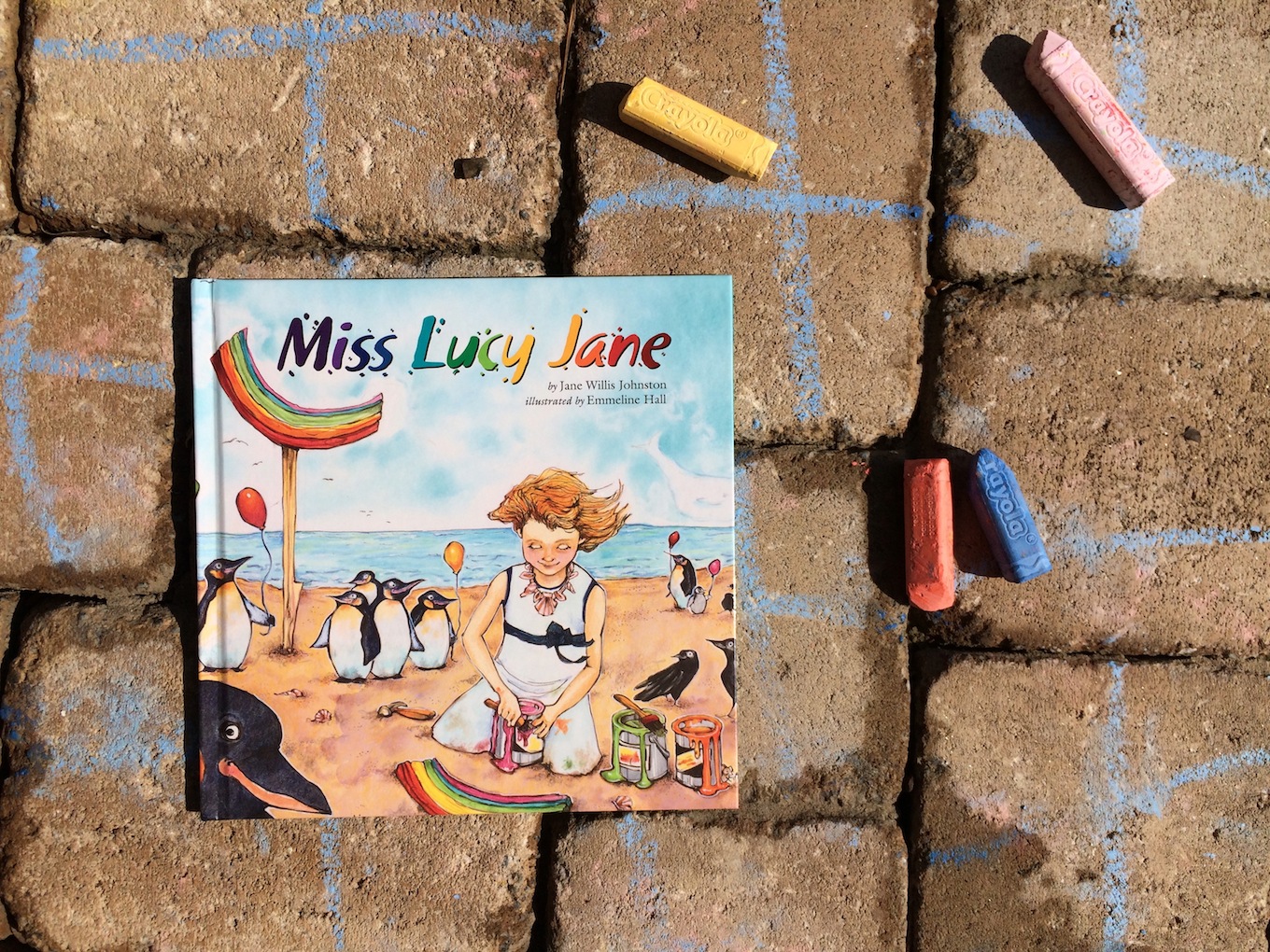
Jane Johnston is an artist and a poet. She also happens to be an adored former children’s librarian who invoked a sense of wonder and whimsy while working at the library. She continues to encourage the imagination of children with her very first, independently published picture book: Miss Lucy Jane:
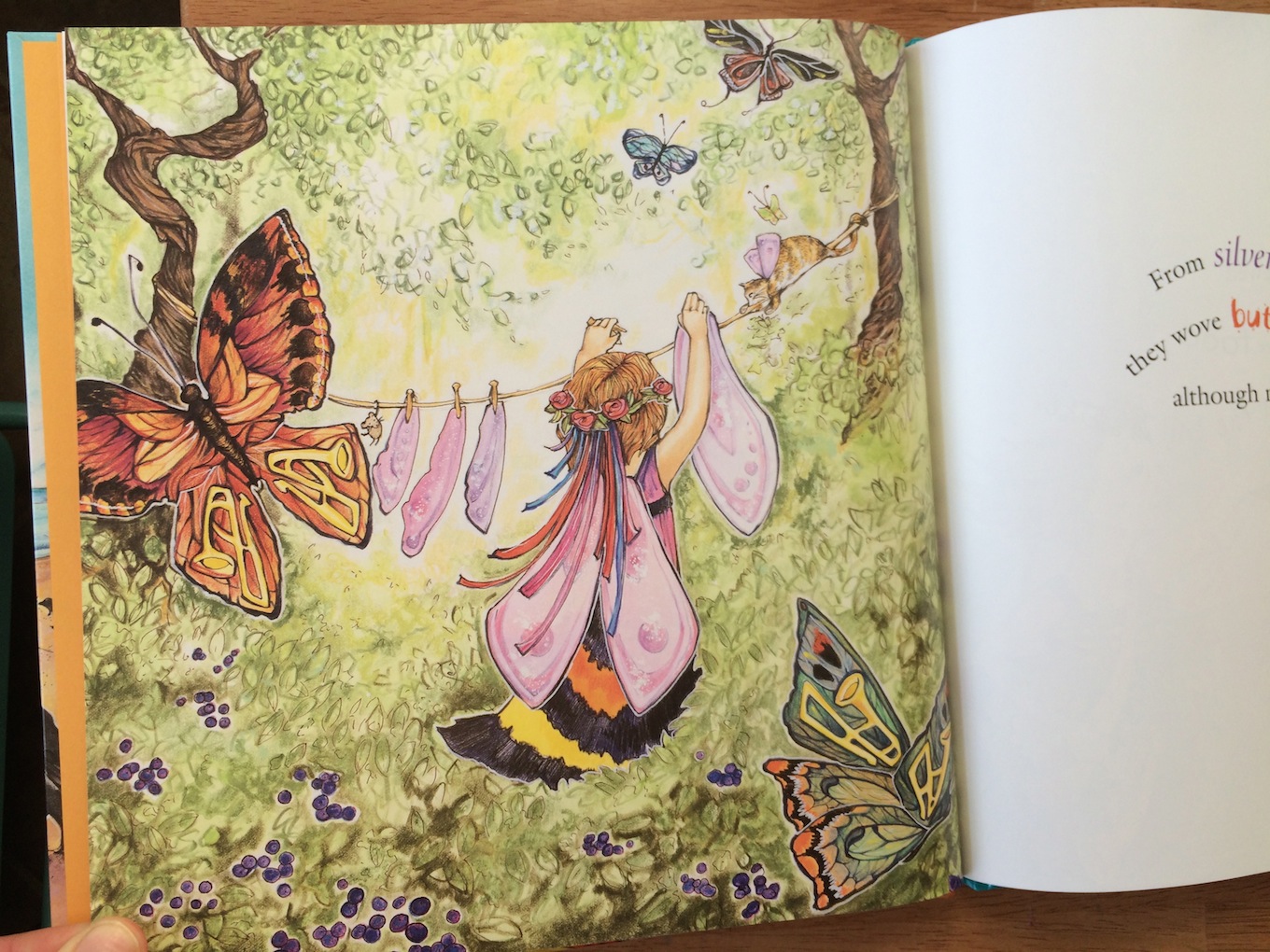
“The fanciful Miss Lucy Jane is “full of dreams and flap-doodle schemes” as she creates a wonderful week of amazing adventures. From building “rainbow smiles on a stilt” to “collecting one wish off a fin of each fish” to lassoing “Mars just to measure the stars,” she makes each day delightfully her own. Search every picture for a mouse that goes along for the ride! Miss Lucy Jane, told with Jane Willis Johnston’s lyrical words and Emmeline Hall’s whimsical illustrations, promises to become a read-aloud favorite for bedtimes, storytimes, and classrooms.I have invited her to share a few ways to share her new picture book, Miss Lucy Jane with you.”
I’ve invited Jane to share ways the many ways readers can enjoy Miss Lucy Jane with you here. We’ve very much enjoyed reading her book and making rainbow smiles (instructions below) during an episode of creating art early this morning.
More Ways to Explore Miss Lucy Jane
Thank you for reading and listening to Miss Lucy Jane. Here are a few suggestions for exploring her world as you share her adventures every day of one wonderful week.
Find the mouse in every picture. He is very small and can be good at hiding. Does the mouse ever see a mouse friend?
Search each picture for something that leads to the next picture. Sometimes the connection is very strong, other times it might seem a little bit tricky.
For example, notice what Miss Lucy Jane is carrying in her bag in the first picture. Did you find some things of different colors? These things connect to what she makes in the next picture, because she does something with colors, and also with what she leaves on the sidewalk in the last picture in the book.
In the first Sunday picture Miss Lucy Jane is at the ocean shore. Do you see anything in the sky that connects to the next picture?
Some pictures may have two or even three connections. Look at the first Wednesday picture. What is the cat doing with her tail? What kind of bushes do you find in the next picture? Who else is sitting on the hat with the cat? Where have you seen them before and where do you see them after the hat picture?
In the second Thursday picture, can you find something in the river that runs under the square trees that connects with the big Friday picture?
For the second Saturday picture, find out two names the bear constellation is called.
Make a list of the sets of rhyming words in each verse just to make sure you hear the rhymes. Find your favorite set of rhyming words and see if you can think of a third word and maybe even a fourth word to rhyme with them.
Which day’s adventure would you choose to go on with Miss Lucy Jane and why?
Read Miss Lucy Jane at least two times, maybe even three, to feel the rhythm.
HAVE FUN!!
Good Ideas for Storytime and Craft
I have had success and great fun presenting Miss Lucy Jane in a storytime setting to children from two to twelve years old and all ages of adults. I had two teenage helpers who were intrigued by the book, as well, so Miss Lucy Jane appears to appeal to all ages.
I believe in opening many doors and windows into the books I read to children as some children are more inclined to focus on sounds, some on visuals, some on my facial expressions, some on my hand movements, or some simply to the turning of the pages of the book.
Below you will find rather lengthy description of how I enjoy reading this book to children. You can, of course, just read it straight through and that will work wonderfully, too!
In order to be sure I keep all ages connected to Miss Lucy Jane, I start with a basket of objects to identity and to watch for in the illustrations. Study the book and put together your own collection. I include some sidewalk chalk, a rainbow colored on cardstock and cut out,* a red ball, a real banana (real things are always attention-getters!), a plastic horse, a small stuffed animal cat, a fabric butterfly, a paper kite made from cardstock, a toy rowboat, a rubber fish, some paper stars, a small stuffed animal black bear (standing on all four feet, not a teddy bear)…and a small stuffed animal mouse. (*When I show the rainbow, I do talk about the arch shape, turn it over to make it a smile shape, and call it a “rainbow smile.”)
I talk about the book briefly, that it is about a girl who likes to find adventures in every day and that this book takes us along on one week in her busy life. I say it is fun to look for things as we read the book…so then I hold up each object in random order and we all identify them. I hold up the mouse last and say that he is too small for the children to see from so far away, but that when they check out the book and take it home to look at the pictures closely, they will find the mouse!
Before I start reading, we review in chorus the days of the week.
I announce we are going to read the book twice, once a little slowly with some extra words I will use, and once a little faster after we have heard the words once and have felt the rhymes and rhythm of the poem that makes the story of Miss Lucy Jane.
Then I read the book, stopping to ask what day of the week Miss Lucy Jane is ready for, sometimes saying all of the days of the week up to that day. In the first picture, where Lucy Jane is on her scooter, I mention that she is carrying a bag of lots of colors of chalk and to remember that. Sometimes throughout the reading I note other objects we talked about. When we get to the last page and picture, I ask what she did with her chalk and we talk about the sidewalk drawings from all the things she did in her wonderful week.
We have a discussion about what were some favorite pictures and adventures and days. We talk about some of the rhyme sets. We try to think of more words that rhyme with the sets. Then we read it again, straight through, listening for the rhymes and being carried along by the rhythm as we watch the pictures that create the world of Miss Lucy Jane.
Rainbow Smiles Craft for Miss Lucy Jane
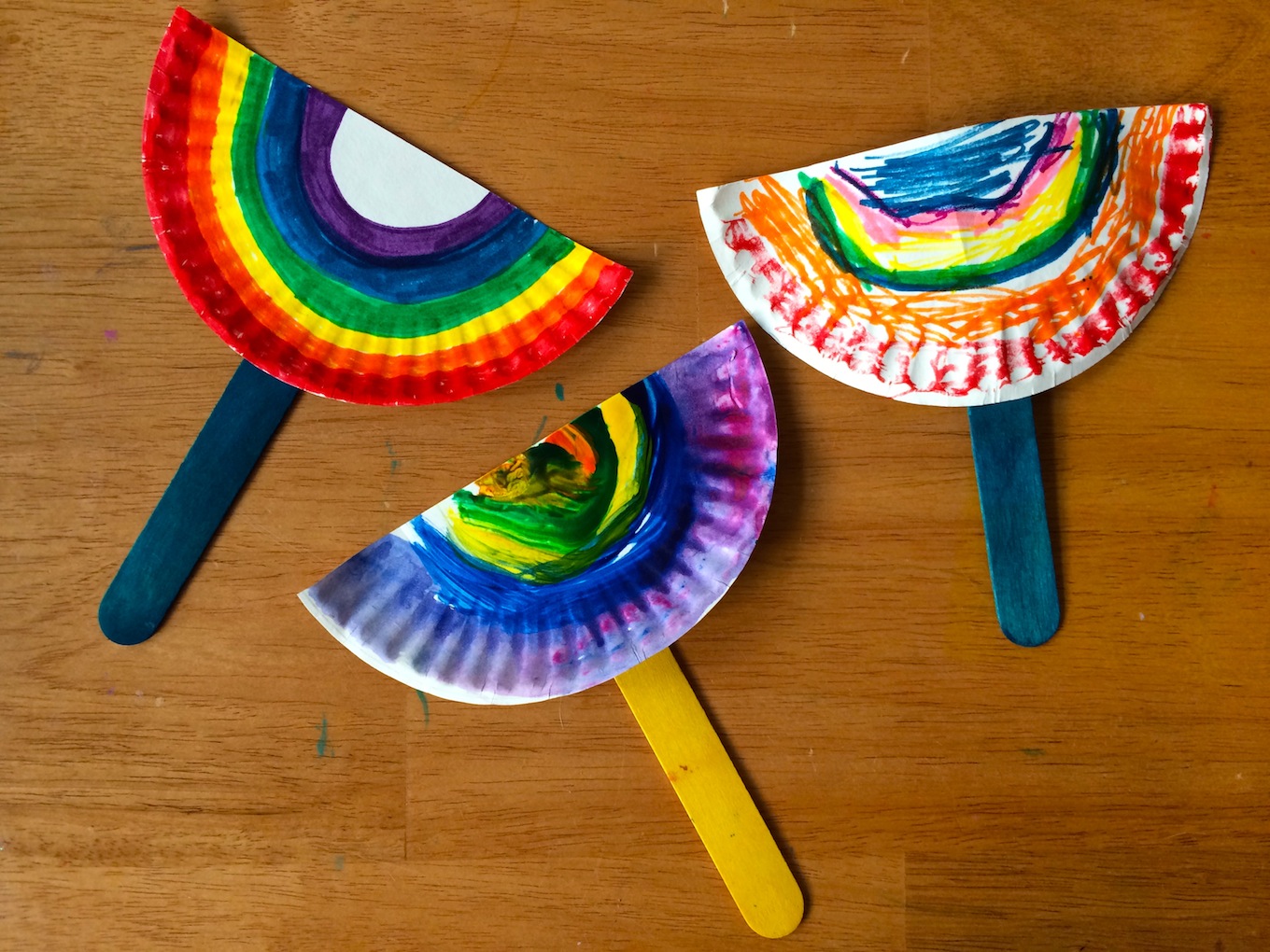
Make rainbow smiles on sticks!
Supplies: 6” lightweight white paper plates, cut in half and trimmed in the center to create a rainbow curve; markers; colored jumbo craft sticks (6“x ¾”); double stick tape.
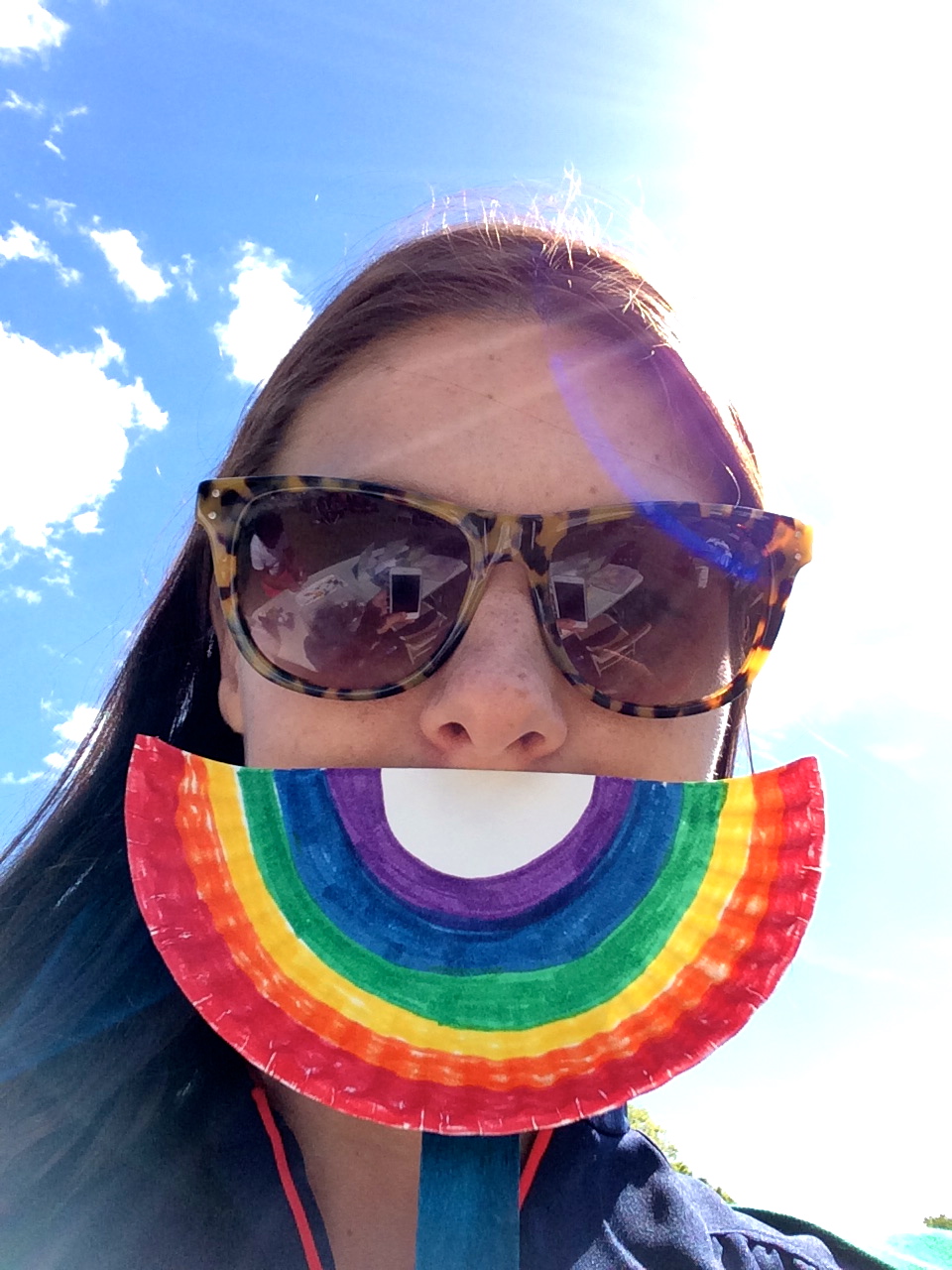
Color your rainbow, turn it upside down into a smile, and tape it to the end of a stick. You could also make a starry night smile, or a flower power smile, or a scribble and spot smile, or a letters and numbers smile, and/or any kind of smile that makes you smile!
Use your smile to keep yourself happy! Stand in front of a mirror and hold it up to your face.
Use it like a puppet and make it dance to music.
Use it to make up a story about anything that comes into your head!
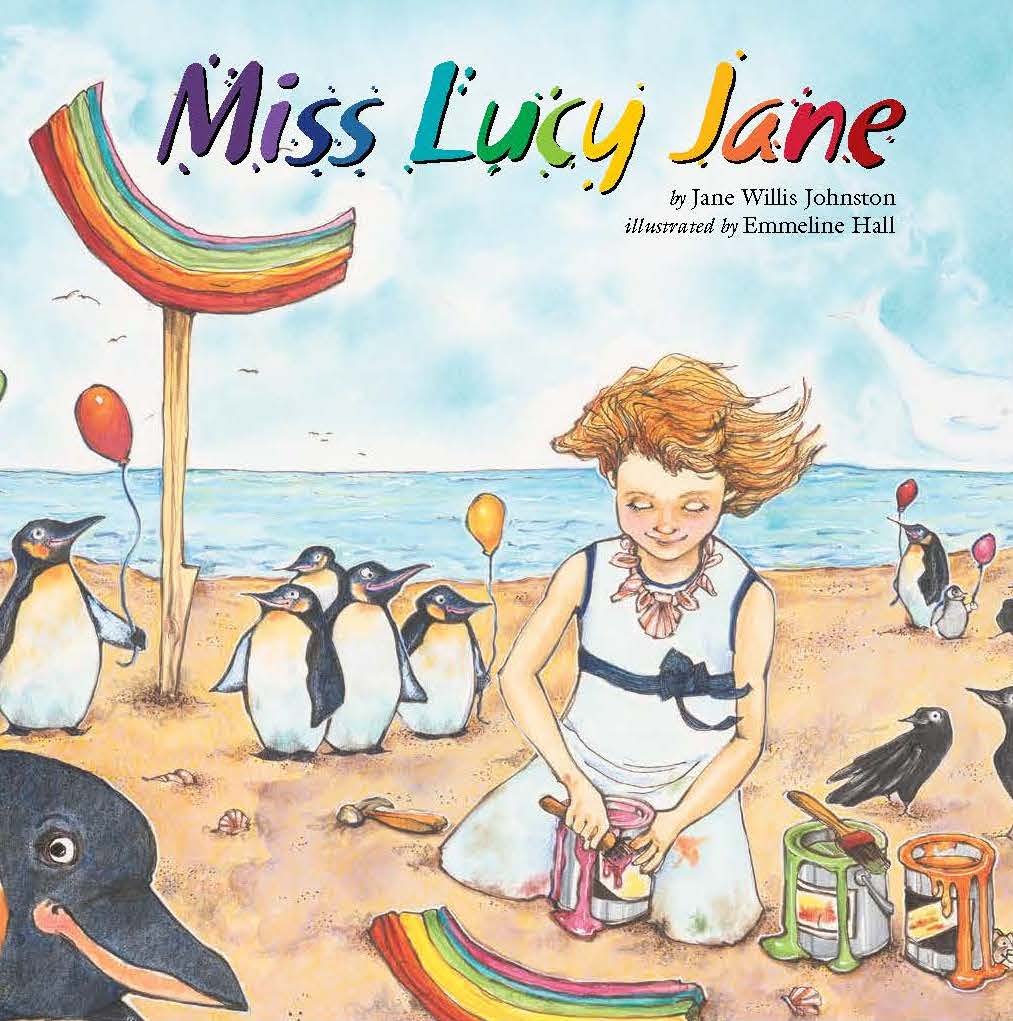
Miss Lucy Jane by Jane Willis Johnston, illustrated by Emmeline Hall is available for purchase on Amazon or by emailing the author.
Rainbow smiles and many thanks to Jane for sharing the wonderful world of Miss Lucy Jane with us!
26
Aug
3 Magical New Pictures Books
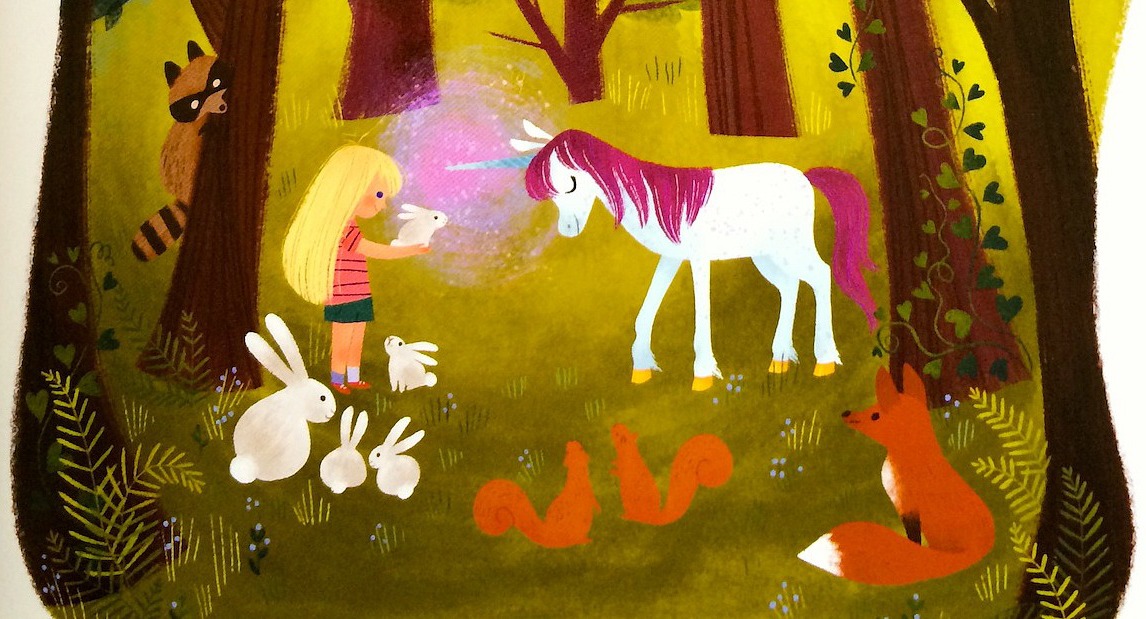
As with most children (and adult children), magic is pretty much the best thing in the world. Picture books featuring mermaids, unicorns, dragons, or fairies are an automatic win. This fall, there’s a surge of unique stories with magical creatures so full of imagination and wonder that really go above and beyond. Notably, Julia’s House for Lost Creatures by Ben Hatke, Uni the Unicorn: A Story About Believing by Amy Krouse Rosenthal illustrated by Brigette Barrager, and Day Dreamers: A Journey of Imagination by Emily Winfield Martin.
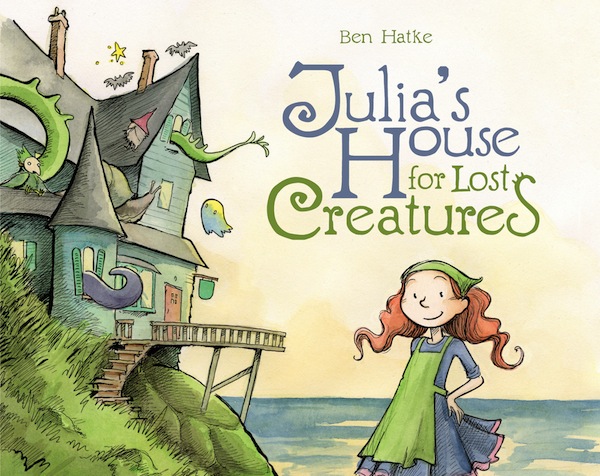
Julia’s House for Lost Creatures
by Ben Hatke
Ben Hatke, author of graphic novel awesomeness Zita the Space Girl series, has a much anticipated picture book out early September, Julia’s House for Lost Creatures! It all starts when Julia moves to town (her house rests on a giant turtle!?!?!). Once she settles in, she feels it’s a little too quiet for her liking, so she decides to transform her house into an inn for lost creatures. All too soon her house is flooded with a troll, folletti, goblins, ghosts, a mermaid… You name it and it was living at Julia’s house causing a ruckus.
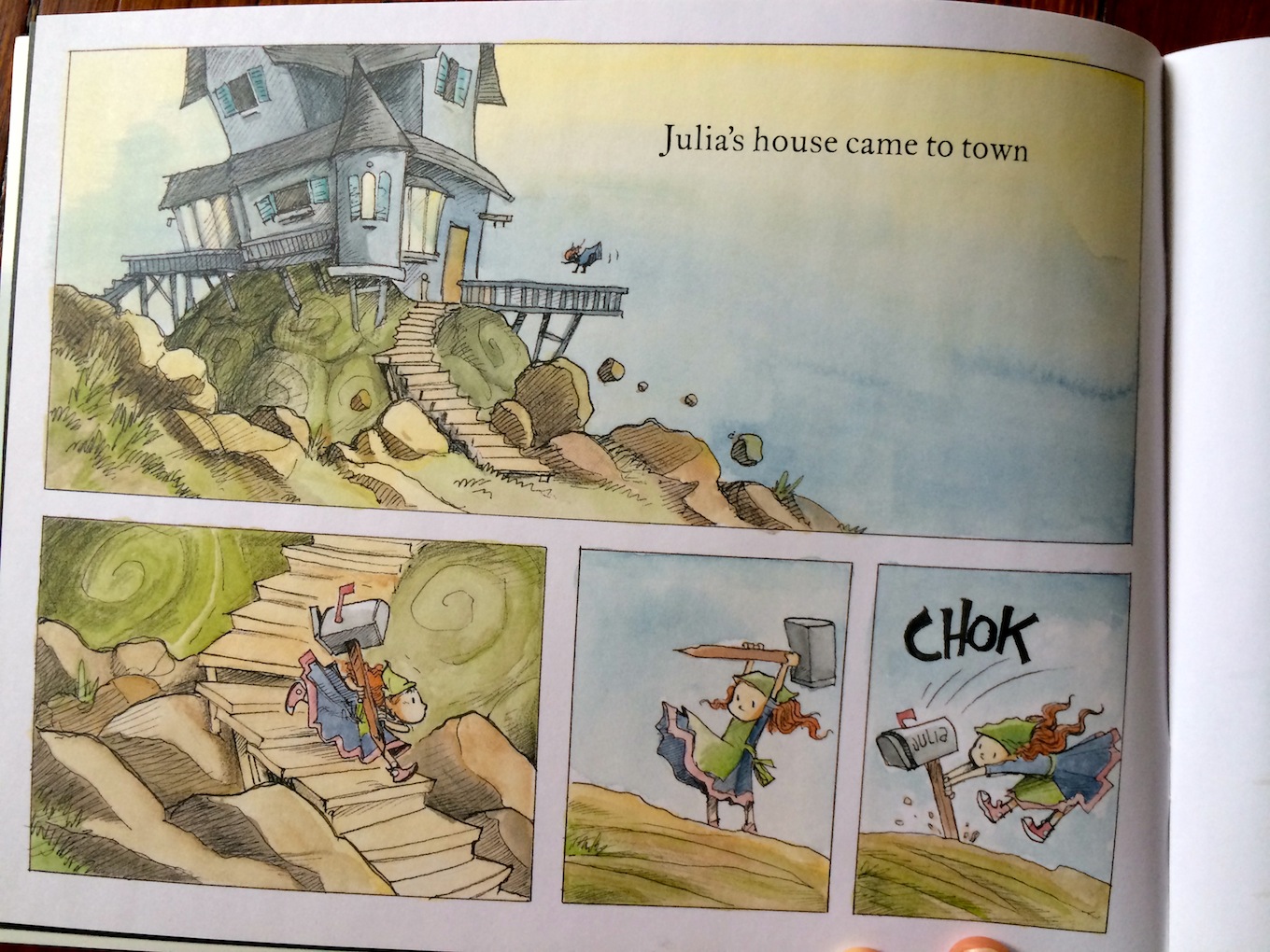
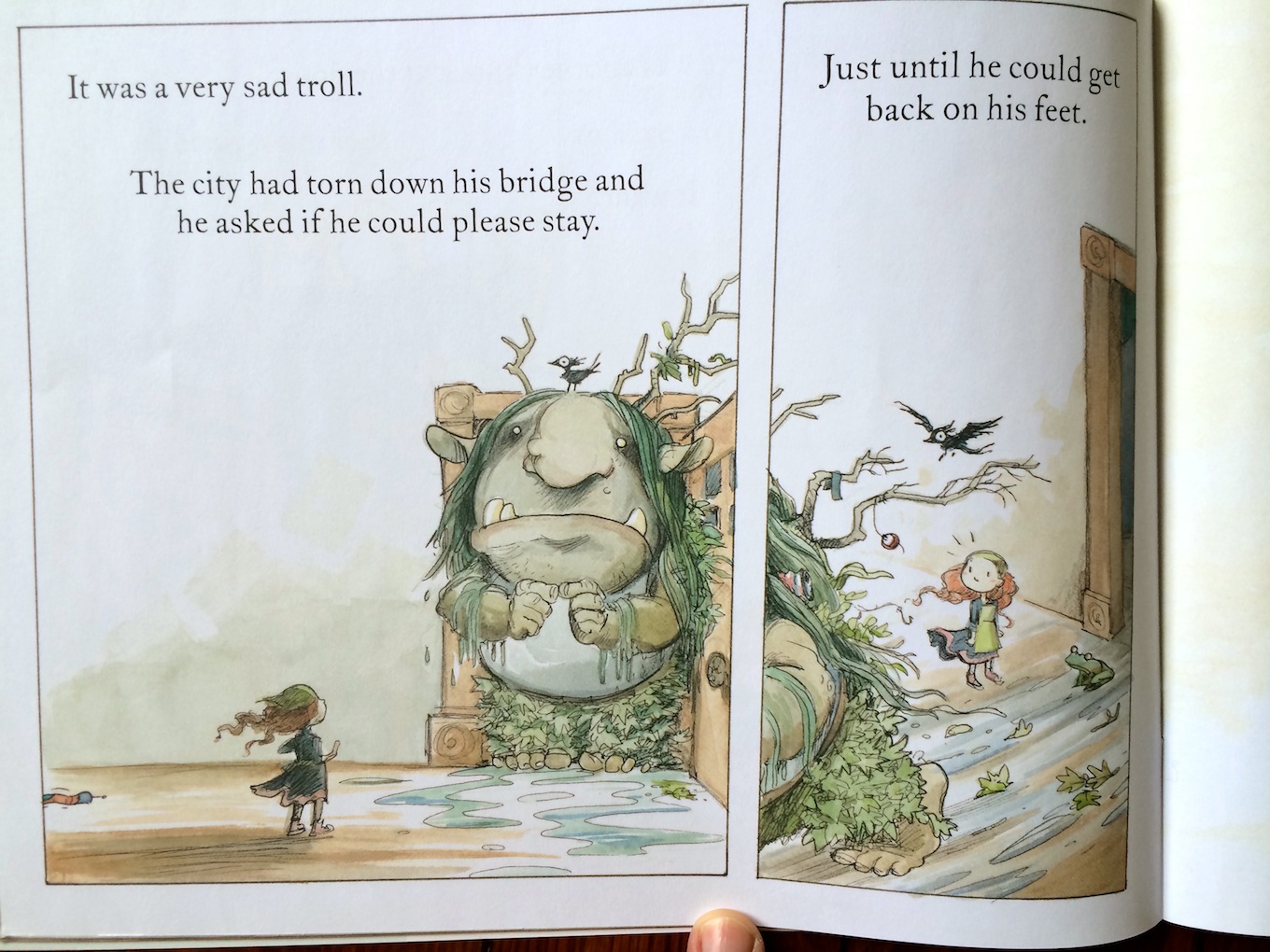
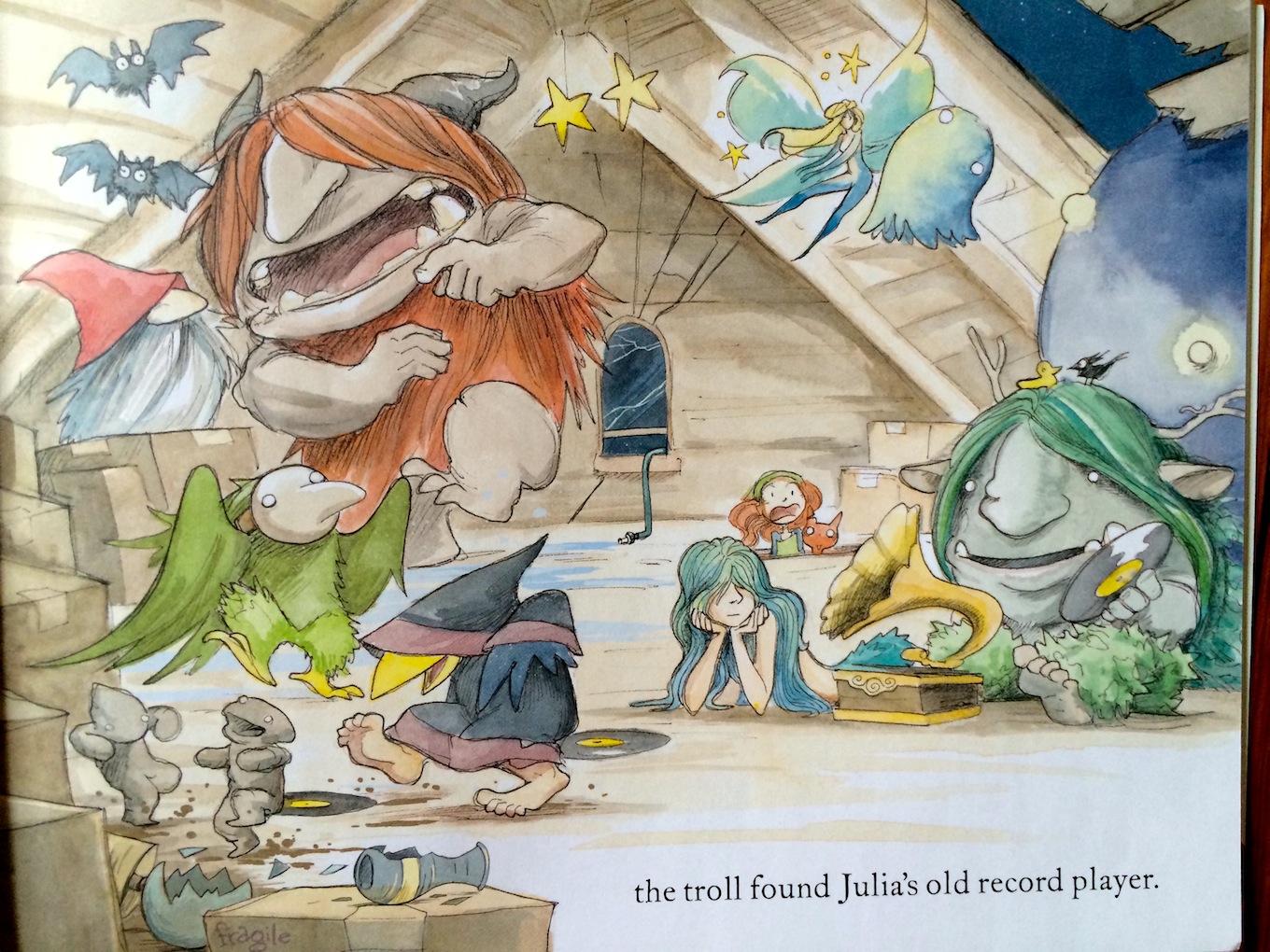
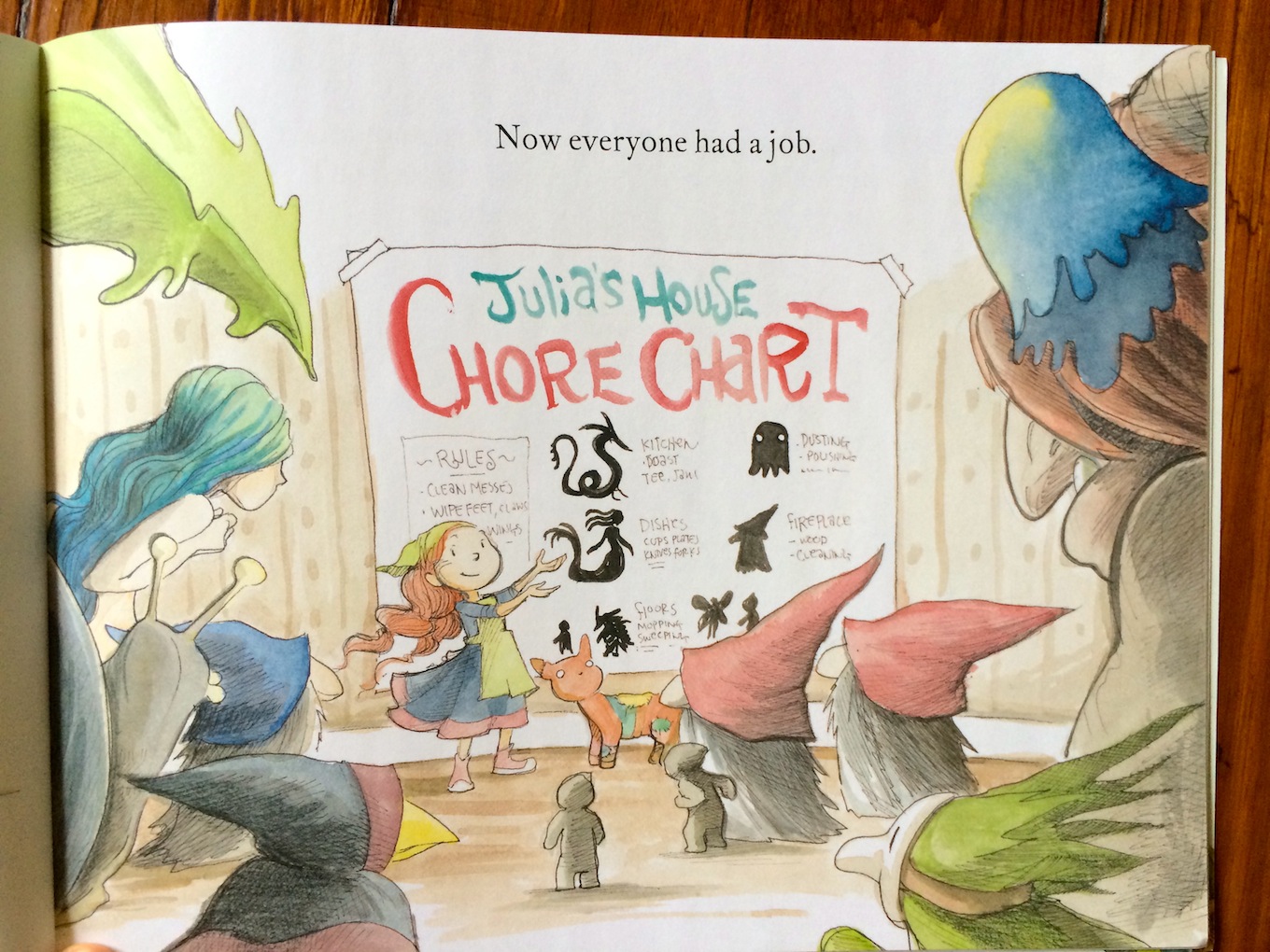
To tame the wild rumpus, Julia devices a clever plan to add a little order to her fairyland woes. I’m such a fan of Ben Hatke and am just thrilled with Julia’s House for Lost Creatures. I 100% plan on using it as a tool to discuss chores with my own kids. It;d also be a phenomenal book for preschool or early elementary grades to talk about classroom jobs. Highly recommend!
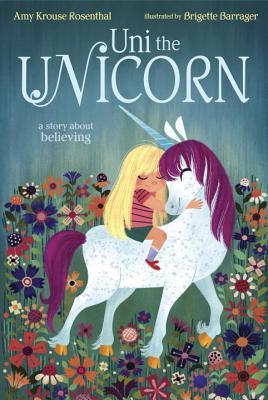
Uni the Unicorn: A Story About Believing
by Amy Krouse Rosenthal, illustrated by Brigette Barrager
I grew up loving unicorns, and regardless of what anyone said a little part of me did, and always will, believe they exist. Uni the Unicorn is a darling tale by Amy Krouse Rosenthal and about just that same faith in the impossible. In a lot of ways, Uni is just like other unicorns, a swirly horn, the power to heal, and the ability make wishes come true. But despite what her friends and parents said, she believes with her whole unicorn heart that little girls are real. And so the reader follows Uni’s dream of all the fun things she and her best friend, this very real little girl, would do together if someday they happened to meet.
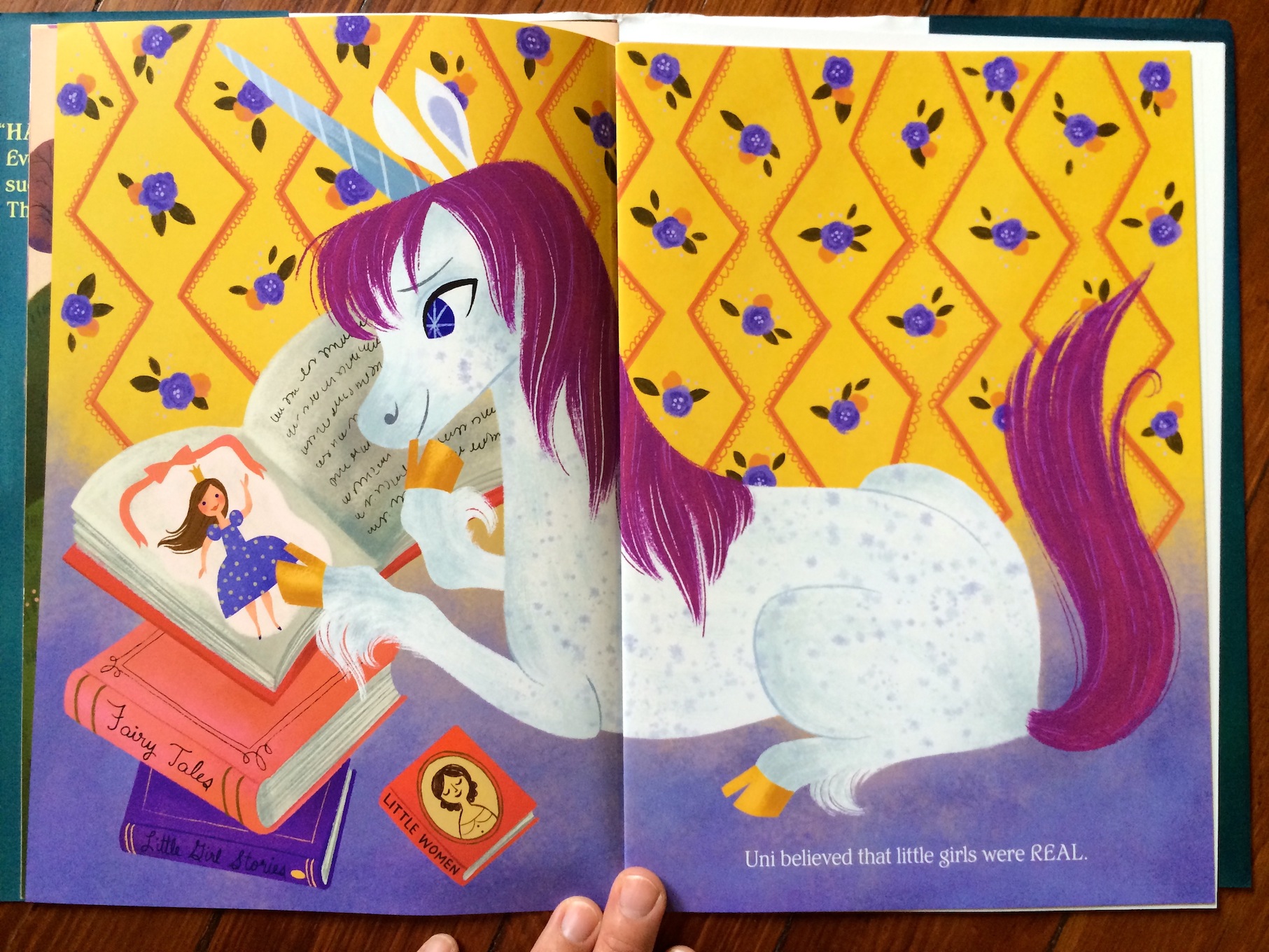
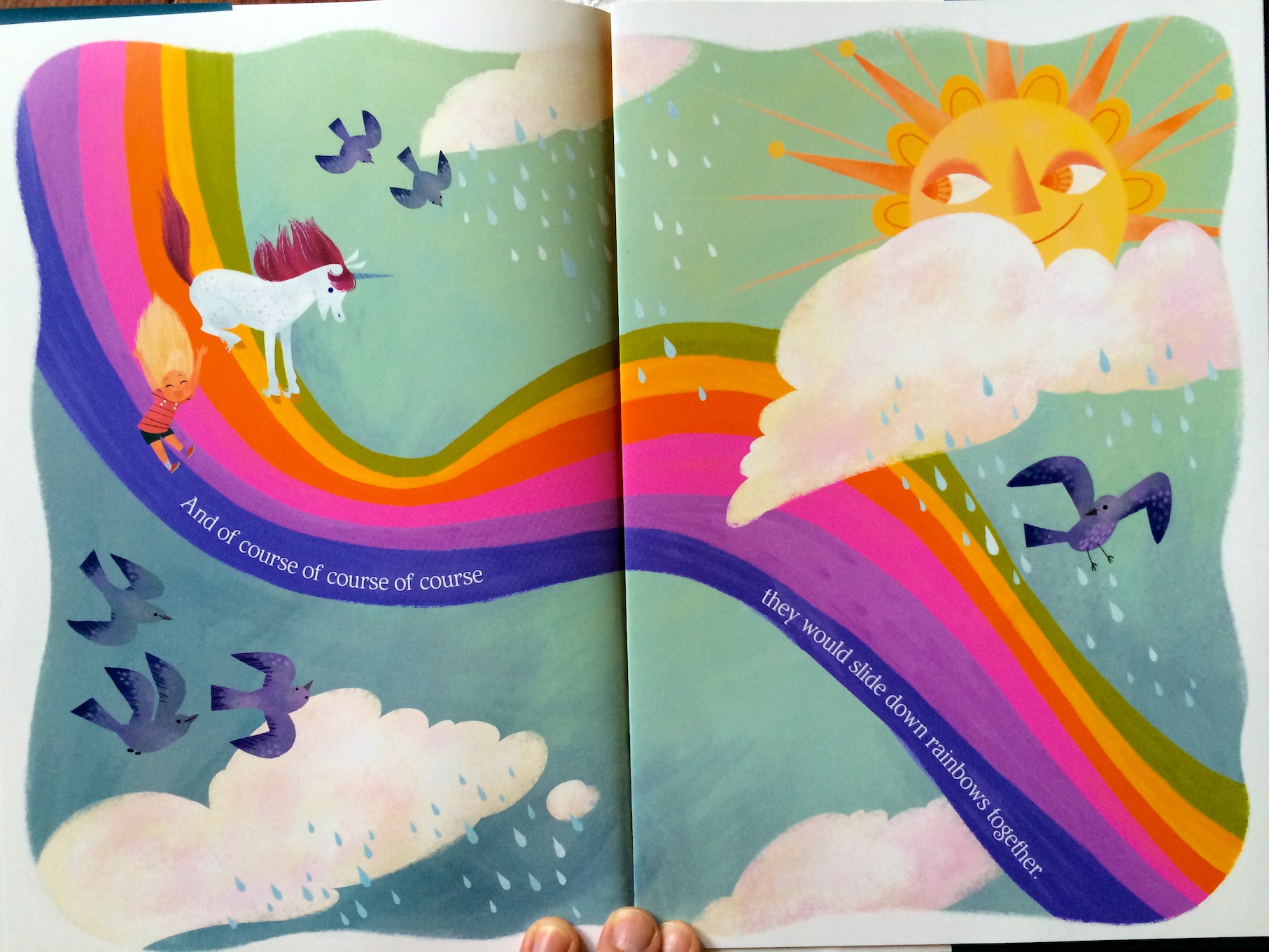
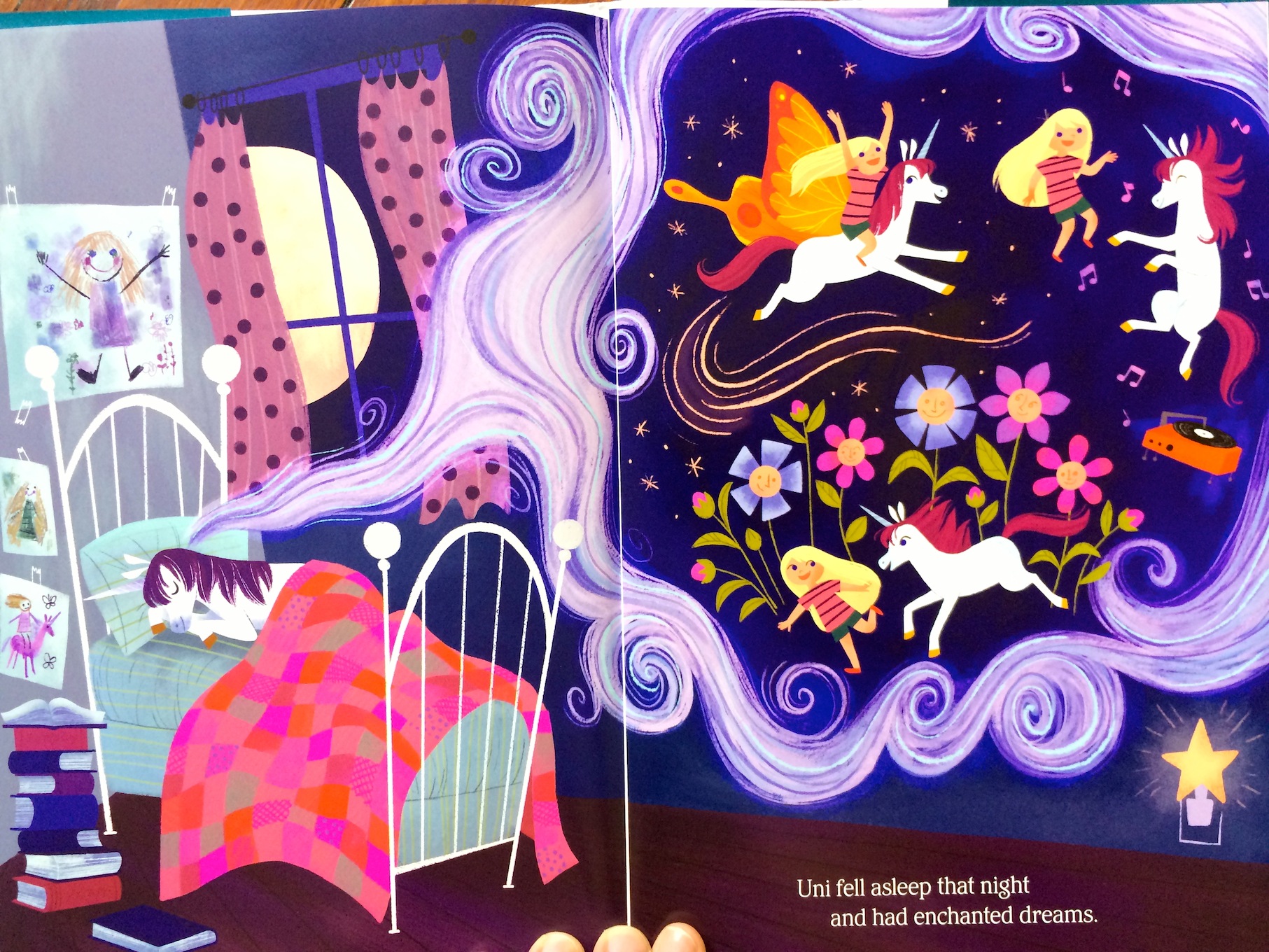
The illustrations by Brigette Barrager are like sliding down rainbows, whimsical and vibrant, and the story is a sweet as pink rock candy. It’s anything a child (or grownup child) could ask for in a unicorn story.
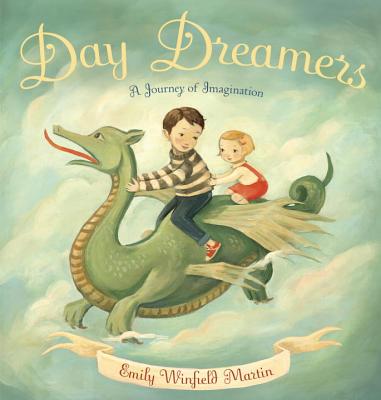
Day Dreamers: A Journey of Imagination
by Emily Winfield Martin
“They say there are no dragons left / And that’s the way it seems. / To find them you must visit / The land of waking dreams.” The open line of Emily Winfield Martin‘s Day Dreamers: A Journey of Imagination invites the reader to revel in the extraordinary. You never know where you mind can take you or what magical animals you might meet while on seemingly ordinary daytime occurrences. Watching the clouds go by, visiting the beach or the museum, or even reading a book can reveal fantastical possibilities.
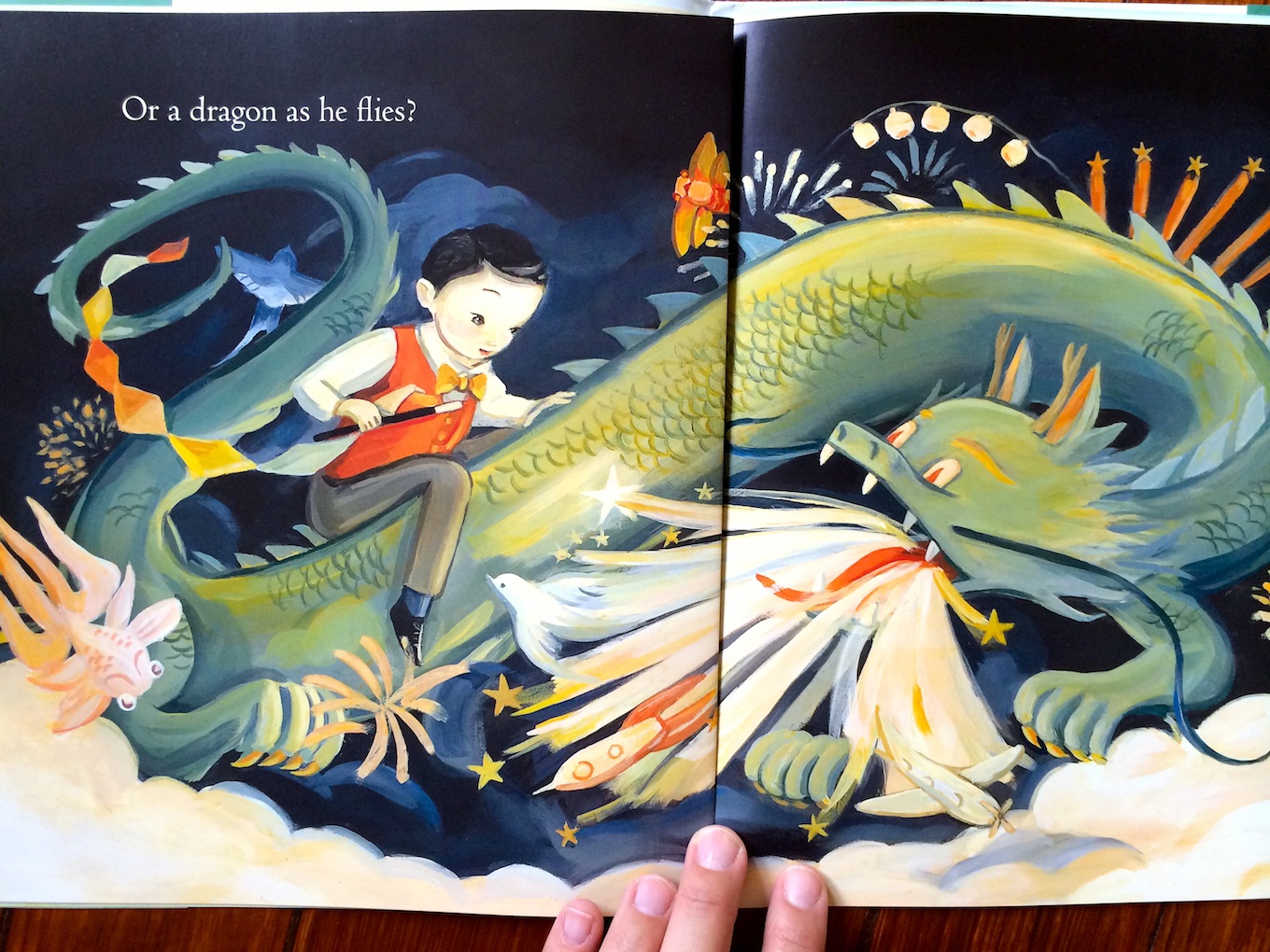
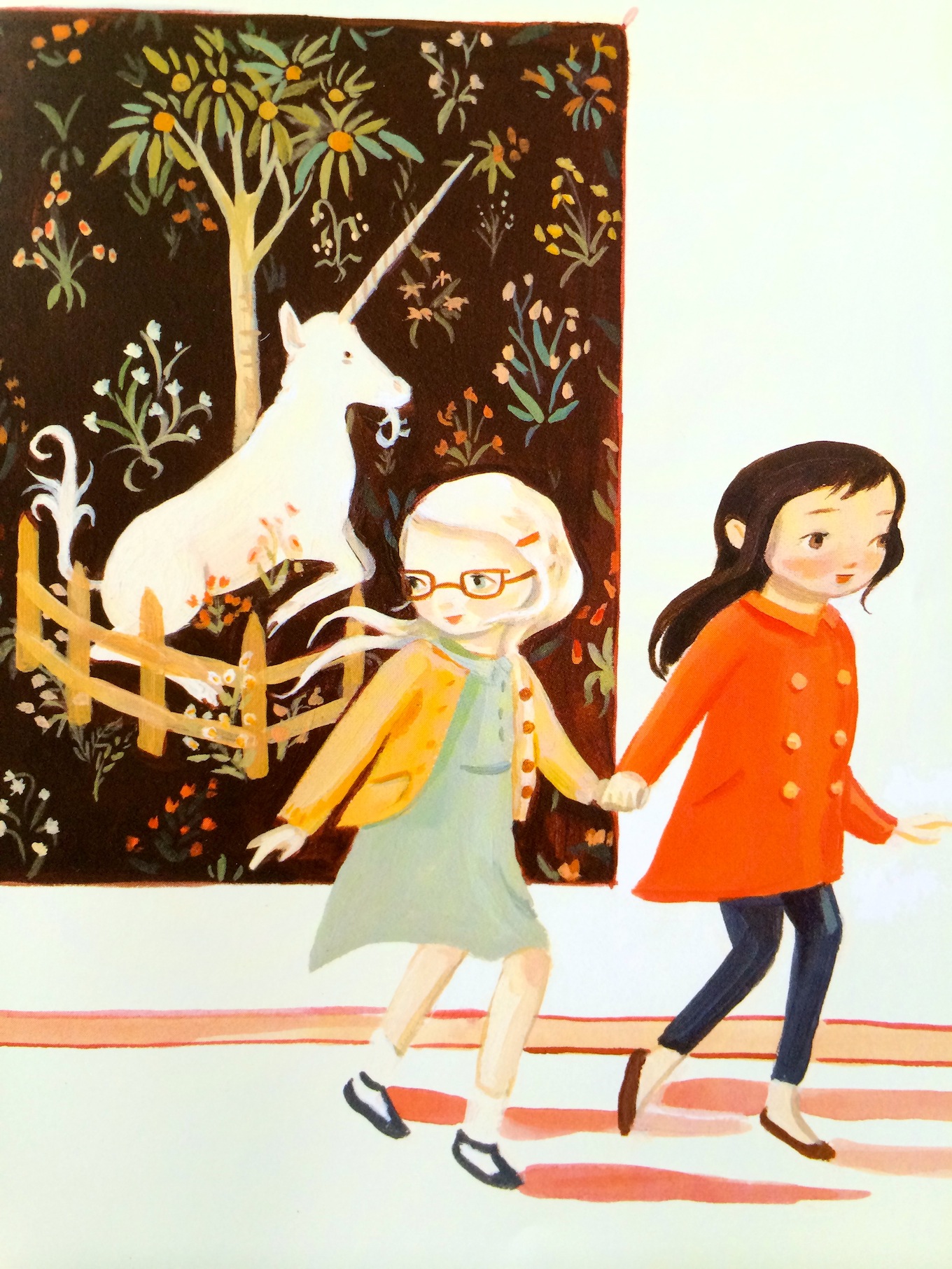
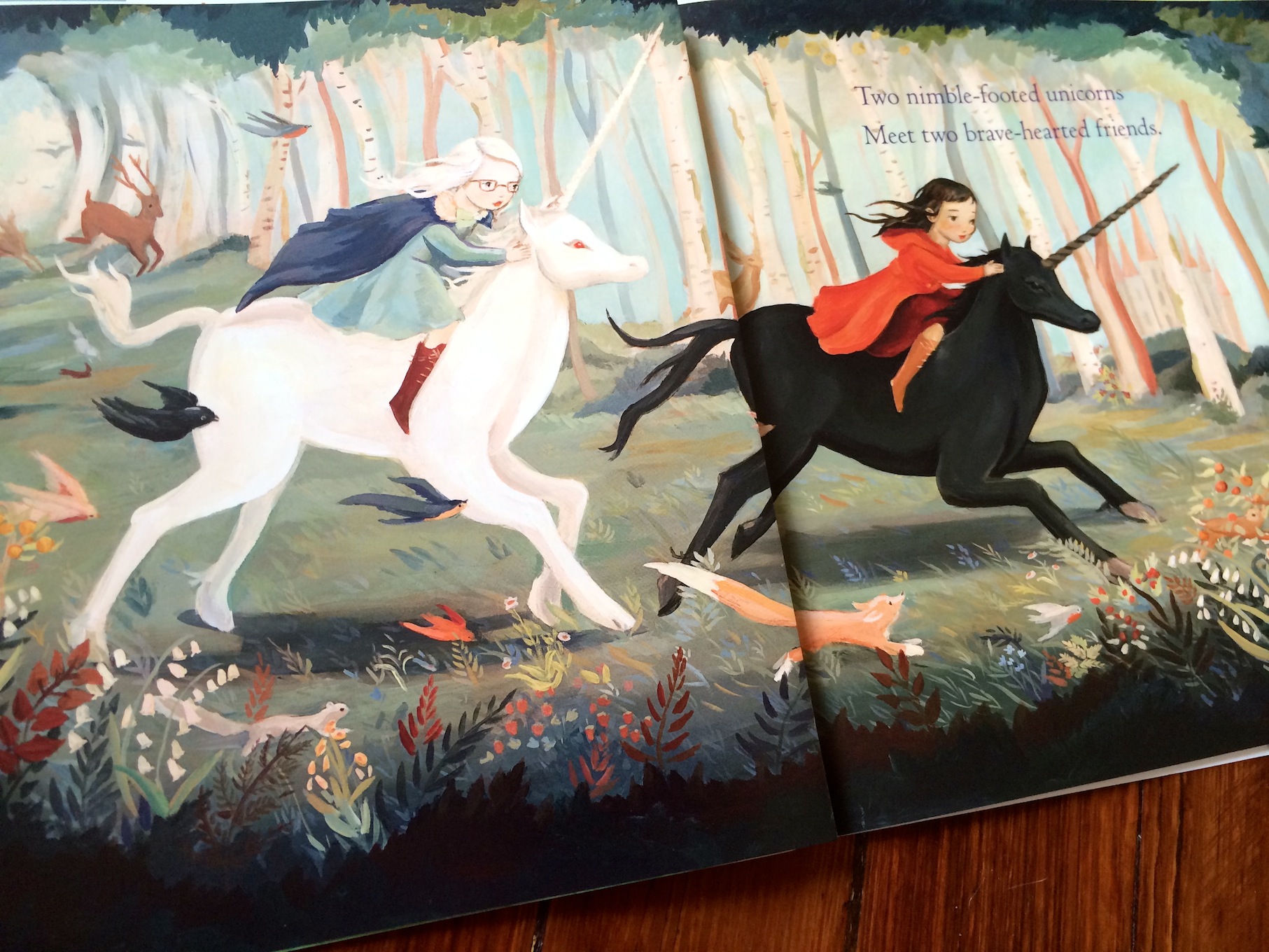
Curiosity of the imagination is a beautiful thing, and this story’s lyrical prose and otherworldly illustrations will surely captivate daydreaming readers young and old.
Source of books reviewed: Review copies provided by the lovely people over at First Second Books and Random House Kids
30
Jul
Author Interview with Natalie Lloyd
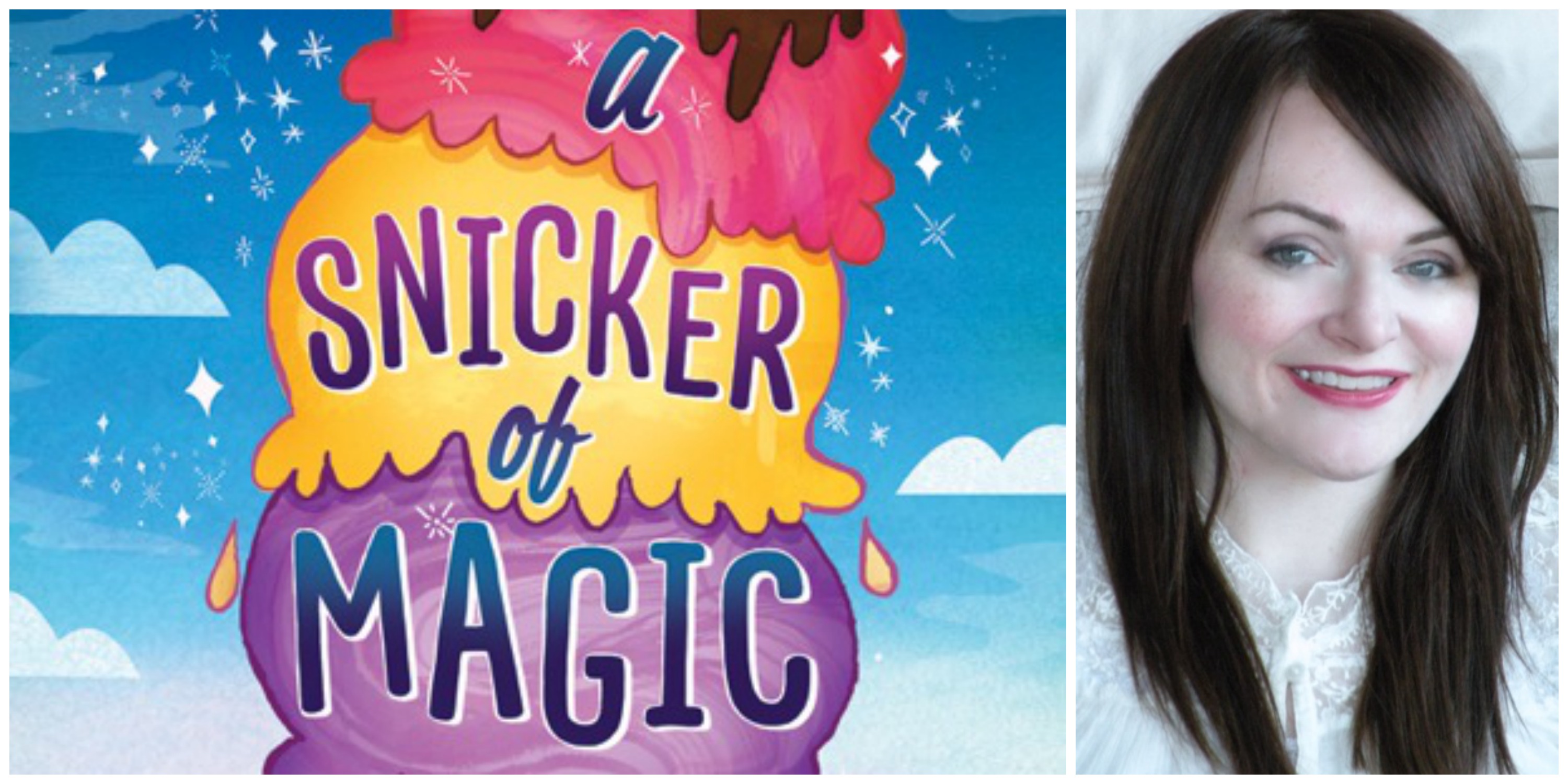
***I’m beyond excited to have Natalie Lloyd, author of the much talked about middle grade novel, A Snicker of Magic, here visiting SfCT today. She’s as enchanting in person as her book and it’s such a treat to feature her! Enjoy! She is magic!***
A Snicker of Magic is your first book and it’s already charmed kids and adults alike. It’s currently voted #1 on this Goodreads 2015 Newbery prediction list and received this stellar review in the New York Times. Was this success foreseen in your childhood daydreams? When and how did you decide to become a writer?
Since I’ve been old enough to daydream, I’ve wanted to be a writer. But actually being a novelist definitely seemed like the kind of dream that was too good to ever come true. I still can’t believe I get to do this. I’m grateful anyone would take the time to read Snicker and overwhelmed (in a good way) by the creative ways readers have taken the book into their hearts.
I always tell students that I became a writer because I love to read. Reading was a fun escape for me that brought so much joy. But books also helped me find courage and find my voice. When I was in elementary school, I started writing short stories and poems. I’m so lucky that my parents and teachers encouraged me to keep writing. Writing gave me room to unpack my heart, to wonder and daydream in a new way. Then (and now!), I was shy about sharing my work with anyone. But I enjoyed that part of it too; I liked the thought that something I’d written could give someone a little burst of joy.
When I graduated from college, I think I believed *any* kind of writing would scrape the creative longing in my heart. I studied Journalism in college and wrote non-fiction after that. I worked at a church for a bit writing curriculum. I worked at a small publisher writing press releases. I’m grateful for all those opportunities. But writing fiction was always my first love. This sounds cheesy, but I finally realized life was too short not to at least try to share my fiction. Middle-grade novels have long been my favorite, so I’m not surprised I like writing from a young character’s perspective. I like writing hopeful, geeky characters who are brave enough to wear their hearts on their sleeves. And I like vibrant, playful language. I think both of those elements make writing middle grade fiction so creatively satisfying. Plus, I vividly remember my middle-school years. I remember the awkwardness and anxiety, and I remember the way wonder seemed to flutter at the edge of every situation.
Sometimes young readers ask me if I believe in magic. In some ways, I do. I believe love is better than magic. Or maybe I should say love is the best magic. And I believe in the kind of magic that enables you to crawl inside a book and live there for a few hundred pages. I know how to tuck memories into books like bookmarks. I know what it’s like to find courage in a story, and then press that courage against my heart, permanently, once the story is finished. Reading is an amazing magic that I’ve felt and love. And sometimes, every now and then, writing feels like magic, too.
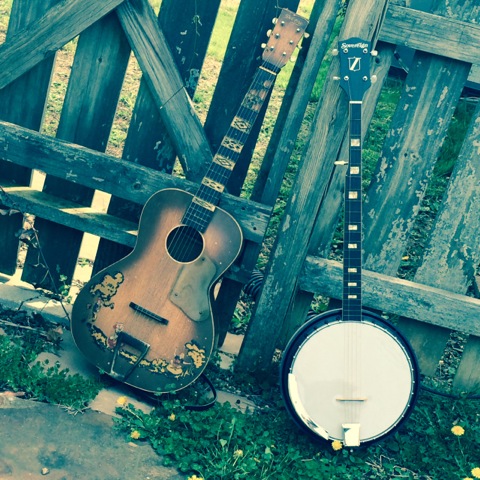
The inspiration behind A Snicker of Magic came from one spectacular evening of seeing the Avett Brothers perform in concert. What about that experience gave you what you needed to weld together the wonderful world of Felicity Pickle and Midnight Gulch? (Bonus question: Do you have a favorite song? Mine is “January Wedding”)
I love meeting other Avett fans! And “January Wedding;” my word. My favorite lyric is: “I was sick with heartache, and she was sick like Audrey Hepburn.” The Avetts have been my favorite band for years, and I was thrilled when I finally got to see them live. As soon as the lights dimmed and the first lick of a banjo singed the air, I felt chill bumps ripple up and down my arms. The music started, and people began dancing in the aisles. They were dancing with each other. They were raising their hands and spinning in circles. People screamed out beautiful, meaningful lyrics. And it was a sweet thing to see; people who were so different, who believed different things, with so many different backgrounds, all coming together under this magical banner of music. I told my brother it felt more like a magic show than a concert, which is where an early seed for A Snicker of Magic was planted.
It wasn’t until later that I realized I’d also written Snicker because I missed my grandparents. They’ve all passed away now, but I was so close to them. My grandfather played a guitar and a banjo. Whenever my brother plays those instruments now, it’s never just music I hear. I hear sunlight and summer days and cowboy boots tapping the porch. And I remember how happy I felt whenever I was around them; what it felt like to be totally, unconditionally loved. One of my grandmothers was a talented quilter. I remember stitching together a quilt with her (she called it a “cobblestone” quilt). Then we looked through old black and white pictures, ate oatmeal cakes, and watched Double Dare. My other granny loved poetry. For Christmas one year, she gave me a stack of her favorite poetry books. She left notes in the margins about why she liked some of them, and I remember thinking it was like she’d pressed memories in the book for me to find.
Ultimately, I wrote A Snicker of Magic because I was homesick for people I love and miss. In the story, Felicity gets to experience what it’s like to hear the word “home” and think of people, not just a place. I felt that way while I was writing.
Oh! My favorite Avett Brothers song is “Swept Away.” And my heart breaks (in a good way) anytime I hear, “If it’s the Beaches.”
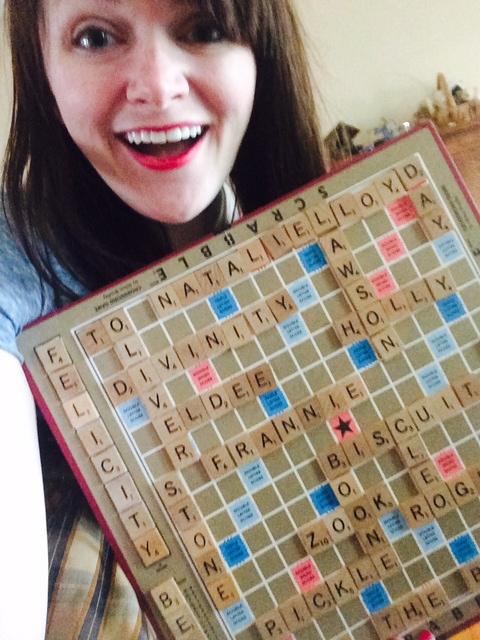
In A Snicker of Magic (and in life!), magic happens if we will it and believe in it. In my opinion, you have willed magic into being by writing this story. Can you share some of the responses you’ve received from kids reading your book?
Thank you so much! When a young reader tells me they actually finished the book and enjoyed it, I’m thrilled. I know readers have so much competing for their time and attention. I’m amazed they’d take the time to read Snicker, and that teachers are bringing it into their classrooms.
Several students have shown me their word collecting notebooks. One reader sent me a poem she wrote from Felicity’s perspective. A girl told me that she asked her teacher to draw Oliver’s bird tattoo on her wrist during a spelling bee, and it gave her courage. I was doing a Q&A via Skype last week, and a student said, “I don’t have a question. I just wanted to say thank you because the story gave me confidence.” That’s the sweetest thing to hear. Felicity (my main character) and I both have this in common: we’re quite shy, and fearful about many situations. And we love words, but we both know what it’s like to be afraid to share those words. I love when readers leave Midnight Gulch excited to share their voice. When they’re encouraged by the fact that their words are so important.
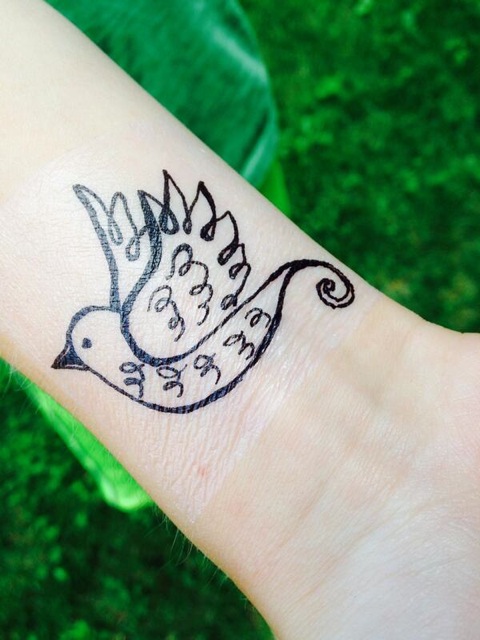
“A girl told me that she asked her teacher to draw Oliver’s bird tattoo on her wrist during a spelling bee, and it gave her courage.”
One of the sweetest surprises that came out of this process has to do with The Beedle. In A Snicker of Magic, The Beedle is an anonymous do-gooder who has been doing nice things all over town for 50+ years. Readers have really connected with that character. A class I met at a library presentation in Ohio told me they had a Beedle in their classroom who leaves sweet notes around the room and new books in the classroom library. When their teacher took a group photo, someone whispered in my ear, “I’m the Beedle.” Another reader emailed to tell me she was The Beedle in her hometown one weekend, and sent me pictures of some of the sweet things she did. I heard from a teacher in California that the Beedle came to her classroom this week, leaving notes and a quarter on each student’s desk so they could buy suckers. I shouldn’t be surprised young readers connect to that character; kids are kind and creative and have a way of looking for the best in a person. But I am absolutely floored by it. I love those stories so much.
If you were to submit an ice cream flavor recommendation to Dr. Zook’s Ice Cream Factory, what would the flavor be?
Fun question! I think Dr. Zook’s needs an “ice cream” for dogs. Dogs can’t have dairy, of course, so it would have to be some sort of funky concoction that looked like ice cream but was super healthy for K-9’s. I’d call it Biscuit’s Peanut Butter Banana Smash. My flavor would probably be Natalie’s Neon Strawberry-Pistachio Surprise. And it would make your smile glow in the dark for a few hours after you finish eating it.
What books did you read as a child that have stayed with you and influenced who you are today?
So many! The Lion, The Witch, and The Wardrobe is one of my forever-favorite books. The Narnia series is so special to me. I’m a big fan of Roald Dahl, especially The Witches. And I still have the entire Anne of Green Gables series in a special place on my bookshelf. I love that series so much that my parents saved up and took my family on a road trip to Prince Edward Island when I was in college. I also adored The Babysitters’ Club. That series made me a voracious reader.
What books are currently on your TBR pile?
Some books on my TBR mountain include: Amber Turner’s Circa Now, Aaron Starmer’s The Riverman, and Jess Keating’s How to Outrun a Crocodile When Your Shoes Are Untied. I’m also so lucky to have read an early copy of Mike Curato’s picture book Little Elliot in the Big City. It’s a dreamy, beautiful book about friendship (and how just one true friendship can make you feel at home in an intimidating place). I can’t wait to share it with people I love. What about your TBR pile?
RDZ: I haven’t read any of those yet! They all look awesome! A few days ago I finished Brown Girl Dreaming by Jacqueline Woodson. Beautiful, beautiful, beautiful book. Up next is Cartwheeling in Thunderstorms by Katherine Rundell and The Turtle of Omar by Naomi Shihab Nye.
When you close your eyes and imagine the most fantastical, spindiddly library, what does that dream library look like?
My mind always goes to a fairytale place, like the library in Beauty and the Beast. I imagine rolling ladders and spiral staircases. I imagine a library where shelves hide secret rooms … with even more books to discover. The library would have painted murals of my favorite scenes in books. And a few dogs who live in the library, of course, and cuddle beside patrons while they read. And window seats where you can hide away on a rainy day.
Really though, I think any library is magical. I love small-town libraries with creaky doors and cracked windows. And I like big-city libraries with mile-high shelves and worn-out books. I think library cards are as precious as passports.
You and I are going to be neighbors soon! I’m moving to your hometown of Chattanooga, Tennessee in June. Is there any magic I should be aware of that lives in those city streets?
There’s so much magic in this city! You’ll see golden dance steps embedded into the sidewalks downtown. You’ll find quirky, delightful treats at places like Milk & Honey, Clumpies, and Rembrandts (I also think the Banana Bread French Toast at Food Works is magical). One of my favorite magical spots is the carousel in Coolidge Park. It’s truly a work of art.
And not everybody will agree with me, but I’m a total nerd for Rock City. I have a yearly pass. It’s so fun; especially around the holidays. They open it at night and string it with thousands of lights. You’ll feel like you’re surrounded by stars.
If you had Felicity Pickle’s sight of words hanging in the air, what words are hovering over you this very moment?
Pioneer
Rebel
Firefly
Believe
Pioneer is actually my word for this year. I don’t do New Year’s resolutions, but my sister and I always pick a word to embrace for the year. We usually don’t know it on January 1 … we wait and watch for the *right* word. A word that seems to echo in books, conversations, just random places. This year my word is pioneer. As I said, I’m quite shy and fearful (like Felicity Pickle). But I love the idea of bravely stepping into new places, and new adventures. My friend Kristen just made me this funky little art out of old typewriter keys:
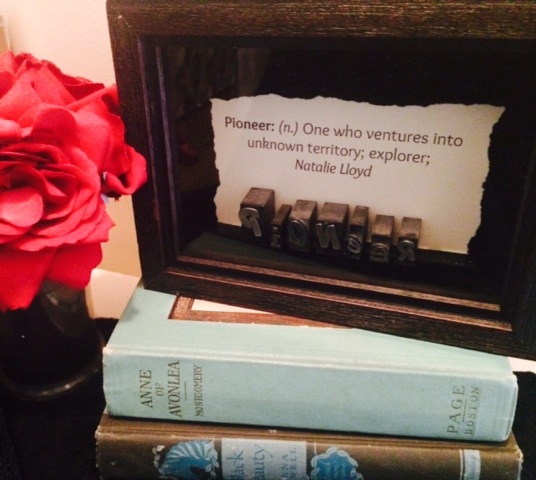
She dug through a barrel in an antique store trying to find the letters she wanted. She said it was so exciting, to have ink up to her elbows. Like she was covered in stories. I love that image.
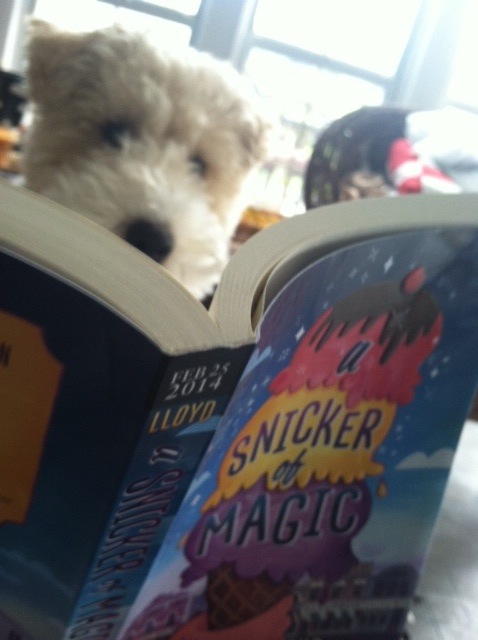
How can the lovely people reading this interview keep follow all things Natalie Lloyd in internetland?
I have a blog (currently functioning as my website) here: http://natalielloyd.blogspot.com
And I love to tweet pictures of my dog, Biscuit: twitter.com/_natalielloyd
And I also have an author page on Facebook: https://www.facebook.com/pages/Natalie-Lloyd/488497067936134
Thank you for taking time to chat about all things writing, books, and magic!
Thanks so much for inviting me over to your blog, Rebecca! I can’t wait to have coffee with you! Welcome to Chattanooga!
29
Jul
Review: A Snicker of Magic
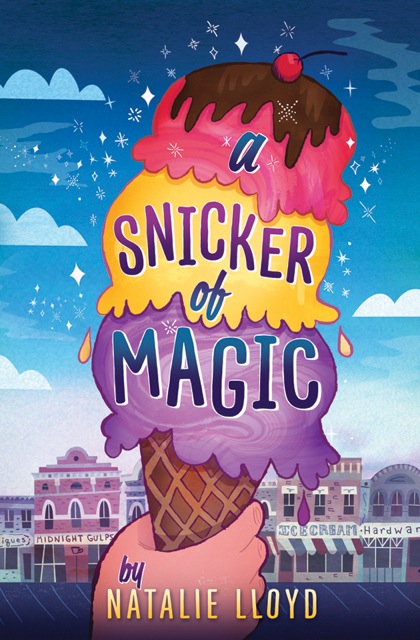
A Snicker of Magic
by Natalie Lloyd
Find it at your: Local Library | Local Bookstore
Published: Scholastic (February 2014)
Recommended reading age: 8 & up
In a nutshell: Two nights ago, there was a lightning storm like nothing I’ve ever seen. The sky was flashing as fast as a strobe light. So much electricity flying around up in those dark clouds. Reading A Snicker of Magic was like watching that night sky.
“They say some people could catch stars in Mason jars. And some people could sing up thunderstorms and some could dance up sunflowers. Some people could bake magic into a pie, make folks fall in love, or remember something good, or forget something bad. Some people had a magic for music…”
I first read A Snicker of Magic before moving to the south back in March. It was a coincidence when I picked it up form the library before we had decided to move to Chattanooga. So, it was serendipitous to find out the author, Natalie Lloyd, hailed from there. It was also served in a lot of ways as a tiny catalyst in deciding to move. Twelve-year-old Felicity Pickle, along with her mom, sister, and dog have had their fair share of moving around. Their next home-place-of-the-moment is Midnight Gultch, Tennessee, a place of magical origins and also her mother’s hometown. But the magic no longer lingers in the streets. It’s lost. A curse removed all the magic, and what remains is a town of the ghosts of what was. But there is more magic in that small town than meets the eye and it starts with it’s residents. This is especially true of newcomer Felicity who can see words hanging, buzzing, spinning, dancing and what have you in places or over people’s heads and keeps them in a notebook. The Beedle, the mysterious town do-gooder who leaves gifts and tokens with the townspeople when least expected. And the delicious Dr. Zook’s ice cream that stays cold for 24 hours and a flavor, Blackberry Sunrise, that has a curious way of surfacing old memories.
Reading this book is like listening to a ballad. The writing is magic itself, and as I read more and more about Felicity, her family, and Midnight Gultch I fell in love with the characters and the story.
I fear this review does not do this book justice. It is something you have to experience yourself.
Extras: Visit Natalie Lloyd at her blog home!
This blog post about the incredible response from kids and adults who have read A Snicker of Magic.
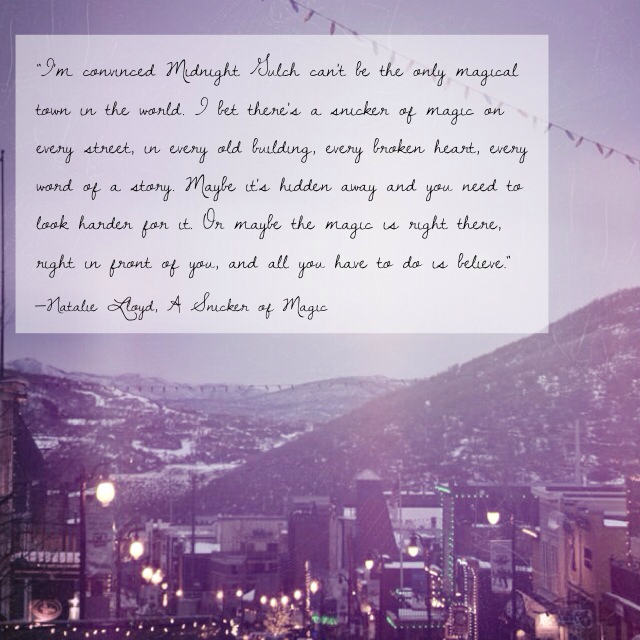
Check out these *fantastic* fan pinboards (here and here and here) inspired by the book, as well as Natalie Lloyd’s pinboard.
BEST PART! TOMORROW! On the blog: An interview with the wonderful Natalie Lloyd!!!
I can hardly wait!
Source of book reviewed: My local library!
19
May
Review: This Book Was a Tree
This Book Was a Tree
by Marcie Chambers Cuff
Find it at Your: Local Library | Local Bookstore
Published: Perigee (imprint of Penguin Group), April 1, 2014
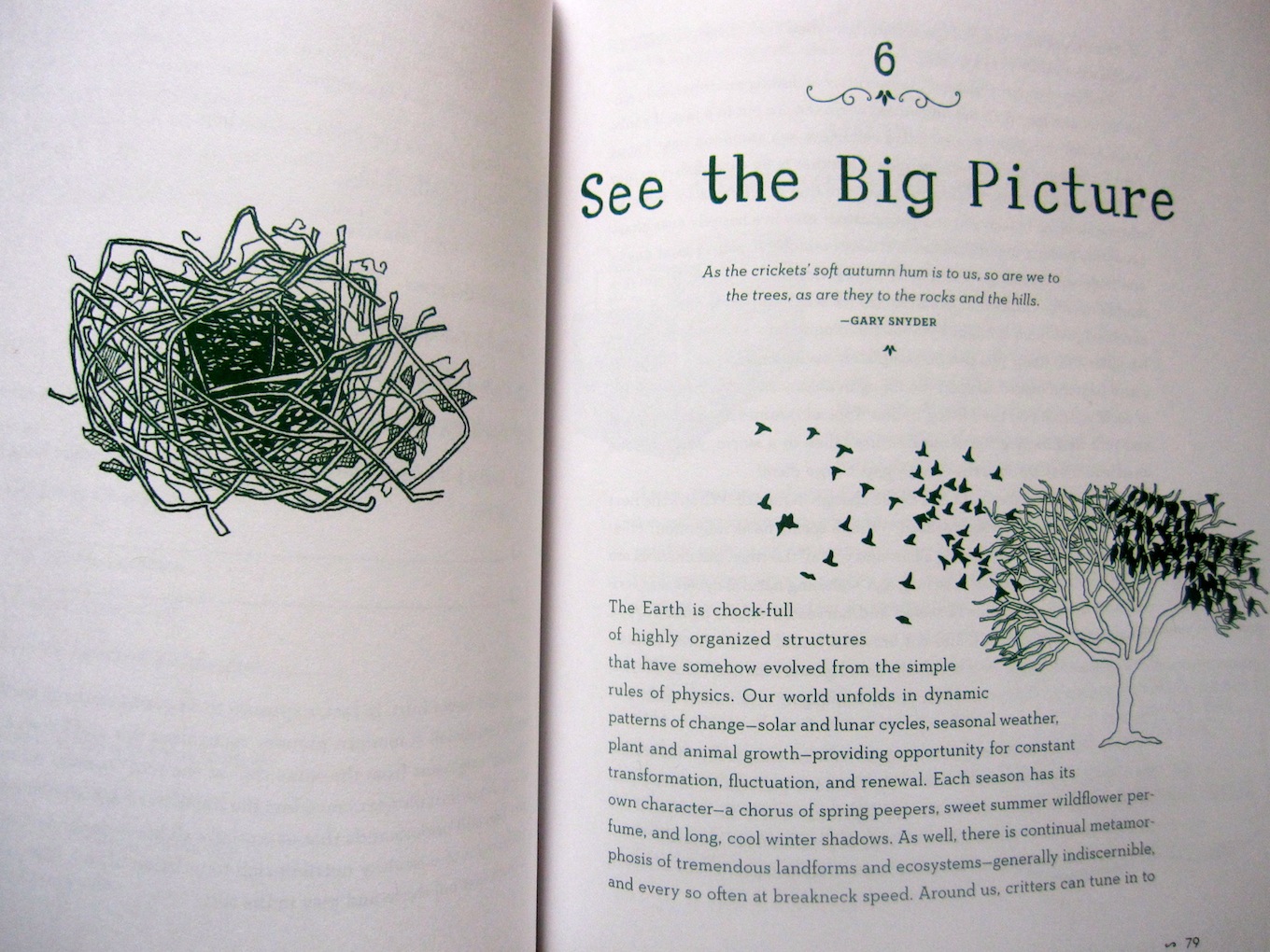
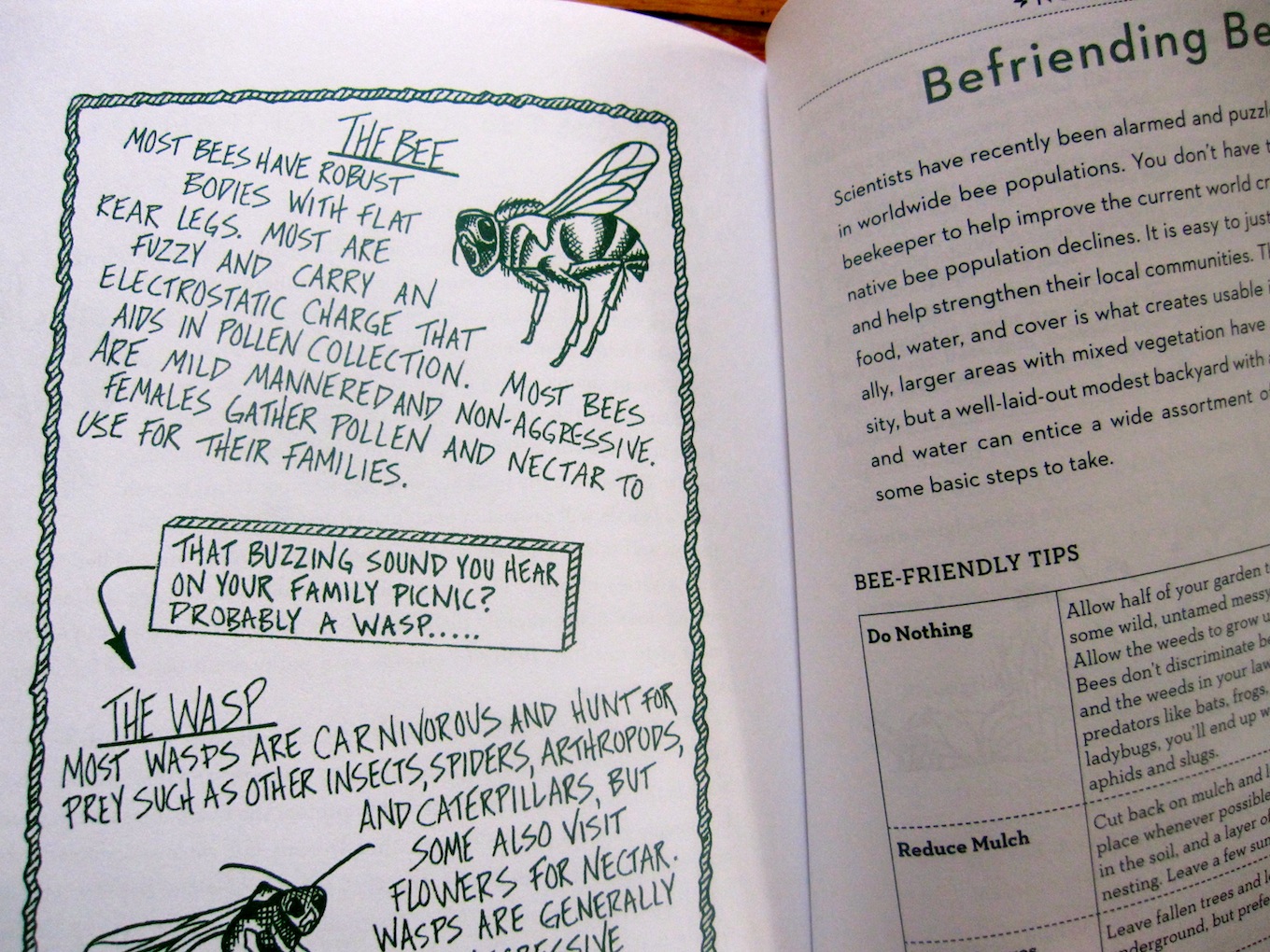
In a Nutshell: This Book Was a Tree: Ideas, Adventures, and Inspiration for Rediscovering the Natural World is science teacher and blogger Marcie Chambers Cuff’s invitation to us all to (re)connect to nature through projects, science, and reflection. When I first started reading this book, I became instantly hooked when I saw phrases such as “explore more”, “think like a scientist”, and “try this”. As someone that works with kids in a public library, this book instantly became a tool of inspiration for future library programming for all-ages. You can find many passive programming prompts for families, as well as ideas for individual programs or even an entire series devoted to connecting with nature through projects and activities. Many of the craft projects such as building a pinhole camera, starting a flower press, or building a bee coop can be achieved by late elementary school-age/middle school-age children and older. Some might need adult supervision or assistance, but many of the projects can also be modified for younger children to complete independently. Activities such as stargazing, exploring, camping in the backyard (even if it’s only for a few hours), agreeing to spend “x” amount of time outside a day, journaling, and collecting can be done with kids as young as preschool-age. What I love most of all is This Book Was a Tree is that it reminds the reader to revel in the natural world and to take time to be outside, continually exploring it. I truly believe learning about science starts with venturing outside. As Carl Sagan once said, “Every kid starts out as a natural-born scientist, and then we beat it out of them. A few trickle through the system with their wonder and enthusiasm for science intact.” And have I mentioned all the sketches are all the author’s own creations? Take a peek:
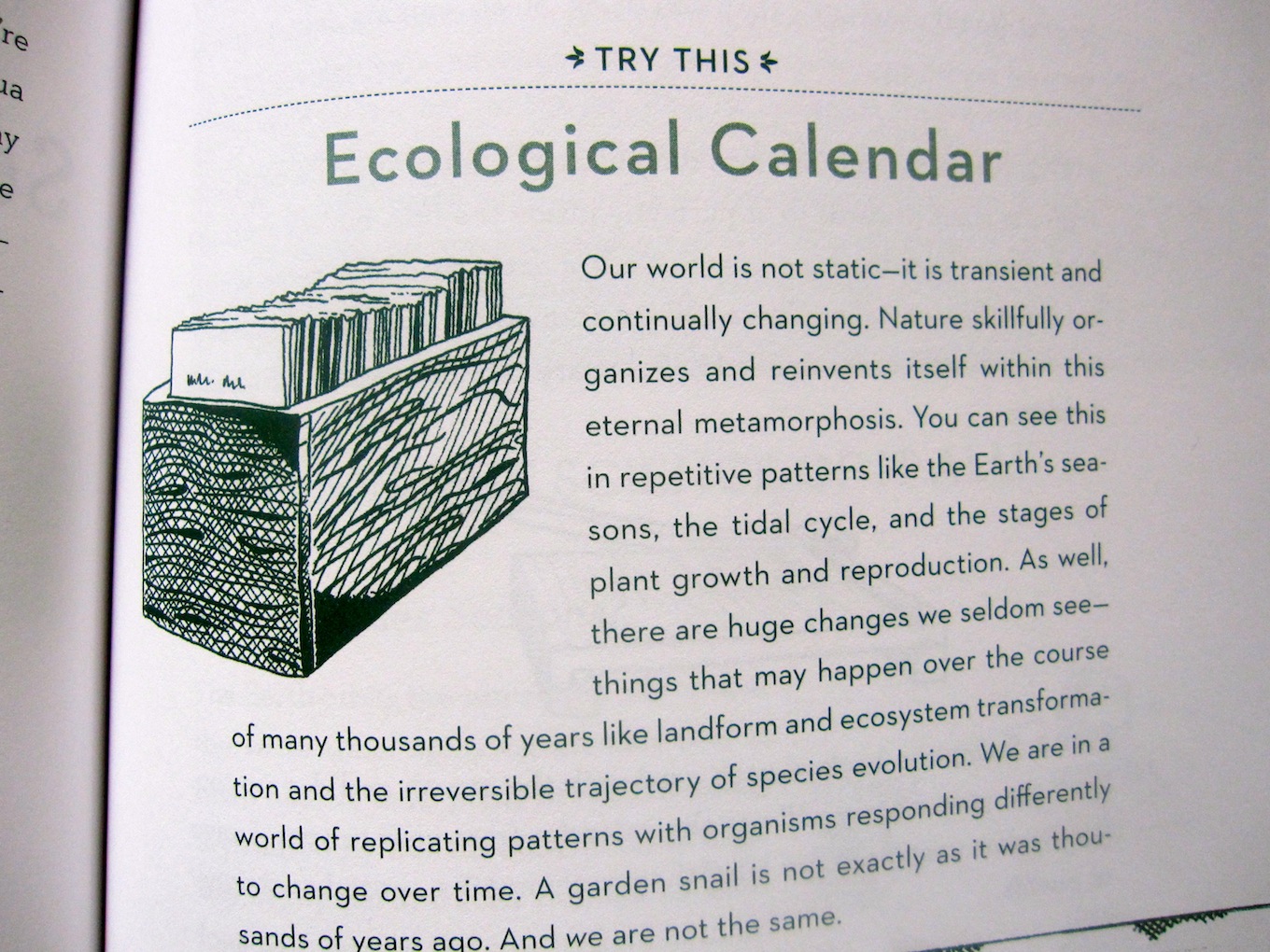
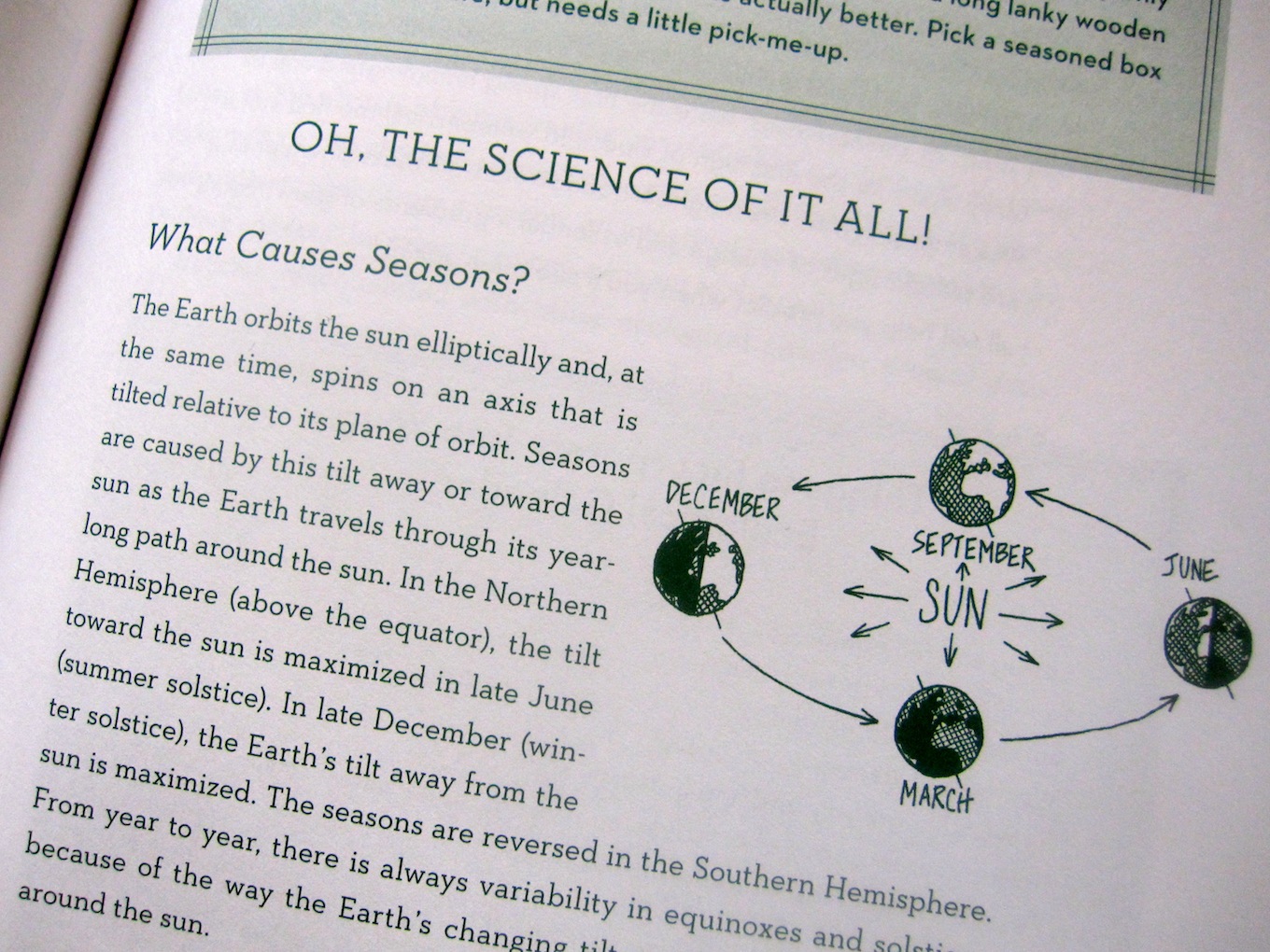
Extras:
Visit Marcie on her website HERE
And on her blog HERE
And this video:
Source of Book Reviewed: Review copy provided by the good folks at Penguin.
5
May
Review: This One Summer
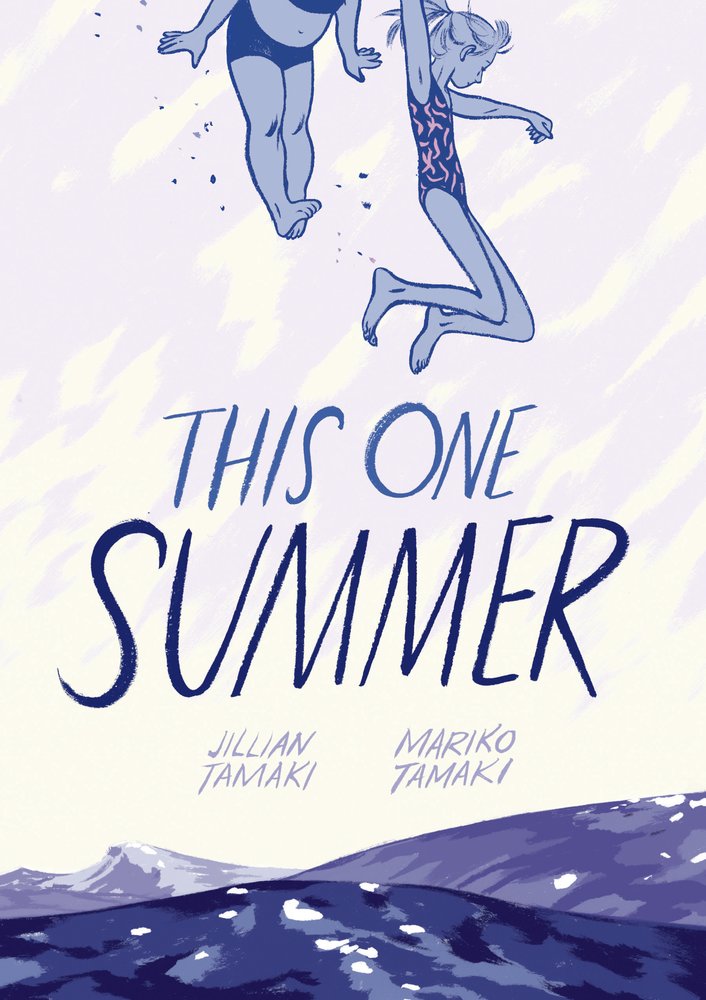
This One Summer
by Jillian Tamaki and Mariko Tamaki
Find it at: Your Local Library | Your Local Bookstore
Published: First Second Books (May 6, 2014)
Recommended Reading Age: 12 & up
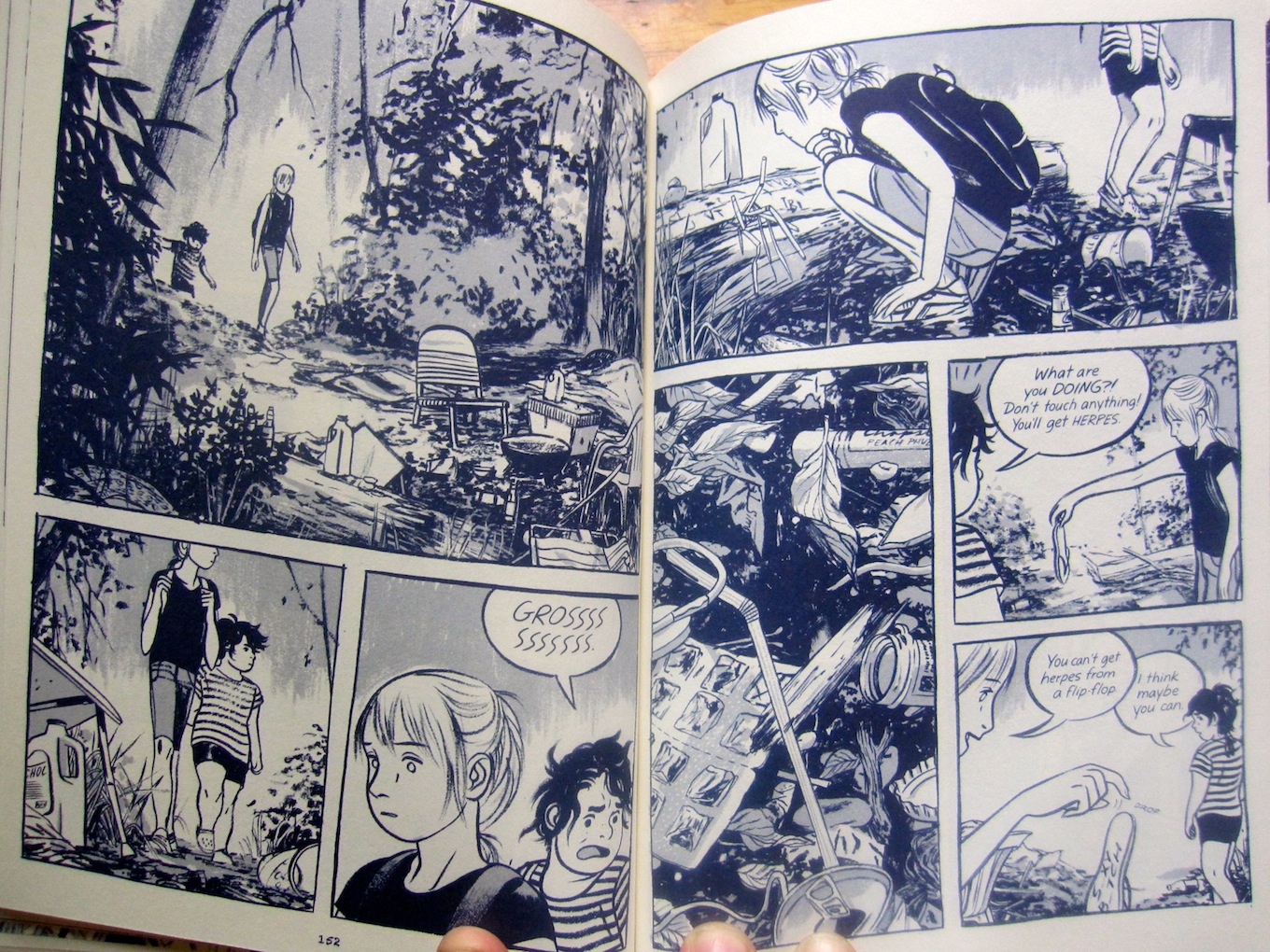
In a nutshell: I read this book in one sitting. This One Summer is funny and honest and heartbreaking and beautiful. Every summer, Rose vacations on Awago beach with her parents, as does her spunky summer bud, Windy, with her mother. The two have been palling around each summer since they were little kids, but this summer growing pains start kicking in. Rose’s mother seems to be in a strange funk, and both Windy and Rose become fascinated with a summer romance between two teenage townies.
The Tamaki sisters have captured life as a preteen girl like no other book I’ve ever read…. The unknowns, first crushes, friendship, the endless days. I have a strong inkling it’ll be a very popular pick among the older middle school and high school kids this summer, but really it’s the perfect read for grown up types too. Rose and Windy are unforgettable and the artwork is…
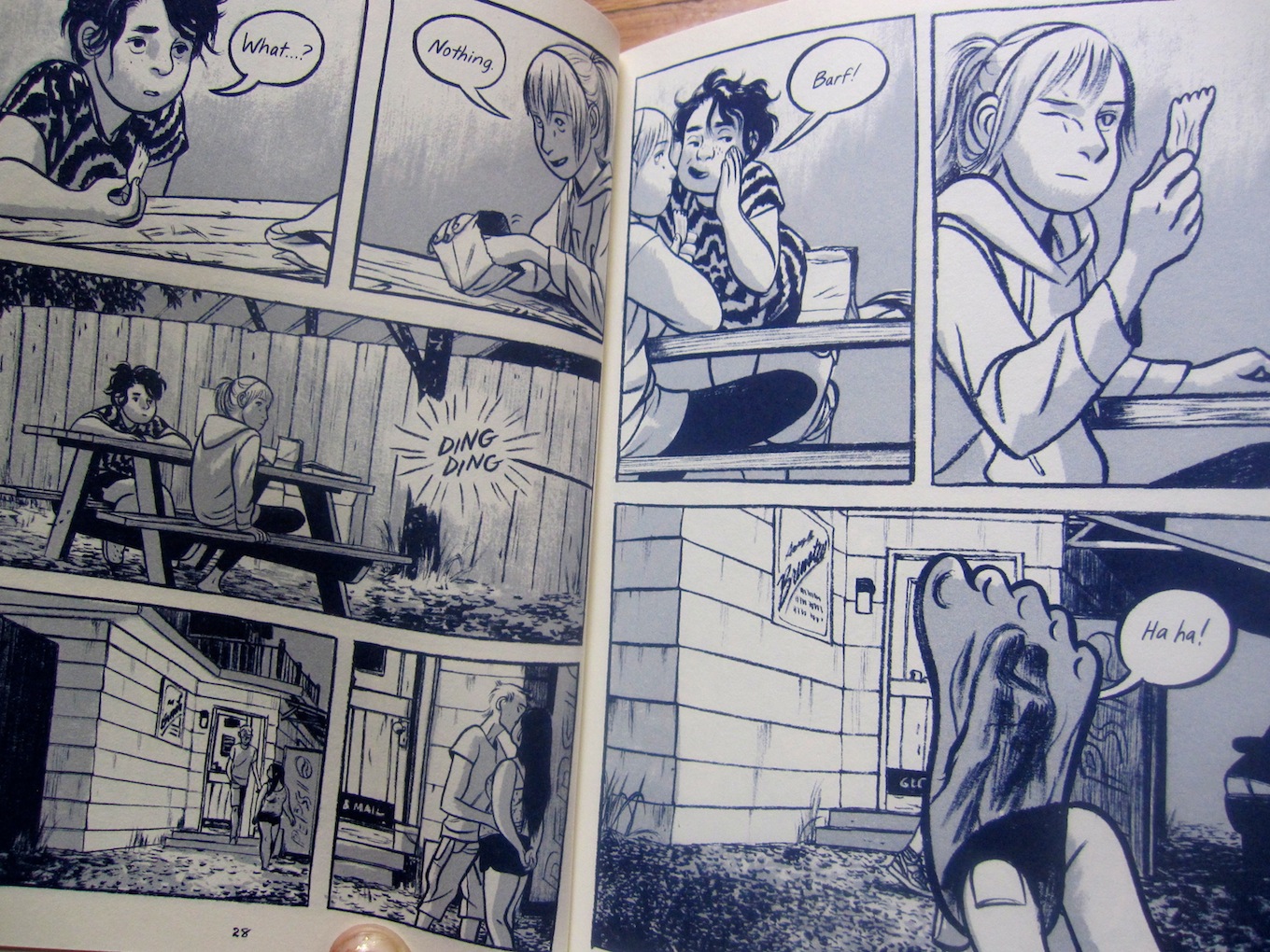
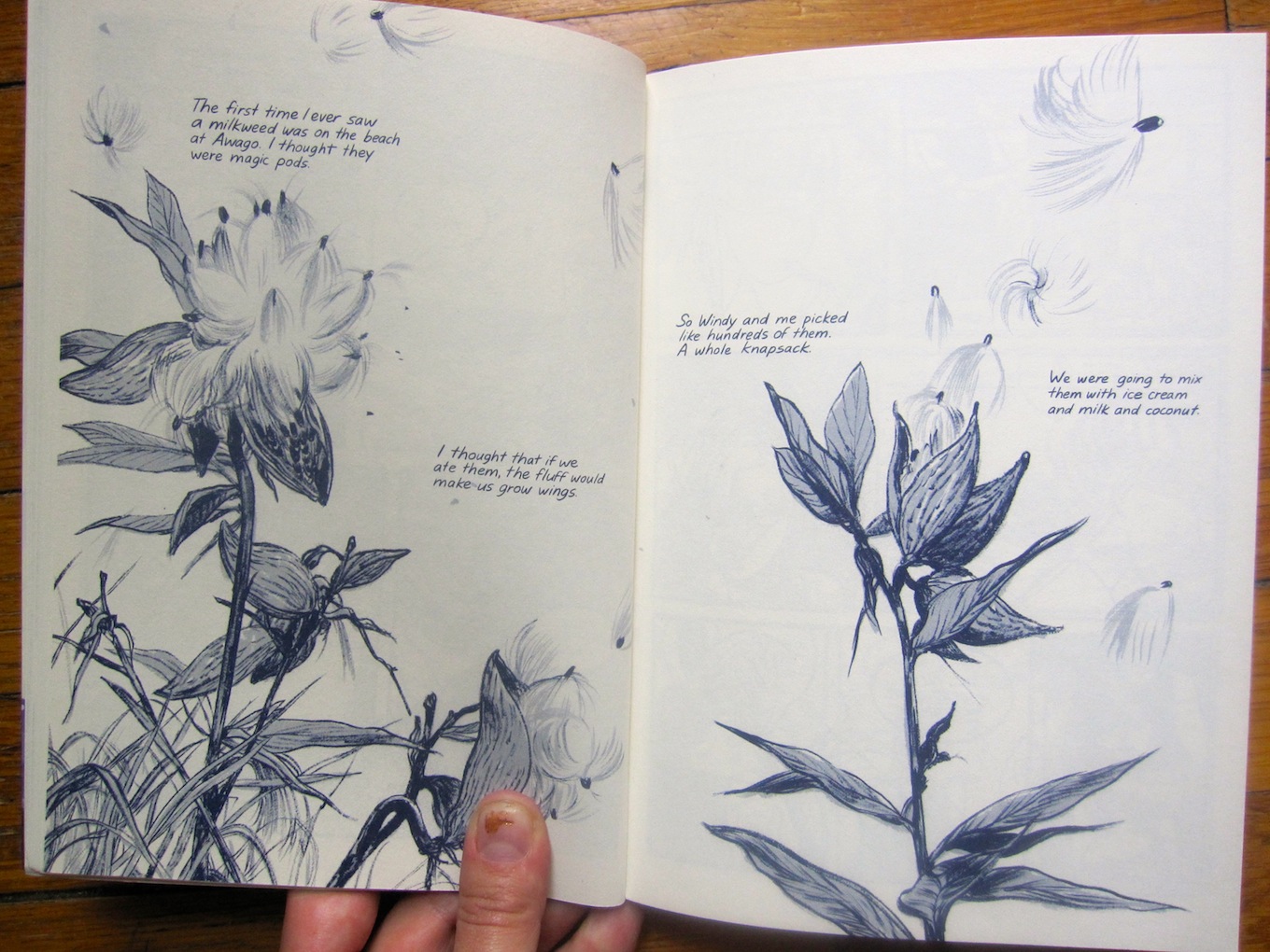
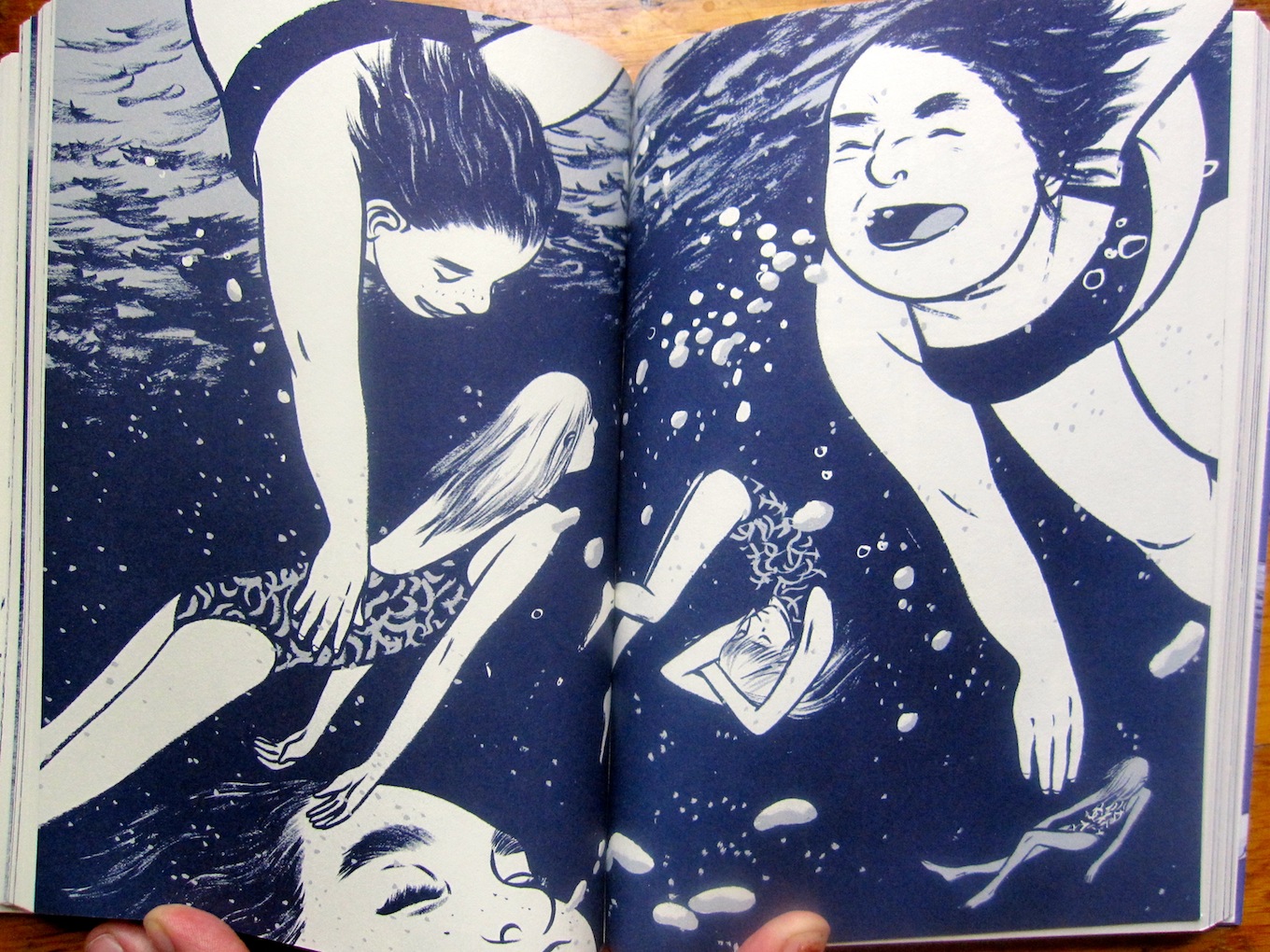
Sublime.
Add it to your must-read list. Ideally, read on a warm summer evening. Lemonade and gummy candies optional.
Extras: Visit Jillian Tamaki’s website and Mariko Tamaki’s blog.
Source of book reviewed: Review copy sent by the lovely people over at First Second Books!


